About Carstian Luyckx
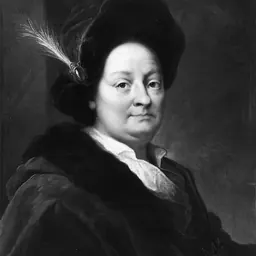
Lived 1623 – 1657 (aged 33–34). Carstian Luyckx was a painter.
Carstian Luyckx, also known as the Monogrammist KL (1623 – c. 1675), was a Flemish painter and draughtsman who specialized in still lifes in various subgenres including flower still lifes, fruit still lifes, fish still lifes, pronkstillevens (sumptuous still lifes), vanitas still lifes, hunting pieces and garland paintings. He also painted animals and a few genre scenes. After starting his career in Antwerp he is believed to have worked later in France.
Life Carstian Luyckx was born in Antwerp in 1623 as the son of David Luycx and Margriet Cloot. He was baptized on 17 August 1623. He studied painting under Philips de Marlier, a still life specialist, in 1642 and under Frans Francken III, a history painter, in 1645.
In 1645 he became a master of the Antwerp Guild of St. Luke. He is documented in Antwerp up to August 1653. It is believed that he left Antwerp and worked in France as many of his later works carry French inscriptions. During his residence in France, Luyckx influenced other vanitas painters, including Simon Renard de St. André.
It is not clear when and where Luyckx died but his death date is assumed to fall between the years 1657 and 1677.
Pronkstillevens
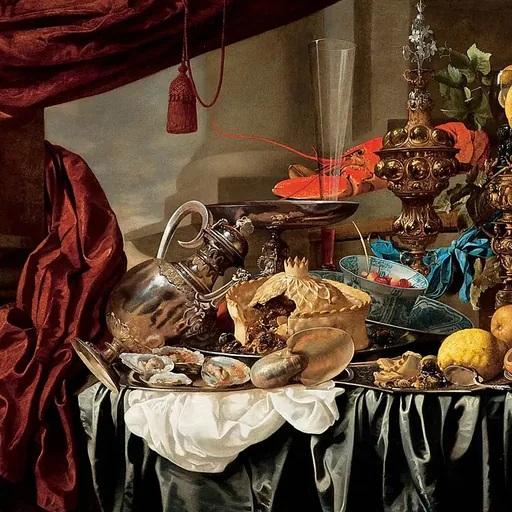
A large portion of his output consists of pronkstillevens, the sumptuous still lifes that were popular in Flanders and the Dutch Republic from the 1640s. Luyckx’ work in this genre was influenced by the artist Jan Davidsz. de Heem who was active in both Antwerp and the Dutch Republic. A representative example in this genre is the Opulent still life at the Montreal Museum of Fine Arts. This work dates from about 1650 and is painted on copper.
Vanitas Luyckx was especially known for his vanitas still lifes, a genre of still lifes which are intended as a reflection on the meaninglessness of earthly life and the transient nature of all earthly goods and pursuits. He had followers in France such as Simon Renard de St. André and vanitas works by Luyckx have in the past been attributed to these artists. This is for instance the case with the composition Vanitas still life with a skull, a violin, a musical score, a pipe and tobacco, an hourglass and a candle on a draped table (Sold at Sotheby's on 6 December 2012 in London, lot 201) previously given to St. André. This composition shows a musical score, which contains a single vocal part of a religious Latin choral composition, the text of which specifically relates to death. The inscription on the musical score probably refers to the 16th-century composer Orlande de Lassus.
Hunting pieces and animals His hunting pieces (game still lifes) were influenced by the Flemish specialists in this genre Frans Snyders and especially Jan Fyt. An example of his hunting pieces is A hunting still life of partridges with four Springer spaniels, a hawk, a game-bag and belt and other hunting gear in a landscape (Sold at Christie's on 20–21 November 2013 in Amsterdam, lot 168). This work is believed to date to the transitional phase between Luyckx’ Antwerp and French periods in the 1650s.
Luyckx painted compositions with life animals. A good example of this is the Fowl Attacked by a Fox (The Kremer Collection). This composition gives a lively rendering of a fox catching a chicken amidst a group of fowl. The artist has aptly observed the startled reaction of the rooster nearest to the fox. The other fowl appear unaware of the danger that they are in. The chicken that is being grabbed stares at the viewer more in surprise than in fear.
Flower and garland paintings Carstian Luyckx painted flower paintings as well as garland paintings, a special type of still life developed in Antwerp at the beginning of the 17th century by Jan Brueghel the Elder in collaboration with the Italian cardinal Federico Borromeo.
Other artists involved in the early development of the genre included Hendrick van Balen, Andries Daniels, Peter Paul Rubens and Daniel Seghers. The genre was initially connected to the visual imagery of the Counter-Reformation movement. Garland paintings typically show a flower garland around a devotional image, portrait or other religious symbol (such as the host).
Don’t just read it —
keep it.
Full-length biographies made to live with: read them, listen on the way to work, watch them tonight.
- E-book
- Audio
- Video
Instant download · yours to keep · every purchase keeps this site free
Important facts
more
Christian Lux, Corstiaen Lucx, Christiaan Luyckx, Christiaan Lucks, Christian Luycks, Christiaan Lux, Christiaan Luycks, Cristian Ludol, Lux, Cristian Ludoc, Lucks, Luckx, Cars de Lücker, Cristiaen Lucx, Carotian Lichx, Luck, Luycks, Lucker, Cristiaen Luckx, Christian Luckx, Christ. Lükx, Kerstiaan LuyckxPeople in Carstian Luyckx's life
Named in this biography and alive at the same time




Related people
Same field, nearest in time

Contemporaries
People whose lives overlapped Carstian Luyckx's





Frequently asked questions
Who was Carstian Luyckx?
Flemish painter (1623-1657)
When was Carstian Luyckx born?
Carstian Luyckx was born in 1623 in Antwerp.
When did Carstian Luyckx die?
Carstian Luyckx died in 1657 in Antwerp.
What was Carstian Luyckx's occupation?
Carstian Luyckx was a painter.
What nationality was Carstian Luyckx?
Carstian Luyckx's recorded nationality: Habsburg Netherlands.
Sources & further reading
Cite this page
APA: Biography.guide. (2026). Carstian Luyckx. https://biography.guide/carstian-luyckx/
MLA: "Carstian Luyckx." Biography.guide, https://biography.guide/carstian-luyckx/.
Chicago: "Carstian Luyckx." Biography.guide. https://biography.guide/carstian-luyckx/.
Data last updated: 2026-09-22 · Spot an error? Report a correction.
Portrait: Wikimedia Commons · author & licence
Page generated 2026-09-27 05:02 UTC