
About Nicholas Saunderson
Lived 1682 – 1739 (aged 57). Nicholas Saunderson was a British mathematician and university teacher.
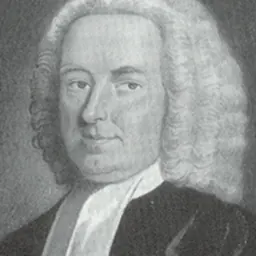
Nicholas Saunderson (20 January 1682 – 19 April 1739) was a blind English scientist and mathematician. According to one historian of statistics, he may have been the earliest discoverer of Bayes' theorem. He worked as Lucasian Professor of Mathematics at Cambridge University, a post also held by Isaac Newton, Charles Babbage and Stephen Hawking.
Biography Saunderson was born at Thurlstone, Yorkshire, in January 1682. His parents were John and Ann Sanderson (or Saunderson), and his father made a living as an excise man. When he was about a year old, he lost his sight through smallpox; but this did not prevent him from learning arithmetic through assisting his father. As a child, he is also thought to have learnt to read by tracing the engravings on tombstones around St John the Baptist Church in Penistone with his fingers. His early education was at the free school, Penistone Grammar School where he learnt French, Latin and Greek, taught by then-headmaster Nathan Staniforth. In 1700 a tutor taught him algebra and geometry, and in 1702 he attended Attercliffe Academy, near Sheffield, for logic and metaphysics. He wanted to teach and with the permission of the Lucasian professor, William Whiston, Saunderson was allowed to teach, lecturing on mathematics, astronomy and optics. His teaching was highly appreciated. On 6 November 1718 Saunderson was elected a fellow of the Royal Society. He was also a member of the Spitalfields Mathematical Society. He provided the first systematic introduction to Differential calculus, detailed in his posthumous work The Method of Fluxions Applied to a Select Number of Useful Problems.
The discovery of Bayes' theorem remains a controversial topic in the history of mathematics. While it is certain to have been discovered before Thomas Bayes' time, there are several contenders for priority including Saunderson. At the time, much of mathematics research was performed through the exchange of private letters, and through verbal discussions, rather than publications. Historian of statistics Stephen Stigler concluded that Saunderson was the most probable discoverer after attempting to trace some of these letters and discussions, but has been challenged by other statisticians. Somewhat fittingly for a question about probability, it seems likely that the question will never be resolved completely but will remain as a probabilistic belief about Saunderson and others.
Legacy
He appears as a fictional character on his deathbed in eighteenth-century novelist Denis Diderot's Letter on the Blind for the Use of those who can see, which discusses how man can acquire knowledge not only through perception, but also through reason. His character represents a person with no perception but endowed with logical genius, trying to comprehend God. This gives some indication of his celebrity status during his life, being used as an icon similarly to his chair's later occupant, Stephen Hawking, who also appears in debates about disability and genius.
In Penistone, St John's Gardens at St John's Church features a memorial to Saunderson. His birthplace in a nearby house on Towngate, Thurlstone, bore a "Hic Natus Est" inscribed stone; the house is long gone (1950s) but the stone is built into a wall in a small garden at nearby Townend. One of the old school buildings and a house of Penistone Grammar School, and a local residential street, Saunderson Gardens, are named after him.
In 2006, Saunderson's life was turned into a musical, No Horizon, written by Andy Platt, headmaster of Springvale Primary School in Penistone. The musical was performed at the Edinburgh Festival Fringe from 3–27 August 2016.
Don’t just read it —
keep it.
Full-length biographies made to live with: read them, listen on the way to work, watch them tonight.
- E-book
- Audio
- Video
Instant download · yours to keep · every purchase keeps this site free
Important facts
People in Nicholas Saunderson's life
Named in this biography and alive at the same time

Related people
Same field, nearest in time




Contemporaries
People whose lives overlapped Nicholas Saunderson's


Frequently asked questions
Who was Nicholas Saunderson?
English mathematician (1682–1739)
When was Nicholas Saunderson born?
Nicholas Saunderson was born on 20 January 1682 in Yorkshire, Thurlstone.
When did Nicholas Saunderson die?
Nicholas Saunderson died on 19 April 1739 in Cambridge.
What was Nicholas Saunderson's occupation?
Nicholas Saunderson was a mathematician and university teacher.
What nationality was Nicholas Saunderson?
Nicholas Saunderson was British.
Sources & further reading
· Wikipedia: Nicholas Saunderson
· DBpedia: Nicholas Saunderson
Cite this page
APA: Biography.guide. (2026). Nicholas Saunderson. https://biography.guide/nicholas-saunderson/
MLA: "Nicholas Saunderson." Biography.guide, https://biography.guide/nicholas-saunderson/.
Chicago: "Nicholas Saunderson." Biography.guide. https://biography.guide/nicholas-saunderson/.
Data last updated: 2026-09-20 · Spot an error? Report a correction.
Page generated 2026-09-27 05:20 UTC