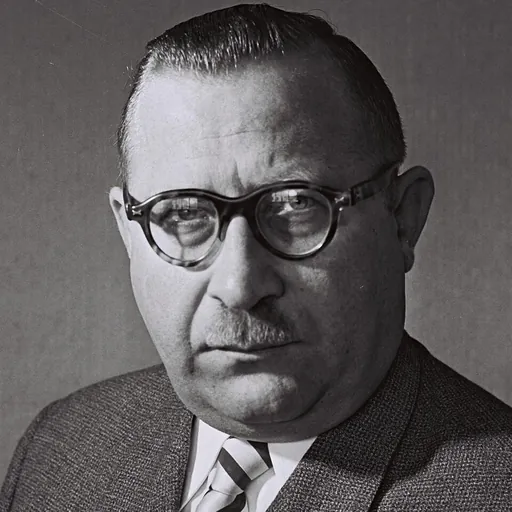
About Nathan Yellin-Mor
Lived 1913 – 1980 (aged 66). Nathan Yellin-Mor was an Israeli politician, partisan and editing staff.
Nathan Yellin-Mor (, Nathan Friedman-Yellin; 28 June 1913 – 18 February 1980) was an Israeli political activist, one of the leaders of the militant group Lehi, Canaanite ideologue, and politician. In later years, he became a leader of the Israeli peace camp, a Communist and pacifist who supported negotiations with the Palestine Liberation Organization and concessions in the Israeli-Arab conflict.
As the leader of Lehi, he rejected the Zionist movement and instead formulated a new ideology with the goal of Jewish re-indigenization, unity of all Middle Eastern peoples, and the absolute rejection of Western imperialism. This was to be carried out through his "neutralization of the Middle East" policy. Yellin-Mor also promoted Jewish-Arab cooperation against the British and sent out several Arabic publications calling for cooperation in combating Western powers in the region. He believed the conflict with the Palestinians would not devolve into a race war and instead be seen as Jewish paramilitaries reacting in self defense and to restore civil order.
Biography
Nathan Friedman-Yellin was born in Grodno in the Russian Empire (now Belarus). His father was a builder who was killed after getting drafted into the Russian Army during World War I. Following his father's death, his family moved to Lipsko, where he went to public school He studied engineering at the Warsaw Polytechnic. He was active in Betar and Irgun in Poland.
Between 1938 and 1939, he was the coeditor, along with Avraham Stern (Yair), of Di Tat ("The Action "), the Irgun's newspaper in Poland.
Activism He immigrated clandestinely to the British Mandate of Palestine and joined Lehi, a Jewish paramilitary group, Lohamei Herut Yisrael (Hebrew acronym LHI - in English, Fighters for the Freedom of Israel; derogatorily called by the British the Stern gang) where he operated under the name "Gera". After Stern's murder, he became a member of Lehi's guiding triumvirate, with Israel Eldad as chief of propaganda and Yitzhak Shamir as chief of operations. Yellin-Mor was in charge of Lehi's political activities.thumb
He was one of the planners of the assassination of Lord Moyne in 1944. He saw the struggle against the British in an international context and advocated collaboration with other anti-colonialist forces, including Palestinian and other Arab forces. After the Deir Yassin massacre, he privately confronted Eldad. After the assassination in September 1948 of United Nations mediator Count Folke Bernadotte, he was arrested along with Lehi member Matityahu Shmuelevitch and charged with leadership of a terrorist organization. They were found guilty on January 25, 1949, the day on which Yellin-Mor was elected to the Knesset. On February 10, 1949, Yellin-Mor was sentenced to 8 years' imprisonment. The court offered to release the defendants if they agreed to certain conditions, including forswearing underground activity and submitting to police supervision, but they rejected the offer.
Political career Yellin-Mor speaking at a meeting of the Fighters' List in Tel Aviv-Yafo on February 24, 1949. In 1948, Yellin-Mor formed the nationalist political party, the Fighters' List, one of the few parties in Israel that had both Jewish and Arab candidates on its Knesset list.
He was elected in the 1949 election to the first Knesset as the leader and only representative of the Fighters' List, a political party that was created by former Lehi members. He served from 1949 to 1951 and was a member of the Internal Affairs Committee.
In 1949, he denounced the Partition of Palestine as "bartering with the territory of the homeland" and opposed the Palestinian right of return. Later, he moved increasingly to the left, in a return to the pro-Soviet position of some Lehi militants in the 1940s, by advocating a pro-Soviet foreign policy. In 1956 he helped found the group Semitic Action, whose journal Etgar ("Challenge") he edited.
Ideology
As the leader of Lehi, Yellin-Mor began shifting Lehi towards a more National Bolshevik platform, synthesizing Revisionist Zionist beliefs with a uniquely indigenous form of left wing nationalism. Aside from National Bolshevism, inspirations of this new ideology included Titoism, Irish republicanism, Maximalism, nationalistic Egoism, Stalinism, Maoism, and Italian fascism.
In a letter to Israel Eldad, Yellin-Mor stated the following regarding the ideology of Lehi:We must stress with great emphasis that we are not a Zionist movement. Zionism is empty of all content and no longer compels us forward to accomplish anything more. We are not a Zionist option, and it is not our duty to bring this or that party back to the proper path. We are the Hebrew liberation movement in the Land of Israel. For us, Zionism is dead and we no longer wish to busy ourselves trying to revive it or anything else of its kind.In 1956, Yellin-Mor, along with Boaz Evron, Uri Avnery, Shlomo ben Shlomo, Ya'akov Yardor, and others founded the left wing Canaanite group, Semitic Action, in part due to their opposition to Israel's alliances with Britain and France during their Second Israeli-Arab War. In 1958, the group published "The Hebrew Manifesto" which "advocated that Hebrew-speaking Israelis cut their ties with the Jewish diaspora and integrate into the Middle East as natives of the region based on an anticolonialist alliance with its indigenous Arab inhabitants." and the establishment of a Palestinian state alongside Israel.
Final years and death
In his later years, he dedicated himself to working for reconciliation with the Palestinians, promoting negotiations with the Palestine Liberation Organization. A street in Montefiore neighborhood in Tel Aviv is named after him.
Ideological successors Semitic Action was revived in early 2011 as a grassroots peace movement by activists seeking what they call "a revolutionary alternative to foreign-backed organizations that only exacerbate local frictions and bring the peoples of our region further from genuine peace."
The new Semitic Action describes itself as "an Israel-based movement seeking to unite the indigenous peoples of the Middle East against the devastating influence of foreign powers in our region and the local conflicts created by the pursuit of their interests". initiated campaigns to raise support for an independent Kurdistan and promoted a unified front of indigenous peoples against foreign political influences in the Middle East. The movement has also been vocal against westernization, globalization, pro-Israel support from the American Christian right, Islamophobia in Israeli society, capitalism and the funding of local political organizations by foreign governments.
The VISION Movement, which subscribes to the ideology of Hebrew Universalism, also draws inspiration from Natan Yellin-Mor and other Lehi veteran ideologues.
Published works
Don’t just read it —
keep it.
Full-length biographies made to live with: read them, listen on the way to work, watch them tonight.
- E-book
- Audio
- Video
Instant download · yours to keep · every purchase keeps this site free
Important facts
People in Nathan Yellin-Mor's life
Named in this biography and alive at the same time


Related people
Same field, nearest in time





Contemporaries
People whose lives overlapped Nathan Yellin-Mor's


Frequently asked questions
Who was Nathan Yellin-Mor?
Israeli politician (1913-1980)
When was Nathan Yellin-Mor born?
Nathan Yellin-Mor was born on 28 June 1913 in Hrodna.
When did Nathan Yellin-Mor die?
Nathan Yellin-Mor died on 19 February 1980 in Israel.
What was Nathan Yellin-Mor's occupation?
Nathan Yellin-Mor was a politician, partisan and editing staff.
What nationality was Nathan Yellin-Mor?
Nathan Yellin-Mor was Israeli.
Sources & further reading
· Wikipedia: Nathan Yellin-Mor
Cite this page
APA: Biography.guide. (2026). Nathan Yellin-Mor. https://biography.guide/nathan-yellin-mor/
MLA: "Nathan Yellin-Mor." Biography.guide, https://biography.guide/nathan-yellin-mor/.
Chicago: "Nathan Yellin-Mor." Biography.guide. https://biography.guide/nathan-yellin-mor/.
Data last updated: 2026-09-24 · Spot an error? Report a correction.
Portrait: Wikimedia Commons · author & licence
Page generated 2026-09-27 05:09 UTC