
About Israel Eldad
Lived 1910 – 1996 (aged 85). Israel Eldad was an Israeli philosopher, historian, opinion journalist, pedagogue, university teacher and journalist.
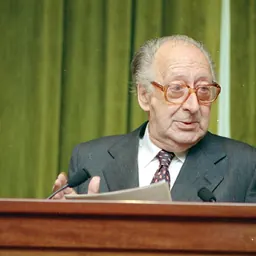
Israel Eldad (; born Israel Scheib; 11 November 1910 – 22 January 1996) was an Israeli political philosopher, writer, and the primary ideologue of the Lehi underground movement in Mandatory Palestine.
Biography Israel Scheib was born in 1910 in Pidvolochysk, Galicia in a traditional Jewish home. The Scheibs wandered as refugees during the First World War. In 1918, in Lvov, young Scheib witnessed a funeral procession for Jews murdered in a pogrom. After high school, Scheib enrolled at the Rabbinical Seminary of Vienna for religious studies and the University of Vienna for secular studies. He completed his doctorate on "The Voluntarism of Eduard von Hartmann, Based on Schopenhauer," but never took his rabbinical exams at the seminary.
Meanwhile, he attended, with his father, a protest demonstration in front of the local British Consulate following the 1929 Palestine riots in Palestine. The next year he read a poem by Uri Zvi Greenberg, "I'll Tell It to a Child," about a messiah who cannot redeem his people because they are not ready to accept redemption. Two or three years later, Scheib met Greenberg at a speech Greenberg was giving entitled "The Land of Israel Is in Flames."
Pedagogic and academic career, 1937–1939 Scheib's first job after graduation was high school teaching in Volkovisk. Scheib joined the staff of the Teachers Seminary in Vilna in 1937 while this city was part of Poland, where he stayed for two years.
Zionist activism In Poland During that time he rose in the Betar ranks to the position of regional staff officer. In 1938, at the Third Betar Conference in Warsaw, when the Revisionist leader Ze'ev Jabotinsky attacked the militant stance of Poland's Betar leader Menachem Begin, Scheib spoke in Begin's defense.
The next year, when the Second World War broke out, Scheib and Begin escaped together from Warsaw. Begin was arrested by the Soviet police in the middle of a chess game with Scheib, and it was several years before their next encounter.
Eldad immigrated to Mandatory Palestine in 1941.
Leader of Lehi in Mandatory Palestine Eldad and Begin met again in British-ruled Mandatory Palestine, where Scheib was already a leader of the Lehi underground and Begin would soon command the Irgun. The Lehi was at that point waging a violent struggle for freedom from British rule and the Irgun would, under Begin, soon join the revolt in hopes of turning Palestine into a Jewish state.
Scheib adopted several aliases while living underground, including "Sambatyon" and "Eldad". He worked in 1942 directly with Lehi founder Avraham Stern. After Stern's killing by the British, Eldad became one of a triumvirate of Lehi commanders, working together with Natan Yellin-Mor and future prime minister Yitzhak Shamir. Yellin-Mor was the diplomatic "foreign minister," Shamir the operations man, and Eldad the ideologue. For the next six years Eldad wrote articles for various underground newspapers, some of which he edited. Eldad also wrote some of the speeches delivered in court by Lehi defendants. Among his works: Chronicles . The Jewish Revolution appeared in 1971, and was reissued in 2007. Free Jerusalem includes a chapter by Eldad ("Meanwhile, A European Interlude") about Polish Jewry on the eve of war. Israel: The Road to Full Redemption, a translation of an article in Sulam, was published in 1961 and is today a virtually unobtainable brochure. His memoirs of the time he led the Lehi underground organisation, The First Tithe, were translated and first published in 2008. God, Man and Nietzsche includes a lengthy examination of Eldad's philosophy of history and excerpts from an article about Nietzsche written by Eldad in the underground.
When he died on the first day of the Hebrew month of Shevat, in January 1996, his funeral was attended by future Prime Minister Benjamin Netanyahu, former Lehi commander and prime minister Yitzhak Shamir and Knesset Speaker Dov Shilansky. Eldad was buried on the Mount of Olives, at the foot of the grave of his mentor and friend, Uri Zvi Greenberg.
Views and opinions
Jewish state Eldad did not believe that the creation of the state of Israel was the goal of Zionism. He considered the state a tool to be used in realizing the true goal of Zionism, which he called Malkhut Yisrael, "the Kingdom of Israel". Eldad sought what he referred to as national redemption, meaning a sovereign Jewish kingdom in the biblical borders of Israel, with all the world's Jews living there, and the Jewish Temple rebuilt in Jerusalem.
Jewish diaspora Eldad steadfastly refused to give legitimacy to any Jewish presence in the Diaspora, which he felt was doomed to extinction. Nonetheless, in his view of history, past generations of Jews in exile from the Land of Israel were not denigrated as passive sufferers, but were considered creative players in history.
Awards and recognition In 1977, Eldad was awarded the Tchernichovsky Prize for exemplary translation. In 1988, he was the co-recipient (jointly with Zvi Meir Rabinovitz) of the Bialik Prize for Jewish thought. In 1990, he received the Yakir Yerushalayim (Worthy Citizen of Jerusalem) award from the city of Jerusalem.
Published works The Jewish Revolution: Jewish Statehood (Israel: Gefen Publishing House, 2007), Maaser Rishon. Originally published in 1950 in Hebrew. English translation: The First Tithe (Tel Aviv: Jabotinsky Institute, 2008), Israel: The Road to Full Redemption (New York: Futuro Press, 1961)
Don’t just read it —
keep it.
Full-length biographies made to live with: read them, listen on the way to work, watch them tonight.
- E-book
- Audio
- Video
Instant download · yours to keep · every purchase keeps this site free
Important facts
People in Israel Eldad's life
Named in this biography and alive at the same time


Related people
Same field, nearest in time




Contemporaries
People whose lives overlapped Israel Eldad's






Frequently asked questions
Who was Israel Eldad?
Israeli philosopher (1910–1996)
When was Israel Eldad born?
Israel Eldad was born on 11 November 1910 in Pidvolochysk.
When did Israel Eldad die?
Israel Eldad died on 22 January 1996 in Jerusalem.
What was Israel Eldad's occupation?
Israel Eldad was a philosopher, historian, opinion journalist, pedagogue, university teacher and journalist.
What nationality was Israel Eldad?
Israel Eldad was Israeli.
Sources & further reading
Cite this page
APA: Biography.guide. (2026). Israel Eldad. https://biography.guide/israel-eldad/
MLA: "Israel Eldad." Biography.guide, https://biography.guide/israel-eldad/.
Chicago: "Israel Eldad." Biography.guide. https://biography.guide/israel-eldad/.
Data last updated: 2026-09-27 · Spot an error? Report a correction.
Page generated 2026-09-27 05:17 UTC