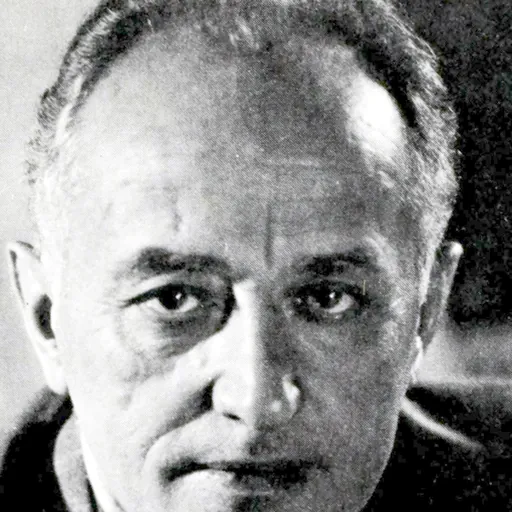
About Muzaffer Şerif
Lived 1906 – 1988 (aged 82). Muzaffer Şerif was a Turkish and American psychologist.
Muzafer Sherif (born Muzaffer Şerif Başoğlu; July 29, 1906 – October 16, 1988) was a Turkish-American social psychologist. He helped develop social judgment theory and realistic conflict theory.
Sherif was a founder of modern social psychology who developed several unique and powerful techniques for understanding social processes, particularly social norms and social conflict. Many of his original contributions to social psychology have been absorbed into the field so fully that his role in the development and discovery has disappeared. Other reformulations of social psychology have taken his contributions for granted, and re-presented his ideas as new.
Life and career
Early life, education and political involvement Muzafer Sherif was born as Muzaffer Şerif Başoğlu and grew up in a wealthy family that included five children, of whom he was the second born. He attended Elementary School in Ödemiş for six years and then attended Izmir International College from which he received a Bachelor of Arts in 1926. Sherif then obtained MA degree from the Istanbul University in 1928, The social academic environment during Sherif's first years in America supported Sherif's Marxist views and inspired The Psychology of Ego Involvements (1947), published from Princeton University.
By 1951 Sherif's relationship with Turkey had been completely damaged. He'd lost all contact with close friends and colleagues during Turkey's anti-Communist shutdown and his relationships with family dwindled. Sherif no longer held rights in Turkey and was not granted US citizenship.
In the 1954 experiment, "22 white, fifth grade, 11 year old boys with average-to-good school performance and above average intelligence with a protestant, two parent background were sent to a special remote summer camp in Oklahoma, Robbers Cave State Park." The failed 1953 experiment took place in Middle Grove, New York with the same criteria in place for choosing participants. The participants were carefully screened to be psychologically normal, and they did not know each other. Sending them to such a remote location was done to reduce the influence of external factors and better allow "the true nature of conflict and prejudice" to be studied.
Researchers, who doubled as counsellors at this summer camp, divided the participants into two different groups, and each group were assigned cabins far from the other. During the first phase, groups did not know the existence of the others. "The boys developed an attachment to their groups throughout the first week of the camp by doing various activities together: hiking, swimming, etc. The boys chose names for their groups, The Eagles and The Rattlers, and stenciled them onto shirts and flags". In this "ingroup formation" phase, members of the groups got to know each other, social norms developed and leadership and structure emerged.
Then the second, group conflict or "friction" phase began, in which the groups came into contact with each other. Researchers set up a four-day competitions between those groups with promised prizes to the winners. Prejudice became apparent between the two groups. The prejudice was initially only verbally expressed, such as through taunting or name calling, but as the competition progressed, the prejudice began being expressed more directly, such as with one group burning the other's flag or ransacking their cabin. The groups became too aggressive with each other to control; the researchers had to separate them physically.
Researchers then gave all boys a two-day cooling-off period, and asked them to list characteristics of the two groups. The boys tended to characterize their own group highly favourably and the other group very negatively. The researchers then attempted to reduce the prejudice between the groups, and found that simply increasing their contact with each other made matters worse. In contrast, "Forcing the groups to work together to reach superordinate goals, or common goals, eased the prejudice and tension among the groups". Thus, in this "integration" or conflict resolution phase, it was shown that superordinate goals reduce conflict significantly more effectively than communication or contact did.
Crisis in social psychology In 1977, Sherif published a paper identifying problem areas in Social Psychology as well as solutions towards them.
Publication Quality vs Volume
Sherif begins by describing that social psychology (at the time of publication) was undergoing an increase in the amount of research taking place, and publications printed. To state his position he claims that the ratio of chaff (dry, unusable, straw material used to symbolize meaningless research) to wheat (meaningful and useful research) is off. He believes this is recognized by other social psychologists high in the field such as Harry Triandis, and acknowledges that some may disagree with his opinion.
Thriving Research: Small Group Research and Attitude Change Research
Sherif references Paul Hare and Fred Strodtbeck's bibliographic compilation of all small group research studies from the July 1954 issue of Sociometry in which 584 citations were listed. This is compared with the March 1972 issue which listed 2021 items.
Despite this vast increase, Sherif believes that the studies don't build off of each other so it is hard to argue from common ground when variables, tasks, and measures are not consistent. He also mentions how social psychology has become more individualistic, focusing on internal states like "dissonance, attitudes, [and] attributions", rather than properties of a group.
Sherif blames reductionism, where the phenomena of groups was reduced to interpersonal reaction and ahistoricalism which removed situational factors from consideration. To remedy this he cites Albert Pepitone's stance that social psychology should focus on research normative in substance (address sociocultural perspectives) and comparative methods.
Sherif promotes the idea of attitude and attitude change due to its importance in a quickly changing world. He emphasizes that real world contexts are important, even if regarded as "messy" compared to controlled lab experiments.
Increasing Pressure of the Crisis
Sherif believes this "publish or perish" culture perpetuates a large output of studies that aren't necessarily high quality, as researchers are forced to publish papers for their careers, rather than for good science. This leads to a loss of direction for the field as rather than working together on a shared paradigm, researchers are in "self-contained castles" within psychology, but also across disciplines in the social sciences. Clyde Hendrick, asked his colleagues about the "crisis" in the social psychology field and had researchers provide arguments on the following topics: - Scientific vs Historical - Environmental vs Social Psychologies - Field vs Experimental research - Grand theory vs Smaller operational theories vs belief that the field is doing well Following Psychologists participated: Y. Epstein, D. Stokols, H. Pronshansky, I. Altman, M. Mania, K. Gergen, B. Schlenker, A. Greenwald, C. Hendrick, W. Thorngate, R. Harris, P. Secord, M. B. Smith, D. Forsyth, S. Baumgardner, B. Earn, and R. Kroger (Fall, 1976)
Sherif mentions that the crisis reproduces itself such that researchers who are in their "self-contained castles" write Social Psychology textbooks, but exclude positions which disagree with their own rather than educate students of a shared paradigm (such paradigms don't exist, Sherif argues). This is likely as Akan Elm's states that Social Psychology is still in its "pre-paradigmatic stage of development" and any sort of yield should be celebrated. To this Sherif asks why the field isn't closer in the 70s than in the 50s, despite roughly 3000 publications being produced since the 50s.
Sherif endorses the communication across discipline where it isn't scientific vs historical to understand a problem, but scientific AND historical. This will help to create commonly shared paradigms, to remove those from their "castles" and disband "disorderly faction-infested tribes" for the greater good of science.
Breaking Through the Crisis
Sherif explains that some theory model-builders become fixated and create models of small trivial problems, and to break through the crisis is to ask some "unthinkable" questions. What is the nature of a social system in terms of its structure, and function. Sherif claims that psychologists may avoid this, as this is a social rather than psychological question. But ignoring the social aspects of a system is like avoiding the physics of light while studying vision.
If Psychology wants to join the ranks of physical sciences, it has to be acknowledged that they asked their "unthinkable" questions during their establishment. They tested their phenomena through simulation models and studies, by viewing physical phenomena in the real world, psychologists need to do the same according to Sherif rather than standing at a far distance.
The importance of cross-cultural comparisons is also mentioned by Sherif to insure the validity of methods.
Contributions to sociology The social judgement theory examines how the assessment and perception of one's ideas are consistent with current attitudes. As new ideas are present, it is assessed by contrasting with one's current beliefs. Muzafer Sherif examined how one has their own latitudes of perception of their ideas and that may be opposing to others' point of view. As a result, he illustrated three forms of latitude which are the latitude of acceptance, rejection and non-commitment. The latitude of acceptance explores the variety of ideas that individuals perceive as considerable and acceptable. The latitude of rejection explores the variety of ideas that an individual perceives to be disagreeable and not deemed considerable. The latitude of noncommitment explores the ideas that are neither considerable or disagreeable. Furthermore, ego involvement is significant in the theory of social judgement as individuals who do not provide an importance to an issue, determine that they consist of broad latitude of noncommitment. As a result, the latitude of rejection of ideas and opposing ideas result in involvement of high ego. Moreover, Sherif explored contrast and assimilation in people's latitudes. Contrast latitude explains how individuals perceive perspectives and beliefs within the latitude of rejection than it actually should be considered and assimilation explains how individuals perceive perspectives and beliefs within their latitude of acceptance than it actually should be. The boomerang effect explored how one's beliefs and attitudes change directions in opposing way to what the message is conveying. Therefore, people are distant from the message of the idea instead of being conveyed to the message.
Books and editorial work
During his career, Sherif authored and coauthored 24 books and over 60 journal articles and chapters which are still influential in the field of psychology.
1937–1944
He established a small laboratory at Ankara University. The laboratory was on the social judgment from where he, along with his students translated many works in psychology into the Turkish language. The translation included but was not limited to 1937 Stanford-Binet, chapters from E. G. Boring's History of Experimental Psychology as well as Robert S. Woodworth's Contemporary Schools of Psychology.
1945–1947
Upon returning to the United States in January 1945, he joined Princeton University as a Fellow of the U.S. State Department. Here he collaborated with Hadley Cantril on The Psychology of Ego-Involvements, which was later published in 1947.
1947–1949
Sherif was a Rockefeller Research Fellow at Yale University from 1947 to 1949. His long and prolific collaboration with Carl Hovland began from here, which led to many influential papers on the anchoring effects of attitudes as well as the book, Social Judgement: Assimilation and Contrast Effects in Communication and Attitude Change which was published in 1961.
1949–1966
He moved to Oklahoma in 1949, where he worked as a professor, research professor, and director of the Institute of Group Relations, which he founded in 1952. This was the peak of his scholarly activity that resulted in 12 books and 43 research articles and chapters on various topics like attitudes, properties of natural and experimentally created groups on perception, anchoring effects of psychophysical scales, judgment, and self-functioning, etc.
Sherif organized different seminars at Oklahoma and later wrote five books based on the papers delivered at those seminars. Some of the well-known volumes included Group in Harmony and Tension (with his wife Carolyn Sherif), Social Judgment (with Carl Hovland), Reference Groups: An Exploration Into Conformity and Deviation of Adolescents (with Carolyn Sherif), Attitude and Attitude Change: The Social Judgment-Involvement Approach (with Carolyn Sherif and R. Nebergall), In Common Predicament: Social Psychology of Inter-group Conflict and Cooperation, and a major revision of a textbook, An Outline of Social Psychology (with Carolyn Sherif).
Although he wrote many texts and research in psychology, his best-known work during his 16 years stay at Oklahoma is the Inter-group Conflict and Cooperation: The Robber's Cave Experiment (with O. J. Harvey, B. J. White, W. R. Hood, and C. W. Sherif). This was initially distributed as a technical report in 1954 but was reprinted without the copyrights of the University Oklahoma Bookstore in 1961. In 1988, it was published by Wesleyan University Press for the first time.
In 1966 he and his wife moved to Pennsylvania State University, where she became a member of the Psychology Department and he became a Sociology Professor. During this time, he authored, co-authored and co-edited several journal articles and five books with his wife, Carolyn. These five books were: Group Conflict and Cooperation; Attitude, Ego-Involvement and Change; Social Interaction, Process, and Products: Selected Essays of Muzafer Sherif; and Social Psychology, a revision of the 1966 edition of that textbook.
Don’t just read it —
keep it.
Full-length biographies made to live with: read them, listen on the way to work, watch them tonight.
- E-book
- Audio
- Video
Instant download · yours to keep · every purchase keeps this site free
Important facts
People in Muzaffer Şerif's life
Named in this biography and alive at the same time




Related people
Same field, nearest in time



Contemporaries
People whose lives overlapped Muzaffer Şerif's

Frequently asked questions
Who was Muzaffer Şerif?
Turkish psychologist (1906–1988)
When was Muzaffer Şerif born?
Muzaffer Şerif was born on 29 July 1906 in Ödemiş district.
When did Muzaffer Şerif die?
Muzaffer Şerif died on 16 October 1988 in Fairbanks.
What was Muzaffer Şerif's occupation?
Muzaffer Şerif was a psychologist.
What nationality was Muzaffer Şerif?
Muzaffer Şerif was Turkish and American.
Sources & further reading
Cite this page
APA: Biography.guide. (2026). Muzaffer Şerif. https://biography.guide/muzaffer-serif/
MLA: "Muzaffer Şerif." Biography.guide, https://biography.guide/muzaffer-serif/.
Chicago: "Muzaffer Şerif." Biography.guide. https://biography.guide/muzaffer-serif/.
Data last updated: 2026-09-21 · Spot an error? Report a correction.
Portrait: Wikimedia Commons · author & licence
Page generated 2026-09-27 04:58 UTC