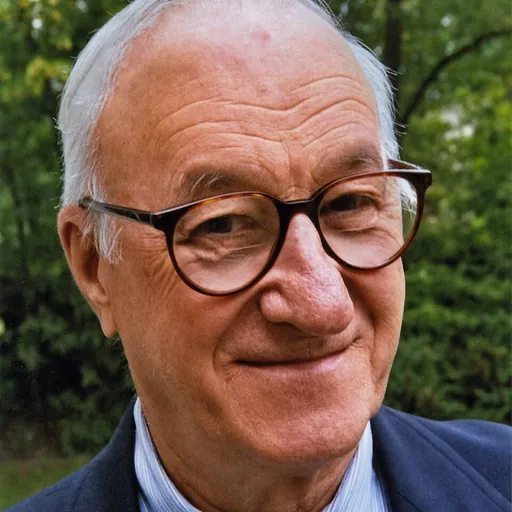
About Albert Bandura
Lived 1925 – 2021 (aged 95). Albert Bandura was a Canadian and American psychologist, university teacher and educator, known for Bobo doll experiment, Human agency and Reciprocal determinism.
Albert Bandura (December 4, 1925 – July 26, 2021) was a Canadian-American psychologist and professor of social science in psychology at Stanford University, who contributed to the fields of education and to the fields of psychology (e.g., social cognitive theory, therapy, and personality psychology), and influenced the transition between behaviorism and cognitive psychology. Bandura also is known as the originator of social learning theory, social cognitive theory, and the theoretical construct of self-efficacy. He was responsible for the theoretically influential Bobo doll experiment, which demonstrated the conceptual validity of observational learning, wherein children would observe an adult act either aggressively or neutrally toward a doll, and, having learned through observation, were more likely to also beat the doll if they had witnessed the aggressive behavior.
A 2002 survey ranked Bandura as the fourth most frequently cited psychologist of all time, behind B. F. Skinner, Sigmund Freud, and Jean Piaget. In April 2025, Bandura became the first psychologist with more than a million Google Scholar citations. During his lifetime, Bandura was widely described as the greatest living psychologist, and as one of the most influential psychologists of all time. Bandura was of Polish and Ukrainian descent; his father was from Kraków, Poland, while his mother was from Ukraine.
Bandura's parents were a key influence in encouraging him to seek ventures out of the small hamlet they resided in. The summer after finishing high school, Bandura worked in the Yukon to protect the Alaska Highway against sinking. Bandura later credited his work in the northern tundra as the origin of his interest in human psychopathology. His experience in the Yukon, where he was exposed to a subculture of drinking and gambling, helped broaden his perspective and scope of views on life.
Education and academic career Bandura took psychology courses in college and became passionate about the subject. He graduated after three years in 1949 with a B.A. from the University of British Columbia, winning the Bolocan Award in psychology, and then moved to the then-epicenter of psychology, the University of Iowa, from where he obtained his M.A. in 1951 giving Bandura a direct academic descent from William James, while Clark Hull and Kenneth Spence were influential collaborators. In 1974, he was elected president of the American Psychological Association (APA), the world's largest association of psychologists.
Research Bandura was initially influenced by Robert Sears' work on familial antecedents of social behavior and identificatory learning and gave up his research of the psychoanalytic theory. He directed his initial research to the role of social modeling in human motivation, thought, and action. In collaboration with Richard Walters, his first doctoral student, he engaged in studies of social learning and aggression. Their joint efforts illustrated the critical role of modeling in human behavior and led to a program of research into the determinants and mechanisms of observational learning.
Social learning theory posits three regulatory systems that control human behavior:
The antecedent inducements greatly influence the time and response of behavior. The stimulus that occurs before the behavioral response must be appropriate in relation to the social context and the performers of the behavior.
Social learning theory became one of the theoretical frameworks for Entertainment-Education, a method of creating socially beneficial entertainment pioneered by Miguel Sabido. Bandura and Sabido went on to forge a close relationship and further refine the theory and practice.
His research with Walters led to Bandura's first book, Adolescent Aggression (1959), followed by Social Learning and Personality Development (1963), and Aggression: A Social Learning Analysis (1973). In 1974, Stanford University awarded him an endowed chair and he became David Starr Jordan Professor of Social Science in Psychology.
In 1961, Bandura conducted a controversial experiment known as the Bobo doll experiment, which was designed to show that similar behaviors were learned by individuals shaping their own behavior after the actions of models. The experiment emphasized how young individuals are influenced by the acts of adults. When the adults were praised for their aggressive behavior, the children were more likely to keep on hitting the doll. However, when the adults were punished, they consequently stopped hitting the doll as well. Bandura's results from the experiment were widely credited with helping shift the focus in academic psychology from pure behaviorism to cognitive psychology.
Social foundations of thought and action In 1986, Bandura published Social Foundations of Thought and Action: A Social Cognitive Theory, in which he re-conceptualized individuals as self-organizing, proactive, self-reflecting, and self-regulating, in opposition to the orthodox conception of humans as governed by external forces. He advanced concepts of triadic reciprocal causation, which determined the connections between human behavior, environmental factors, and personal factors such as cognitive, affective, and biological events, and of reciprocal determinism, governing the causal relations between such factors. Bandura's emphasis on the capacity of agents to self-organize and self-regulate would eventually give rise to his later work on self-efficacy.
Self-efficacy
While investigating the processes by which modeling alleviates phobic disorders in snake-phobics, he found that self-efficacy beliefs (which the phobic individuals had in their own capabilities to alleviate their phobia) mediated changes in behavior and in fear-arousal. He launched a major program of research examining the influential role of self-referent thought in psychological functioning. Although he continued to explore and write on theoretical problems relating to myriad topics, from the late 1970s, he devoted much attention to exploring the role of self-efficacy beliefs in human functioning.
In 1986, he published Social Foundations of Thought and Action: A Social Cognitive Theory, a book in which he offered a social cognitive theory of human functioning that accords a central role to cognitive, vicarious, self-regulatory, and self-reflective processes in human adaptation and change. This theory has roots in an agentic perspective that views people as self-organizing, proactive, self-reflecting, and self-regulating, not just as reactive organisms shaped by environmental forces or driven by inner impulses. His book, Self-Efficacy: The Exercise of Control was published in 1997. These findings validate Bandura's theory and demonstrate ways in which targeting self-efficacy has predicted treatment outcomes in addictive behaviors. In an educational setting, self-efficacy refers to a student or teacher's confidence to participate in certain actions that will help them achieve distinct goals.
Death Bandura died at his home in Stanford, on July 26, 2021, from congestive heart failure, at the age of 95.
Bandura was elected a Fellow of the American Academy of Arts and Sciences in 1980. He received the Award for Distinguished Scientific Contributions from the American Psychological Association (APA) in 1980 In 1999, he received the Thorndike Award for Distinguished Contributions of Psychology to Education from the APA. Bandura is listed as a Distinguished Member of the International Honor Society in Psychology.
In 2001, Bandura received the Lifetime Achievement Award from the Association for the Advancement of Behavior Therapy. He was the recipient of the Outstanding Lifetime Contribution to Psychology Award from the APA
In 2014, Bandura was made an Officer of the Order of Canada "for his foundational contributions to social psychology, notably for uncovering the influence of observation on human learning and aggression". In 2016, he was awarded the National Medal of Science by president Barack Obama.
Books The following books each have more than 5,000 citations in Google Scholar: Bandura, A. (1997). Self-efficacy: the exercise of control. New York: W.H. Freeman. Bandura, A. (1986). Social Foundations of Thought and Action: A Social Cognitive Theory. Englewood Cliffs, N.J.: Prentice-Hall.
Other books Bandura, A., & Walters, R.H. (1959). Adolescent Aggression. Ronald Press: New York. Bandura, A. (1962). Social Learning through Imitation. University of Nebraska Press: Lincoln, NE. Bandura, A. and Walters, R. H.(1963). Social Learning & Personality Development. Holt, Rinehart & Winston, INC: NJ. Bandura, A. (1969). Principles of behavior modification. New York: Holt, Rinehart and Winston. Bandura, A. (1971). Psychological modeling: conflicting theories. Chicago: Aldine·Atherton. Bandura, A. (1973). Aggression: a social learning analysis. Englewood Cliffs, N.J.: Prentice-Hall. Bandura, A., & Ribes-Inesta, Emilio. (1976). Analysis of Delinquency and Aggression. Lawrence Erlbaum Associates, INC: NJ. Bandura, A. (1977). Social Learning Theory. Englewood Cliffs, NJ: Prentice Hall. Bandura, A. (2015). Moral Disengagement: How People Do Harm and Live with Themselves. New York, NY: Worth.
Don’t just read it —
keep it.
Full-length biographies made to live with: read them, listen on the way to work, watch them tonight.
- E-book
- Audio
- Video
Instant download · yours to keep · every purchase keeps this site free
Important facts
People in Albert Bandura's life
Named in this biography and alive at the same time





Related people
Same field, nearest in time





Contemporaries
People whose lives overlapped Albert Bandura's


Frequently asked questions
Who was Albert Bandura?
Canadian psychologist (1925–2021)
When was Albert Bandura born?
Albert Bandura was born on 4 December 1925 in Mundare.
When did Albert Bandura die?
Albert Bandura died on 26 July 2021 in Stanford.
What was Albert Bandura's occupation?
Albert Bandura was a psychologist, university teacher and educator.
What was Albert Bandura known for?
Albert Bandura was known for Bobo doll experiment, Human agency, Reciprocal determinism, Self-efficacy, Social cognitive theory and Social learning theory.
What nationality was Albert Bandura?
Albert Bandura was Canadian and American.
Sources & further reading
Cite this page
APA: Biography.guide. (2026). Albert Bandura. https://biography.guide/albert-bandura/
MLA: "Albert Bandura." Biography.guide, https://biography.guide/albert-bandura/.
Chicago: "Albert Bandura." Biography.guide. https://biography.guide/albert-bandura/.
Data last updated: 2026-09-20 · Spot an error? Report a correction.
Page generated 2026-09-27 05:09 UTC