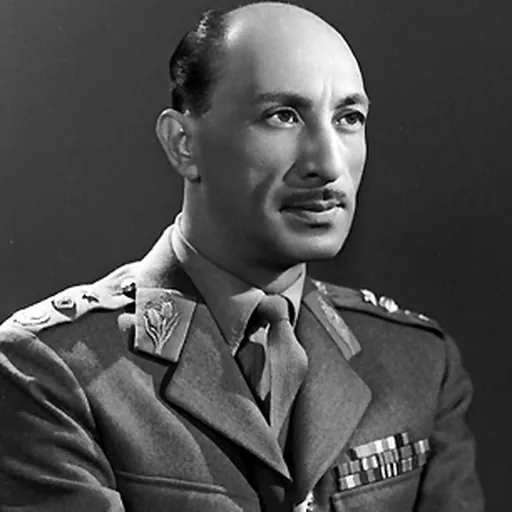
About Mohammed Zahir Shah
Lived 1914 – 2007 (aged 92). Mohammed Zahir Shah was an Afghan politician.
Early life Prince Mohammad Zahir Khan was born on 15 October 1914, in a city quarter called Deh Afghanan in Kabul in the Emirate of Afghanistan, into the royal Musahiban family, who belonged to the Mohammadzai clan of the Barakzai tribe of Pashtuns. after the fall of King Amanullah. Zahir Khan studied at the Infanterie Military School in the winter (school year in Kabul, 21 March to November). He was then sent to France for further training. When he returned to Afghanistan, he helped his father and uncles restore order and reassert government control during a period of lawlessness in the country. He was later enrolled at an Infantry School and appointed a privy counsellor, later serving in the government positions of deputy war minister and minister of education.
Reign
Zahir Khan was proclaimed king (shah) on 8 November 1933 at the age of 19, after the assassination of his father Mohammad Nadir Shah. After his ascension to the throne he was given the regnal title, "He who puts his trust in God, follower of the firm religion of Islam". For the first 20 years, he did not effectively rule, instead ceding power to his paternal uncles, Mohammad Hashim Khan and Shah Mahmud Khan, who both served as Prime Ministers. This period fostered a growth in Afghanistan's relations with the international community as during 1934, Afghanistan joined the League of Nations while also receiving formal recognition from the United States. By the end of the 1930s, agreements on foreign assistance and trade had been reached with many countries, most notably with the Axis powers of Germany, Italy, and Japan.
Zahir Shah provided aid, weapons, and Afghan fighters to the Uyghur and Kirghiz Muslim rebels, who had established the breakaway Turkic Islamic Republic of East Turkestan. The aid was not capable of saving the East Turkestan republic, as the combined forces were defeated in 1934 by the Kuomintang Chinese Muslim New 36th Division of the National Revolutionary Army, commanded by General Ma Zhancang at the Battle of Kashgar and Battle of Yarkand. All Afghan volunteers were killed by Chinese Muslim troops, who then abolished the East Turkestan republic, and reestablished Chinese government control over the area.
Dinner in honour of King Mohammad Zahir Shah of Afghanistan hosted by US President John F. Kennedy (1963)
Despite close relations to the Axis powers, Zahir Shah and his governments refused to take sides during World War II and Afghanistan was one of the few countries in the world which remained neutral. From 1944 to 1947, Afghanistan experienced a series of revolts by various tribes. After the end of World War II, Zahir Shah recognised the need for the modernisation of Afghanistan and recruited a number of foreign advisers to assist with the process. A number of potential advances and reforms were derailed as a result of factionalism and political infighting. Zahir Shah also requested financial aid from both the United States and the Soviet Union, and Afghanistan was one of few countries in the world to receive aid from both Cold War adversaries. In a 1969 interview, Zahir Shah said that he is "not a capitalist. But I also don't want socialism. I don't want socialism that would bring about the kind of situation [that exists] in Czechoslovakia. I don't want us to become the servants of Russia or China or the servant of any other place."
He was considered a relatively lenient leader compared to previous kings; Zahir Shah had never signed a warrant for the execution of anyone for political reasons during his reign. He also used his power several times to commute capital punishment sentences given to some convicted criminals. which means "The leaner on God, Mohammad Zahir Shah". The honorific title of "leaner on God" is taken from Quran 8:61.
By the time he returned to Afghanistan in 2002, Zahir Shah's rule was characterized as a lengthy era of peace. In August 1973,
Zahir Shah lived in exile in Italy for 29 years alongside his wife Queen Humaira Begum and other royal family members. Initially, they lived in a three‐room apartment on Rome's Via Cassia. Relatives of the 1920s King Amanullah Khan, of the same house of Barakzai, also lived in Rome. President Daoud Khan continued to send money to them in Italy consisting of income from property and estates of the former royal family. After the Saur Revolution, the leftist Khalq government cut all funds to Italy.
Zahir Shah eventually lived in a villa in the affluent community of Olgiata on Via Cassia, north of Rome, where he spent his time playing golf and chess, as well as tending to his garden. He was financially supported by the Shah of Iran since the new Afghan government failed to provide him a monthly salary. The Shah also supported his two sons, who were studying in the United States and Canada.
He was prohibited from returning to Afghanistan during the late 1970s by the Soviet-assisted Communist government. In 1983 during the Soviet–Afghan War, Zahir Shah was cautiously involved with plans to develop a government in exile. Ultimately these plans failed because he could not reach a consensus with powerful Islamist factions. Both the Soviet Union and the United States sent representatives to meet him, and President Mohammad Najibullah supported Zahir Shah to play a role in a possible interim government in the quest for peace. In May 1990, Zahir Shah issued a long statement through Voice of America and the BBC calling for unity and peace among Afghans, and offering his services. This reportedly led to a spark of interest and approval among the Kabul populace. However, the idea of a revived political role for Zahir Shah was met with hostility by some, notably radical Islamist Gulbuddin Hekmatyar.
In 1991, Zahir Shah survived an attempt on his life by a knife-wielding assassin masquerading as a Portuguese journalist, who later revealed that the attempted assassination was ordered by Osama bin Laden. After the fall of the pro-Soviet government, Zahir Shah was favoured by many to return and restore the monarchy to unify the country as he was acceptable to most factions. However, these efforts were blocked mostly by Pakistan's ISI, who feared his stance on the Durand Line issue. In June 1995, Zahir Shah's former envoy Sardar Wali announced at talks in Islamabad, Pakistan, that Zahir Shah was willing to participate in peace talks to end the Afghan Civil War, but no consensus was ever reached.
Return to Afghanistan Zahir Shah is seated at the far right during the oath ceremony of Hamid Karzai on 7 December 2004.
On 18 April 2002, at the age of 87 and four months after the end of Taliban rule, Zahir Shah returned to Afghanistan, flown in on an Italian military plane, and welcomed at Kabul's airport by Hamid Karzai and other officials. His return was widely welcomed by Afghans, and he was liked by all ethnic groups. There were proposals for a return to the monarchy – However he was obliged to publicly renounce monarchical leadership at the behest of the United States. As Pakistan would not accept Zahir as king due to fears regarding his stance on the Durand Line issue; the American government knew allowing him to be restored could result in Pakistan feeling threatened to the point they may cease cooperating with the international coalition and potentially even resume their support for the Taliban. At the time, most delegates to the Loya Jirga were prepared to vote for Zahir Shah and block the U.S.-backed leader of the Northern Alliance, Hamid Karzai.
Hamid Karzai, who was favoured by Zahir Shah, became president of Afghanistan after the Loya Jirga. Karzai, from the Pashtun Popalzai clan, provided Zahir Shah's relatives with major jobs in the transitional government. Following the Loya Jirga he was given the title "Father of the Nation" by Karzai, symbolizing his role in Afghanistan's history as a symbol of national unity. This title ended with his death. In August 2002 he relocated back to the Arg, his old palace, after 29 years. who said "He was the servant of his people, the friend of his people, he was a very kind person, kind hearted. He believed in the rule of the people and in human rights." Karzai also declared three days of national mourning for the deceased king.
Personal life Zahir Shah was reportedly shy, modest and "soft-spoken". He liked photography, chess, and smoking cigars.
Zahir Shah was fluent in Pashto, Dari (his mother tongue), and French, and could also speak English.
To Afghan people, he was known as Baba.
Family
He married his first cousin Humaira Begum (1918–2002) on 7 November 1931 in Kabul. They had six sons and two daughters:
In January 2009, an article by Ahmad Majidyar of the American Enterprise Institute included one of his grandsons, Mustafa Zahir, on a list of fifteen possible candidates in the 2009 Afghan presidential election. However, Mustafa did not become a candidate.
His granddaughter, Princess Noal of Afghanistan, is the wife of Muhammad Ali, Prince of the Sa'id, the heir apparent to the abolished thrones of Egypt and Sudan.
Titles and styles
During his reign, His Majesty Mohammad Zahir Shah, King of Afghanistan.
Don’t just read it —
keep it.
Full-length biographies made to live with: read them, listen on the way to work, watch them tonight.
- E-book
- Audio
- Video
Instant download · yours to keep · every purchase keeps this site free
Important facts
People in Mohammed Zahir Shah's life
Named in this biography and alive at the same time





Related people
Same field, nearest in time





Contemporaries
People whose lives overlapped Mohammed Zahir Shah's
Frequently asked questions
Who was Mohammed Zahir Shah?
King of Afghanistan (1933-1973)
When was Mohammed Zahir Shah born?
Mohammed Zahir Shah was born on 15 October 1914 in Kabul.
When did Mohammed Zahir Shah die?
Mohammed Zahir Shah died on 23 July 2007 in Kabul.
What was Mohammed Zahir Shah's occupation?
Mohammed Zahir Shah was a politician.
What nationality was Mohammed Zahir Shah?
Mohammed Zahir Shah was Afghan.
Sources & further reading
· Wikipedia: Mohammed Zahir Shah
· DBpedia: Mohammad Zahir Shah
Cite this page
APA: Biography.guide. (2026). Mohammed Zahir Shah. https://biography.guide/mohammed-zahir-shah/
MLA: "Mohammed Zahir Shah." Biography.guide, https://biography.guide/mohammed-zahir-shah/.
Chicago: "Mohammed Zahir Shah." Biography.guide. https://biography.guide/mohammed-zahir-shah/.
Data last updated: 2026-09-20 · Spot an error? Report a correction.
Portrait: Wikimedia Commons · author & licence
Page generated 2026-09-27 04:58 UTC