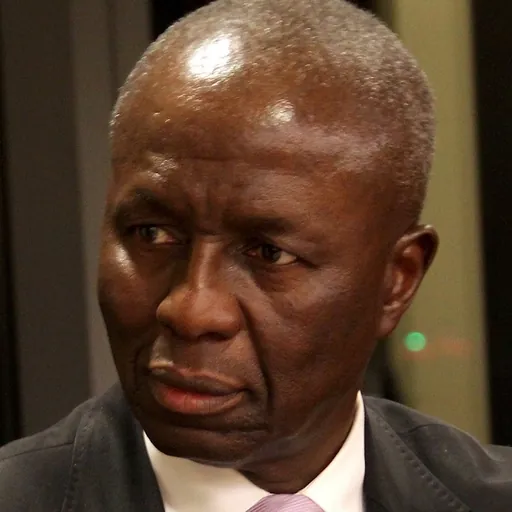
About Mogoeng Mogoeng
Born 1961. Mogoeng Mogoeng is a South African judge.
Mogoeng Thomas Reetsang Mogoeng (born 14 January 1961) is a South African jurist who served as the Chief Justice of South Africa from 8 September 2011 until his retirement on 11 October 2021. Mogoeng became politically active at high school, from which he was briefly suspended for organising a memorial to the victims of the Soweto uprising. Commentators said that Mogoeng's conduct at the interview heightened concerns about his judicial temperament. and is now widely thought to have dispelled suspicions that he would be an executive-minded Chief Justice. thumb The courtroom of the Constitutional Court of South AfricaIn his public addresses he has been "outspoken" and "forthright". He has regularly championed judicial independence and deplored interference by the executive. In June 2015, it emerged that Mogoeng had been the target of two smear campaigns – apparently showing that Mogoeng had, through his outspokenness, "made enemies" in the establishment. Mogoeng also requested a meeting with President Zuma to discuss the situation, which Zuma agreed to three weeks later. Mogoeng was widely praised for his "courageous and principled leadership" and his "efforts to protect the independence of the judiciary". One commentator even said "Mogoeng's intervention might one day be seen as one of the courageous acts that saved South Africa's budding democracy". Mogoeng also held against the government in the high-profile litigation in Helen Suzman Foundation v President. His majority judgment struck down several sections of the South African Police Service Amendment Act of 2012 (the so-called Hawks Act) on the basis that they did not constitute an "adequately independent" anti-corruption unit. (Other members of the Court would, however, have gone further, and struck down other sections which Mogoeng upheld.) Mogoeng's Court also found against the government in Democratic Alliance v President (per Yacoob ADCJ), setting aside President Zuma's highly controversial appointment of Menzi Simelane as National Director of Public Prosecutions. And in October 2014 his Court handed down judgment in National Commissioner of the SAPS v SALC (per Majiedt AJ) and ordered the South African Police Service to investigate allegations of torture in Zimbabwe committed by and against Zimbabwean nationals. This judgment was hailed as a victory for universal jurisdiction. In its wake, one influential columnist said that those who had expected the Constitutional Court to take a pro-executive turn under Mogoeng had been proved wrong. Finally, in 2016, Mogoeng himself wrote the Court's judgment in Economic Freedom Fighters v Speaker of the National Assembly, which declared that President Zuma had violated the South African Constitution by failing to act on the Public Protector's Nkandla report. Mogoeng's "powerful" and "profound" judgment was hailed as a "triumph for the rule of law", and a major blow to the widely criticised President, of whose conduct the judgment was "scathing". One commentator said Mogoeng's judgment was "his moment of triumph and redemption", and marked his transformation from a supposed "tool" of the establishment to a "national hero" in a manner reminiscent of Earl Warren. A year later, Mogoeng delivered the unanimous judgment in UDM v Speaker of the National Assembly, in which he granted an application brought by opposition parties to set aside the refusal by Speaker Baleka Mbete, a close Zuma ally, to have a vote of no confidence in the President conducted by secret ballot. The opposition parties had argued that the secret ballot was necessary to ensure that ANC MPs could vote against the President without fear of retribution.
Shortly before this, however, Mogoeng had cautioned, in a contentious judgment that failed to win the support of a majority of his colleagues, that judges must respect the separation of powers and defer appropriately to the executive, and on this basis refused to accede to complaints that the government's controversial policy on new television broadcast technologies was unlawful. Much more high-profile was his dissent in Economic Freedom Fighters v Speaker of the National Assembly (No. 2), in which opposition parties had argued that Parliament had not taken adequate steps to hold Zuma to account in terms of the order issued by the Court in the first EFF judgment. On this occasion Mogoeng was strongly opposed to finding against Parliament; he described the majority judgment, which upheld the opposition parties' complaints, as "a textbook case of judicial overreach" and criticised his colleagues for overstepping the separation of powers. The majority judgment, though authored by Mogoeng's usual ally, Jafta J, describes this "unprecedented" allegation as "misplaced and unfortunate"; and Froneman J was motivated to write a judgment of his own, saying that Mogoeng's characterisation of the majority's position "does nothing to further the debate". The EFF was highly critical of Mogoeng's judgment, as well as his conduct at the court sitting when the judgment was delivered: Mogoeng had interrupted Jafta J, mid-delivery, to insist that he read out his (Mogoeng's) judgment in full. The EFF described this as an "abuse of power" and an "unacceptable" show of disrespect to a fellow judge. One leading commentator said Mogoeng's "very serious" attack on the majority judgment was "difficult to comprehend"; others, however, defended his right to dissent.
Gender violence In F v Minister of Safety and Security, in an apparent riposte to critics of his allegedly patriarchal views, Mogoeng strongly deplored sexual violence and held the state liable to compensate a young girl who had been raped by an off-duty policeman. And in 2013 he was praised for his "unexpected progressiveness" at the hearing of Teddy Bear Clinic v Minister of Justice, where his questions from the bench showed "he was clearly moved by the notion that consensual sexual behaviour between minors should not be criminalised". A detailed retrospective published in October 2016 concluded that Mogoeng had "begun to craft a new name for himself" as a proponent of gender rights.
Religious views Mogoeng is an lay preacher in the Pentecostal Winners Chapel Mogoeng's religious convictions have also found their way into his judgments: in McBride, for example, he railed against the use of "foul language" and South Africa's "being denuded of moral standards", and cited the Bible. Shortly thereafter, Chief Justice Mogoeng gave a speech at an Advocates for Transformation event in which he said a "deliberate attempt is being made to delegitimize the JSC" through "scare tactics" and blamed this on "a well coordinated network of individuals and entities" – possibly apartheid agents, Mogoeng implied – "pretending to be working in isolation from each other". Mogoeng called on his audience to oppose "this illegitimate neo-political campaign to have certain people appointed".
This now "infamous" speech was criticised for departing from the requirements of judicial impartiality and seeming to betray a racial bias. Paul Hoffman SC sought to have Mogoeng impeached on the basis that he had brought the judiciary into disrepute, but this complaint was itself widely criticised as "ill-considered" and "weak on the law" and was dismissed by the Judicial Conduct Committee. A year later, when Hoffman and Smuts appeared in an unrelated case before the Constitutional Court (coincidentally involving the Helen Suzman Foundation), Mogoeng strongly criticised the conduct of their client's case and upheld a rare punitive costs order against him.
After the retirement of Justice Thembile Skweyiya in May 2014, Mogoeng stated that he wanted to appoint a female judge in his place. The vacancy was then left open for over a year, as a series of female acting appointments were made instead, apparently to provide a test run. This dilatoriness in making a permanent appointment was criticised by commentators, who said it was corrosive of judicial independence and inconsistent with the South African Constitution. Mogoeng's stated reason for the delay, namely the need to find competent female candidates, was said to be "patronising" and unconvincing. The JSC finally acted to fill the vacancy fourteen months after it arose.
Starting in late 2014, after a change in the JSC's composition, several commentators perceived a marked improvement in the conduct of its interviews, especially on questions about gender transformation in the judiciary. The main complaint against Hlophe was laid in 2008 by the judges of the Constitutional Court, who alleged that he tried to persuade them to decide a case in favour of then-President Jacob Zuma. The processing of this complaint was repeatedly stalled so that, more than ten years after it was first lodged, no action had been taken against Hlophe.
In January 2020, further complaints were lodged against Hlophe by his deputy judge president Patricia Goliath. Mogoeng is the chairperson of the JSC's Judicial Conduct Committee, which is mandated to decide this complaint. Mogoeng initially disclaimed responsibility, however, on the basis that he lacks any legal power to take disciplinary action against a judge. This argument has been rejected by commentators
Other positions and awards On 27 March 2018 the University of Johannesburg conferred an honorary doctoral degree on Mogoeng, citing his "notable contributions within the judiciary sphere - which should remind South Africans to take the constitution as a guide which will give us unity to build our country and to reconcile as all South Africans".
In 2013, Mogoeng was awarded an honorary doctorate by North-West University.
Don’t just read it —
keep it.
Full-length biographies made to live with: read them, listen on the way to work, watch them tonight.
- E-book
- Audio
- Video
Instant download · yours to keep · every purchase keeps this site free
Important facts
People in Mogoeng Mogoeng's life
Named in this biography and alive at the same time



Related people
Same field, nearest in time


Contemporaries
People whose lives overlapped Mogoeng Mogoeng's


Frequently asked questions
Who is Mogoeng Mogoeng?
former Chief Justice of South Africa
When was Mogoeng Mogoeng born?
Mogoeng Mogoeng was born on 14 January 1961 in Zeerust.
What is Mogoeng Mogoeng's occupation?
Mogoeng Mogoeng is a judge.
What nationality is Mogoeng Mogoeng?
Mogoeng Mogoeng is South African.
Sources & further reading
Cite this page
APA: Biography.guide. (2026). Mogoeng Mogoeng. https://biography.guide/mogoeng-mogoeng/
MLA: "Mogoeng Mogoeng." Biography.guide, https://biography.guide/mogoeng-mogoeng/.
Chicago: "Mogoeng Mogoeng." Biography.guide. https://biography.guide/mogoeng-mogoeng/.
Data last updated: 2026-09-23 · Spot an error? Report a correction.
Portrait: Wikimedia Commons · author & licence
Page generated 2026-09-27 05:04 UTC