
About Mikhail Frinovsky
Lived 1898 – 1940 (aged 42). Mikhail Frinovsky was a Russian politician.
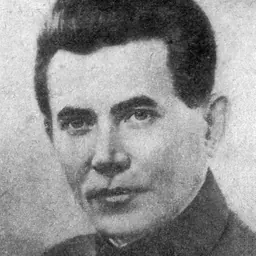
Mikhail Petrovich Frinovsky (; 7 February 1898 – 4 February 1940) was a Soviet secret police official who served as a deputy head of the NKVD under Nikolai Yezhov during the Great Purge.
Frinovsky was a revolutionary during the Russian Revolution and rose through the ranks of the Cheka and its successor agencies. Frinovsky was actively involved in the Great Purge and personally led the mass arrests and executions of security and military officials across the Soviet Union from 1937 to 1938. Frinovsky was made People's Commissar of the Navy of the Soviet Union in 1938 when he was himself removed from power and purged along with Yezhov. Frinovsky was arrested in 1939 on conspiracy charges and executed in 1940.
Early life Mikhail Petrovich Frinovsky was born 7 February 1898 in the village of Narovchat in the Penza Governorate of the Russian Empire, into a Russian family. His father was a teacher and he studied in a religious Orthodox school in Krasnoslobodsk prior to World War I. In January 1916, Frinovsky volunteered for the Imperial Russian Army, serving as a sergeant in the cavalry until his desertion in August. In April 1933, he was again promoted and became the commander of OGPU Border Guard, where he participated in the Soviet invasion of Xinjiang. From January to February 1934, he attended the 17th Congress of the All-Union Communist Party (Bolsheviks) as a delegate. On 11 July, Frinovsky was appointed head of Border and Internal Troops of the NKVD.
Great Purge
Frinovsky was one of the major beneficiaries of the first purge of the NKVD that followed dismissal of its head, Genrikh Yagoda. He had had some kind of falling out with Yagoda, but was on good terms with Yagoda's successor Nikolai Yezhov. On 16 October 1936, Frinovsky was appointed Deputy Chairman of the NKVD, which made him third in seniority within the Soviet security apparatus. On 15 April 1937, he was promoted First Deputy Chairman of the NKVD, and head of the Chief Directorate of State Security. Now second in command to Yezhov, he was in charge of the interrogation of Yagoda, in which Joseph Stalin took a personal interest. He was jointly responsible with Yezhov for setting the quotas of arrests that were required, in accordance with NKVD Order No. 00447, in each part of the Soviet Union.
On 7 June 1937, Frinovsky led the squad of senior NKVD officers who descended on Kiev to facilitate arrest of the recently dismissed head of the Ukraine NKVD, Vsevolod Balitsky, and of Red Army officers suspected of being too closely linked to their former commander, Iona Yakir. On 17 February 1938, he supervised the murder of the head of the NKVD Foreign Department, Abram Slutsky, who was chloroformed and injected with lethal poison in Frinovsky's office. On 28 April 1938, he signed the warrant for the second arrest of the poet Osip Mandelstam, who died in a Gulag. On 17 June 1938, Frinovsky arrived in Khabarovsk in the Far East, in a special train carrying a large contingent of NKVD officers to supervise mass arrests of military and security personnel in the Far East. This purge resulted in execution of 16 senior NKVD officials, who were shot, and Marshal of the Soviet Union Vasily Blyukher, the commander of the Far Eastern Army. While Frinovsky was in the Far East, Stalin proposed that he be appointed People's Commissar of the Navy, an apparent promotion, which was actually part of a manoeuvre to remove Yezhov. On 22 August 1938, it was announced that his replacement as First Deputy Chairman of the NKVD would be Lavrentiy Beria. On 25 August, Frinovsky arrived back in Moscow and effectively ran the NKVD for a few days, while Beria was in Georgia arranging who would take over from him there and Yezhov was in a state of drunken depression. He seized the opportunity to execute a group of former NKVD officers, including Leonid Zakovsky and others, to prevent them giving evidence against him to Beria.
Downfall On 8 September 1938, Frinovsky was named People's Commissar for the Navy, and was sufficiently in favour to be among the guests at a lunch in the Kremlin on the 21st anniversary of the Bolshevik revolution, at which Stalin and Beria were present, but Yezhov was excluded. However, at the party congress in March 1939, he was not elected to the Central Committee (the most powerful body in the party) when one of his nominal juniors was. On March 16, he wrote to Stalin pleading to be dismissed because he knew nothing about running a navy, but he was in office, at least nominally.
On 6 April 1939, Frinovsky was arrested under the charge of "organizing a Trotskyist–Fascist conspiracy" within the NKVD and held at Sukhanovo Prison. On 12 April, his wife Nina and his 17-year-old son Oleg were also arrested. All three were included in a list of 346 people Beria submitted to Stalin on 16 January 1940, with a recommendation that they all be executed. Yezhov and the writer Isaac Babel were on the same death list. Oleg was executed on 21 January and Nina Frinovskaya on 3 February. It was standard procedure that the condemned were photographed prior to execution: the last pictures of Frinovsky's wife and son are in David King's book,Ordinary Citizens.
Death On 4 February 1940, Frinovsky was shot and executed by firing squad, and his body was cremated at the Donskoye Cemetery. His grand apartment in Kropotkinskaya Street (now Prechistenka Street) in Khamovniki was given to Estonian SSR NKVD chief Veniamin Gulst. Frinovsky was never politically rehabilitated after the death of Stalin in 1953 and the subsequent de-Stalinization process.
Awards Order of Lenin (February 14, 1936) three orders of the Red Banner (1924, 20.12.1932, 3.02.1935) Order of the Red Star (July 22, 1937) medal "XX years of the RSCA" (February 22, 1938) Order of the Red Banner of the Mongolian People's Republic (October 25, 1937) Order of the Red Banner of Labor of the Azerbaijan SSR (March 4, 1931) Order of the Red Banner of Labor of the ZRFSR (March 7, 1932) Badge "Honorary Worker of the Cheka-OGPU (V)" (1925) Badge "Honorary Worker of the Cheka-OGPU (XV)" (May 26, 1933)
Decree of the Presidium of the Supreme Soviet of the USSR of January 24, 1941 deprived of state awards and military rank.
Family Brother – Frinovsky Georgy Petrovich (1908–1942) – from January 1937 he served as chief of staff, from October 7, 1937, commander of the 225th escort regiment; supervised the escort of prisoners of the Solovetsky Special Purpose Camp to the places of execution, major of state security. Killed in the Second World War. Wife – Frinovskaya Nina Stepanovna (1903, Ryazan – February 3, 1940) – Russian, non-partisan, higher education, graduate student of the Institute of History of the USSR Academy of Sciences. Arrested April 12, 1939. February 2, 1940 on charges of "concealing the criminal counter-revolutionary activities of enemies of the people" (that is, her own husband and son), the Military Collegium of the Supreme Court of the USSR was sentenced to death. Shot on February 3, 1940. Rehabilitated by the Plenum of the Supreme Court of the USSR on January 12, 1966. Son – Frinovsky Oleg Mikhailovich (1922, Kharkov – January 21, 1940, Moscow) – member of the Komsomol, unfinished secondary education, student of the 10th grade of the 2nd Moscow special artillery school. Arrested April 12, 1939. On January 21, 1940, he was sentenced to death by the Military Collegium of the Supreme Court of the USSR on charges of participating in a "counter-revolutionary youth group". Shot on the same day. Rehabilitated by the Plenum of the Supreme Court of the USSR on January 12, 1966.
In Moscow, Frinovsky occupied a 9-room apartment (Kropotkinskaya street, building 31, apt. 77), in which, after his arrest, the family of a high-ranking NKVD officer, Veniamin Gulst, moved in.
Don’t just read it —
keep it.
Full-length biographies made to live with: read them, listen on the way to work, watch them tonight.
- E-book
- Audio
- Video
Instant download · yours to keep · every purchase keeps this site free
Important facts
People in Mikhail Frinovsky's life
Named in this biography and alive at the same time






Related people
Same field, nearest in time





Contemporaries
People whose lives overlapped Mikhail Frinovsky's



Frequently asked questions
Who was Mikhail Frinovsky?
Great Purge perpetrator (1898-1940)
When was Mikhail Frinovsky born?
Mikhail Frinovsky was born on 26 January 1898 in Narovchat.
When did Mikhail Frinovsky die?
Mikhail Frinovsky died on 4 February 1940 in Moscow.
What was Mikhail Frinovsky's occupation?
Mikhail Frinovsky was a politician.
What nationality was Mikhail Frinovsky?
Mikhail Frinovsky was Russian.
Sources & further reading
· Wikipedia: Mikhail Frinovsky
Cite this page
APA: Biography.guide. (2026). Mikhail Frinovsky. https://biography.guide/mikhail-frinovsky/
MLA: "Mikhail Frinovsky." Biography.guide, https://biography.guide/mikhail-frinovsky/.
Chicago: "Mikhail Frinovsky." Biography.guide. https://biography.guide/mikhail-frinovsky/.
Data last updated: 2026-09-25 · Spot an error? Report a correction.
Page generated 2026-09-27 05:12 UTC