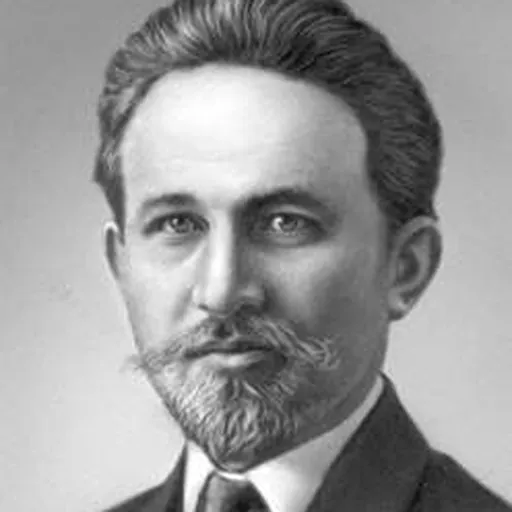
About Matvei Skobelev
Lived 1885 – 1938 (aged 52). Matvei Skobelev was a Russian politician.
Matvey Ivanovich Skobelev (; 9 November 1885 – 29 July 1938) was a Russian Marxist revolutionary and politician.
Biography
Trotsky's Disciple in Vienna (1908–1912) Skobelev was born in the family of a wealthy Baku oilman and industrialist of the Molokan faith. He joined the Russian Social Democratic Labor Party in 1903. After the Russian Revolution of 1905 he went abroad to study at a polytechnic in Vienna. While in Vienna, he became a friend and supporter of Leon Trotsky, whose bi-weekly Pravda he helped edit in 1908–1912. Skobelev and another editor, Adolph Joffe, both scions of wealthy families, also helped Trotsky finance the paper.
Duma Deputy (1912–1917) In the summer of 1912 Skobelev went back to his native Caucasus and was elected to the 4th Duma (1912–1917) from the Social Democrats. He soon came under the influence of the head of the Menshevik part of the Social Democratic faction in the Duma, Nikolay Chkheidze, and supported him against the Bolshevik emigre leaders (Vladimir Lenin, Grigory Zinoviev and Lev Kamenev) who, in 1912–1913, were trying to get the Bolshevik deputies to break away from the Menshevik majority and form a separate faction in the Duma. After the faction finally split in mid-1913, Skobelev and Chkheidze went to London for the 1 December 1913 meeting of the International Socialist Bureau to apply pressure on the Bolshevik deputies to preserve socialist unity, ultimately unsuccessfully . At the outbreak of World War I in 1914, Skobelev and Chkheidze tentatively supported the war effort while remaining critical of the Russian government's internal policies and prosecution of the war. Skobelev, like Chkheidze, was an active member of the irregular freemasonic lodge, the Grand Orient of Russia’s Peoples.
Revolutionary Leader (1917)
During the February Revolution of 1917, Skobelev and other Menshevik Duma deputies became leaders of the Petrograd Soviet when it was formed on 27 February, Skobelev at first serving as chairman. On 7 March Skobelev became one of the 5 original members of the Contact Committee of the Petrograd Soviet which coordinated policy decisions with the newly formed Russian Provisional Government. On 12 March he was elected deputy chairman of the Petrograd Soviet's executive committee with Chkheidze as chairman. When the Mensheviks agreed to join the Provisional Government on 5 May, Skobelev became the new government's Minister of Labor. On 23–24 May Skobelev and Irakli Tsereteli hammered out a compromise with rebellious Kronstadt sailors who, led by Bolsheviks Fedor Raskolnikov and Semion Roshal, had formed a self-styled autonomous Kronstadt Republic. The compromise avoided a showdown with the Provisional Government .
He was also elected deputy chairman of the All Russian Soviet Executive Committee at the first Soviet Congress in June 1917. In August 1917 he published two government "circulars", which attempted to limit factory workers' rights as follows:
23 August - restated the prerogative of management to hire and fire, and the illegality of "coercion", which rendered the culprits liable to criminal prosecution 28 August - reminded factory inspectors and commissars that factory committees could only meet outside hours, and that workers had a duty to maintain productivity, "in order to satisfy the demands of the country's defense and the urgent needs of the population"
After resigning his post as Minister of Labor in September 1917, on 3–5 October Skobelev was made the All-Russian Soviet Executive Committee's representative ("nakaz") at the upcoming Paris conference of Allied powers, a position made defunct by the Bolshevik seizure of power during the October Revolution of 1917 .
After the Revolution (1918–1938) Opposed to the Bolshevik regime, Skobelev moved to his home city of Baku in then-independent Azerbaijan ca. 1919 . After the Bolshevik victory in the Russian Civil War and re-annexation of Azerbaijan in 1920, he fled to Paris. Once the Bolshevik government instituted the NEP policy of partial liberalization, Skobelev became reconciled with the new regime and eventually joined the Russian Communist Party (b) 1922 (over Trotsky's objections ). In late 1922, he worked on facilitating trade relations between France and Russia and then returned to Russia, where he continued working in the Soviet foreign trade system until his arrest and execution in 1938 during the Great Purge.
Don’t just read it —
keep it.
Full-length biographies made to live with: read them, listen on the way to work, watch them tonight.
- E-book
- Audio
- Video
Instant download · yours to keep · every purchase keeps this site free
Important facts
People in Matvei Skobelev's life
Named in this biography and alive at the same time

Related people
Same field, nearest in time




Contemporaries
People whose lives overlapped Matvei Skobelev's



Frequently asked questions
Who was Matvei Skobelev?
Russian politician (1885-1938)
When was Matvei Skobelev born?
Matvei Skobelev was born on 28 October 1885 in Baku.
When did Matvei Skobelev die?
Matvei Skobelev died on 29 July 1938 in Moscow.
What was Matvei Skobelev's occupation?
Matvei Skobelev was a politician.
What nationality was Matvei Skobelev?
Matvei Skobelev was Russian.
Sources & further reading
Cite this page
APA: Biography.guide. (2026). Matvei Skobelev. https://biography.guide/matvei-skobelev/
MLA: "Matvei Skobelev." Biography.guide, https://biography.guide/matvei-skobelev/.
Chicago: "Matvei Skobelev." Biography.guide. https://biography.guide/matvei-skobelev/.
Data last updated: 2026-09-21 · Spot an error? Report a correction.
Portrait: Wikimedia Commons · author & licence
Page generated 2026-09-27 04:59 UTC