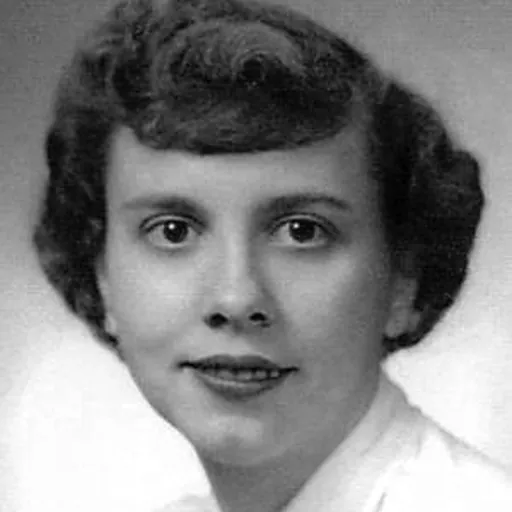
Mary Tsingou
American physicist and mathematician
About Mary Tsingou
Lived 1928 – 2026 (aged 97). Mary Tsingou was an American mathematician, physicist and computer scientist, known for Fermi–Pasta–Ulam–Tsingou problem.
Mary Tsingou-Menzel (October 14, 1928 – August 27, 2026) was an American physicist and mathematician of Greek-Bulgarian descent. She was one of the first programmers on the MANIAC computer at Los Alamos National Laboratory and is best known for having coded the celebrated computer experiment with Enrico Fermi, John Pasta, and Stanisław Ulam. This experiment became an inspiration for the fields of chaos theory and scientific computing, and was a turning point in soliton theory.
Background Mary Tsingou was born in Milwaukee, Wisconsin, on October 14, 1928, her Greek parents having moved to the United States from Bulgaria. In the aftermath of the Great Depression, the family left the US to spend several years in Bulgaria. In 1940, they returned to the States, where Tsingou attended high school and college. She graduated with a bachelor's degree in mathematics and education in 1951 from the University of Wisconsin. She then studied at the University of Michigan, receiving a master's degree in mathematics in 1955. In 1958, she married Joseph Menzel.
Career Tsingou joined the theoretical division of the Los Alamos National Laboratory, where she became one of the first programmers on the MANIAC. Besides working on weapons, the group also studied fundamental physics. Following Fermi's suggestion to analyze numerically the predictions of a statistical model of solids, Tsingou came up with an algorithm to simulate the relaxation of energy in a model crystal, which she implemented on the MANIAC. The result was an important stepping stone for chaos theory.
Early MANIAC programmers included Mary Hunsberger Kircher. She was interviewed in 2002 by the IEEE History Center. Mary Tsingou-Menzel was also interviewed in 2002.
After Fermi's death, James L. Tuck and Tsingou-Menzel repeated the original FPUT results and provided strong indication that the nonlinear FPUT problem might be integrable.
Tsingou-Menzel continued her computational career at Los Alamos. She was an early expert on Fortran. In the 1980s, she worked on calculations for the "proton storage ring" in the Star Wars program (the Strategic Defense Initiative), which was one of President Ronald Reagan's projects. She retired in 1991. In 2020, National Security Science magazine, published by Los Alamos National Laboratory, featured an article on Tsingou that included her commentary and historical reflections on the FPUT problem. The article was titled "We thank Miss Mary Tsingou" in reference to the acknowledgement that appeared on the title page of the original FPUT technical report from 1955.
Publications
Joseph J. Devaney, Albert G. Petschek, Mary Tsingou Menzel. On the Production of Heavy Uranium Isotopes in a Very High Density Fast Neutron Flux (accessed Dec. 2012). Los Alamos Scientific Laboratory of the University of California, 1958; 17 pages.
Don’t just read it —
keep it.
Full-length biographies made to live with: read them, listen on the way to work, watch them tonight.
- E-book
- Audio
- Video
Instant download · yours to keep · every purchase keeps this site free
Important facts
People in Mary Tsingou's life
Named in this biography and alive at the same time





Related people
Same field, nearest in time


Contemporaries
People whose lives overlapped Mary Tsingou's




Frequently asked questions
Who was Mary Tsingou?
American physicist and mathematician
When was Mary Tsingou born?
Mary Tsingou was born on 14 October 1928 in Milwaukee.
When did Mary Tsingou die?
Mary Tsingou died on 27 August 2026 in Los Alamos.
What was Mary Tsingou's occupation?
Mary Tsingou was a mathematician, physicist and computer scientist.
What was Mary Tsingou known for?
Mary Tsingou was known for Fermi–Pasta–Ulam–Tsingou problem.
What nationality was Mary Tsingou?
Mary Tsingou was American.
Sources & further reading
Cite this page
APA: Biography.guide. (2026). Mary Tsingou. https://biography.guide/mary-tsingou/
MLA: "Mary Tsingou." Biography.guide, https://biography.guide/mary-tsingou/.
Chicago: "Mary Tsingou." Biography.guide. https://biography.guide/mary-tsingou/.
Data last updated: 2026-09-21 · Spot an error? Report a correction.
Portrait: Wikimedia Commons · author & licence
Page generated 2026-09-27 04:58 UTC