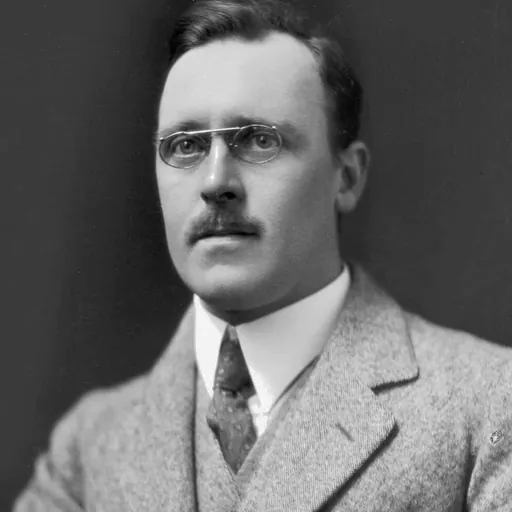
About Ernest Marsden
Lived 1889 – 1970 (aged 81). Ernest Marsden was a British physicist and nuclear physicist, known for Geiger–Marsden experiment.
Sir Ernest Marsden (19 February 1889 – 15 December 1970) was an English-New Zealand physicist. He is recognised internationally for his contributions to science while working under Ernest Rutherford, which led to the discovery of new theories on the structure of the atom. In Marsden's later work in New Zealand, he became a significant member of the scientific community, while maintaining close links to the United Kingdom.
Education Born in Manchester, the son of Thomas Marsden and Phoebe Holden, Marsden lived in Rishton and attended Queen Elizabeth's Grammar School, Blackburn, where an inter-house trophy rewarding academic excellence ('The Marsden Merit Trophy') bears his name. While still an undergraduate he conducted the famous Geiger–Marsden experiment, also called the gold foil experiment, together with Hans Geiger under Rutherford's supervision. This experiment led to Rutherford's new theory for the structure of the atom, with a centralised concentration of mass and positive charge surrounded by empty space and a sea of orbiting negatively charged electrons. Rutherford later described this as "almost as incredible as if you fired a 15-inch shell at a piece of tissue paper and it came back to hit you".
The apparatus used in the experiment was an early version of what was to become the Geiger counter.
In 1915 he moved to Victoria University College in Wellington, New Zealand, to replace Thomas Laby as Professor of Physics; Rutherford recommended his appointment there.
Career Marsden served in France during World War I as a Royal Engineer in a special sound-ranging section and was awarded the Military Cross in the 1919 King's Birthday Honours.
In 1922 Marsden turned from his research and position as Professor of Physics to bureaucracy. He was appointed Assistant Director of Education before accepting the position of Secretary of New Zealand's new Department of Scientific and Industrial Research (DSIR) in 1926. The new Department's focus was on assisting primary industries, and Marsden worked to organise research particularly in the area of agriculture. During the War he worked on radar research, setting up a team to develop the radar equipment for use in the Pacific. Marsden also used his scientific connections to form a team of young New Zealand scientists who would participate in the American Manhattan Project developing the nuclear bomb, and initiated the search for uranium, the raw material needed for nuclear projects, in New Zealand.
Marsden had a post-war vision of a nuclear New Zealand, with scientists working on research using local nuclear reactors, and developing connections with the British nuclear energy and weapons program. While this vision was not fully realised, in 1946 he established a team of scientists to carry out research into atomic energy and the application of nuclear science to problems in agriculture, health, and industry. Ties between Marsden and the scientific community in Britain remained strong, and in 1947 he became the DSIR's scientific liaison officer in London.
Honours and awards Marsden's career recognitions included fellowship in the Royal Society and appointed a Commander of the Order of the British Empire in the Silver Jubilee and King's Birthday Honours. He was appointed a Companion of the Order of St Michael and St George in the 1946 New Year Honours. In 1953, Marsden was awarded the Queen Elizabeth II Coronation Medal, and he was made a Knight Bachelor in the 1958 New Year Honours, for services to science.
Honorific eponyms The Marsden Fund for basic research in New Zealand was set up in 1994.
Massey University has named a major lecture theatre after him.
Don’t just read it —
keep it.
Full-length biographies made to live with: read them, listen on the way to work, watch them tonight.
- E-book
- Audio
- Video
Instant download · yours to keep · every purchase keeps this site free
Important facts
People in Ernest Marsden's life
Named in this biography and alive at the same time


Related people
Same field, nearest in time


Contemporaries
People whose lives overlapped Ernest Marsden's





Frequently asked questions
Who was Ernest Marsden?
British–New Zealand physicist (1889–1970)
When was Ernest Marsden born?
Ernest Marsden was born on 19 February 1889 in Manchester.
When did Ernest Marsden die?
Ernest Marsden died on 15 December 1970 in Wellington.
What was Ernest Marsden's occupation?
Ernest Marsden was a physicist and nuclear physicist.
What was Ernest Marsden known for?
Ernest Marsden was known for Geiger–Marsden experiment.
What nationality was Ernest Marsden?
Ernest Marsden was British.
Sources & further reading
Cite this page
APA: Biography.guide. (2026). Ernest Marsden. https://biography.guide/ernest-marsden/
MLA: "Ernest Marsden." Biography.guide, https://biography.guide/ernest-marsden/.
Chicago: "Ernest Marsden." Biography.guide. https://biography.guide/ernest-marsden/.
Data last updated: 2026-09-24 · Spot an error? Report a correction.
Portrait: Wikimedia Commons · author & licence
Page generated 2026-09-27 05:09 UTC