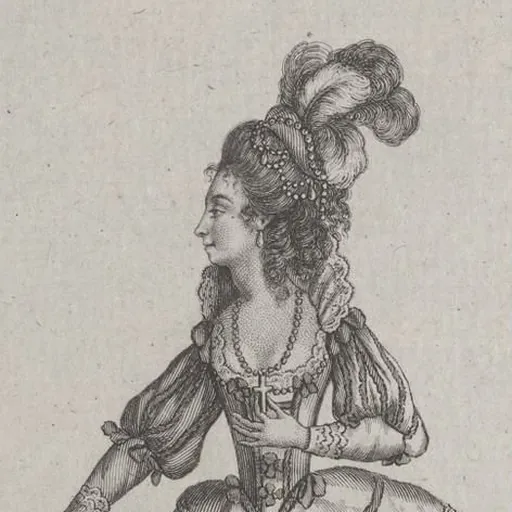
About Mary Bulkley
Lived 1747 – 1792 (aged 44–45). Mary Bulkley was a dancer and actor.
Mary Bulkley, née Wilford (1747/8 – 1792), known professionally as Mrs Bulkley, Miss Bulkley, and later Mrs Barresford, was an English eighteenth-century dancer and comedy stage actress. She performed at various theatres, especially Covent Garden Theatre, the Theatre Royal, Dublin, the Theatre Royal, Edinburgh, the Theatre Royal Haymarket and Shrewsbury Theatre. She performed in all or most of the Shakespearean comedies, and in several tragedies, besides many contemporary comedy plays. She played the part of Hamlet at least twice. She was considered a beauty when young, and her talent was praised. She married George Bulkley and later Captain Ebenezer Barresford, and openly took several lovers. Her early career was successful, but later she was hissed on stage due to her extra-marital affairs, but "could not sing". Hugh Kelly described her:
In the same year, the following poem was anonymously dedicated to her in a newspaper:
Poem quote|How various are the shapes she wears How lovely she's in all! Applauding multitudes she chears, Admirers hopeless fall. ... Yet (blessings on the pious care That rear's the tender frame) One here hath claim to all that share And Wilford is her name. when she was about twenty years old, Mary Wilford married George Jackson Bulkley (1742–1784) in Haymarket. He was a Covent Garden orchestra violinist from Yorkshire. George Bulkley was "grateful" and "useful", but "dull." The second was George Wilford Bulkley (1769–1844), a Newbury and London solicitor. The third was William Fisher Bulkley (1771–1810), baptised 26 September 1771 at Bristol.
Following the affair with Dodd at the King Street Theatre, Bristol, in 1768, there was a scandal. Dodd's wife died after about a year, and public sympathy waned as a result. Nevertheless, Mary Bulkley went with Dodd to Dublin in 1774, but had poor reviews because "Some recent transactions had excited strong prejudices against them." This left Dodd and Mary without money, so for a while she went home to her husband. However she went to live again with Dodd, and worked successfully in 1779 with Tate Wilkinson, manager of the Yorkshire Circuit. In due course there was a scandal involving Bulkley's affairs when she went to live with harlequin John Banks in Scotland, and with actor John (or James) Brown Williamson (d. 1802) around 1782. but by 1791 she was "drinking heavily." Her carriage, overturning on Edinburgh's North Bridge in 1785, caused "hurt," preventing her from performing the following night. That injury may also have contributed to the increase in her drinking. however her Covent Garden debut in 1758 at the age of ten years was as a dancer. She continued as a dancer there until 1765, when at around 18 years old she first performed as a comedy actress.
During her career, Bulkley performed in many plays and only some of them are listed below. Her debut as a comedian was at Covent Garden, as Miranda in The Busie Body, by Susanna Centlivre (1709). At the same theatre she performed in the premières of several plays which are now well known. For example, The Good-Natur'd Man (as Miss Richland, 1768), She Stoops to Conquer (as Constantia Hardcastle, 1773), and The Rivals (as Julia Melville, 1775). In that environment, Bulkley performed in all the Shakespeare comedies, but also played the tragic heroine Cordelia in King Lear, and Portia in The Merchant of Venice. Present at rehearsals for this première were Oliver Goldsmith, Samuel Johnson and Joshua Reynolds. There was an onstage argument between Mary Bulkley and Ann Catley about who should perform the epilogue, and Goldsmith even suggested rewriting it so that they should perform it together, quarrelling in character, but the owner-director George Colman decided that Bulkley should perform it.
Performing with Dodd in Dublin and Shrewsbury
On 29 May 1774 Bulkley arrived with her lover Dodd in Dublin. Her first engagement was to play Beatrice in Much Ado About Nothing at the Theatre Royal, Dublin. This play was billed as a "revival" in the Sanders's News-Letter. On one occasion the performance was short enough to be followed by a farce called Miss in her Teens, with Mrs Bulkley in the line-up. A few days later, they were both in The Clandestine Marriage and a farce called The Citizen by Arthur Murphy. In 1775 and 1776 they were in several plays at Shrewsbury Theatre: in 1775 these were Jane Shore by Nicholas Rowe, The English Tars in India, The Country Girl, and The Life and Death of Julius Caesar. A 1775 review in the Shrewsbury Chronicle says: "The performance was universally well received; Mr Dodd and Mrs Bulkley, both in play and farce, displayed, as usual, the most pleasing and excellent abilities as comedians, and gave general satisfaction." In 1776 they played Richard III, and a farce called Bonton or High Life Above Stairs.
At Covent Garden again It was between 1776 and 1778 that the engraved portraits of Mary Buckley in performance began to appear in Bell's British Theatre. On the other hand, during the 1779–1780 season, the audience hissed her on one occasion because it had become public knowledge that she had "taken the son of her long-term lover to her bed". Her career began to decline after this, and she appeared at Covent Garden less frequently. Jackson replied with a long, detailed response in February, below a Royal Theatre playbill omitting Bulkley's name, saying that he would take no notice of her letters. This was followed at the end of April in the same newspaper by an angry exchange of letters between Bulkley's lover Williamson and Jackson, on the subject of payments and credit, in which Williamson pretends that Mrs Bulkley is his wife.
In 1782, Bulkley was indeed performing at the Theatre Royal, Edinburgh with her lover Williamson. They were in the comedy, Wonder, a Woman Keeps a Secret by Susanna Centlivre, and the farce Three Weeks After Marriage by Arthur Murphy. They also played in The Constant Couple by George Farquhar, and The Rivals, as well as The Maid of the Oaks and An Englishman in Paris by Samuel Foote which both featured a minuet performed by Williamson and Bulkley.
On 23 March 1784, Bulkley played the part of Hamlet successfully at the Theatre Royal, Edinburgh. The Jealous Wife and A Trip to Scarborough, The Critic, and reciting the epilogue Belles Have At Ye All by Thomas Covey. Still apparently without Williamson, in May she was performing Rule a Wife and Have a Wife, a farce called Deuce Is In Him by George Coleman, Wonder; A Woman Keeps a Secret, and The Sultan by Isaac Bickerstaffe. In the same month she played the part of Hamlet, played in Rule a Wife and Have a Wife, School for Scandal, A Trip to Scarborough and Three Weeks After Marriage, and again performed Belles Have At Ye All, and Deuce Is In Him.
By 1788 Bulkey was performing with Williamson in Edinburgh again, in Much Ado About Nothing, The Sultan, and The Provok'd Husband by John Vanburgh and Colley Cibber, Tender Husband, by Richard Steele, The Wonder; A Woman Keeps a Secret, Belles Have At Ye All, The Maid of the Oaks, The School for Wives, Young Quaker by John O'Keeffe, The Deuce Is In Him, and performing a dance called Jamie's Return, besides the Williamson and Bulkley minuet.
Performing as Mrs Barresford During this period, Williamson is often recorded on playbills as acting alongside her. As Mrs Barresford, she performed in Edinburgh between 1789 and 1791. She was nearing the end of her life and was perhaps already ill, but she was apparently working regularly, and still received praise from the manager, Jackson:
How admirably Mr King is supported by Mrs Barresford's performance – her merits as an actress are universally allowed; and, for my own part, I cannot say that ever I saw her in any character she did not support according to my most sanguine expectations. Mr King's Sir Peter, and her Lady Teazle, was as complete a piece of acting as one could see within the walls of a Theatre. —Caledonian Mercury, 1789 She played in The English Merchant by George Colman, The Pannel and The Heiress. She was in All in the Wrong by Arthur Murphy, English Merchant by George Colman, The Beaux' Stratagem, The Critic, and The Pannel. In 1790 she played Hippolyta in The Tempest, Fatima in Cymon, Lady Gayville in The Heiress, Lady Lardoon in the farce The Maid of the Oaks which included the Williamson and Barresford minuet, The Brothers, Three Weeks After Marriage, and she spoke the epilogue to Vimonda by Andrew Macdonald. In 1791 she played Lady Macbeth for the first time, and at the end of the play danced a minuet with Mr Aldridge. On the same night she played a fine lady in the farce Lethe, or Aesop in the Shade by David Garrick. She appeared in I'll Tell You What by Elizabeth Inchbald, and in The Miser. She played the Queen in Hamlet, and was in the farce Three Weeks After Marriage again, The Fashionable Lover with her usual minuet, and Tit For Tat by Charlotte Charke. She was engaged for the 1792 season, but it is not known whether she performed that year.
Decline 1780–1792 During her Edinburgh years Bulkley was employed for the summer seasons at the Haymarket Theatre. She managed to work Drury Lane briefly in 1782, She was with the Theatre Royal Edinburgh company until 1791, around the time when Williamson became deputy manager. After her death he performed on the Continent and in America, to little success.
Explanatory notes
Don’t just read it —
keep it.
Full-length biographies made to live with: read them, listen on the way to work, watch them tonight.
- E-book
- Audio
- Video
Instant download · yours to keep · every purchase keeps this site free
Important facts
People in Mary Bulkley's life
Named in this biography and alive at the same time




Related people
Same field, nearest in time




Contemporaries
People whose lives overlapped Mary Bulkley's





Frequently asked questions
Who was Mary Bulkley?
English dancer and actress
When was Mary Bulkley born?
Mary Bulkley was born in 1747 in London.
When did Mary Bulkley die?
Mary Bulkley died on 19 December 1792 in Dumfries, Scotland.
What was Mary Bulkley's occupation?
Mary Bulkley was a dancer and actor.
Sources & further reading
Cite this page
APA: Biography.guide. (2026). Mary Bulkley. https://biography.guide/mary-bulkley/
MLA: "Mary Bulkley." Biography.guide, https://biography.guide/mary-bulkley/.
Chicago: "Mary Bulkley." Biography.guide. https://biography.guide/mary-bulkley/.
Data last updated: 2026-09-22 · Spot an error? Report a correction.
Page generated 2026-09-27 05:09 UTC