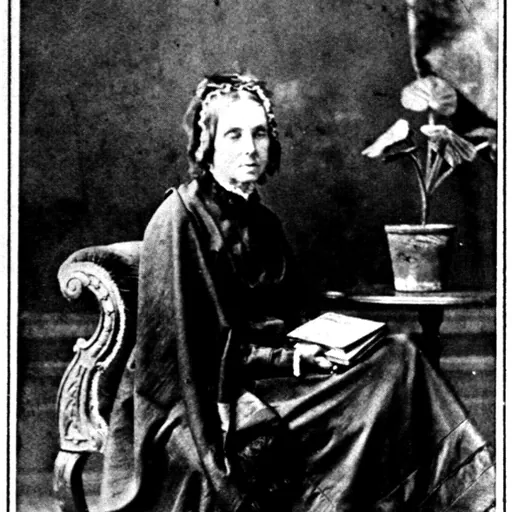
Mary Ball
Irish naturalist, entomologist and botanical collector
About Mary Ball
Lived 1812 – 1898 (aged 86). Mary Ball was a British naturalist, entomologist and botanical collector.
Mary Ball (1812–1898) was an Irish naturalist and entomologist most noted for her studies of Odonata and for her discovery of the stridulation in aquatic bugs in the family Corixidae.
Early life
Mary Ball was born in 1812, the second daughter of Bob Stawell Ball and his wife Mary née Green. She was born near Cobh, County Cork, but shortly moved with the family to nearby Youghal, County Cork. Mary had three siblings who lived into adulthood: Robert, Bent (1806–1860), and Anne, a well-known algologist. The family was Protestant and "involved in trade".
There is not much known about Mary's training, but as a middle-class family she certainly would have access to a microscope and the latest volumes of natural history and scientific classification of the times. It has been recorded that Robert started collecting specimens with his father at the age of five. It can be assumed that Mary would have participated as well.
Mary concentrated on collecting shells and insects, accumulating what was considered one of the best collections of molluscs in the country at the time, though it was disposed after her death.
Later life After the successive deaths of her father in 1841, her mentor William Thompson in 1852 and her brother Robert in 1857,
Publications Mary, as was the convention, did not publish her work under her own name. The three known works were all communicated by her brother Robert. They are:
"On the sounds produced by the Notonectidae under water" Annals and Magazine of Natural History 16: 129. (1846) "On the noises produced by one of the Notonectidae Report of the British Association for the Advancement of Science". Notices and abstracts of communications Cambridge Meeting, June 1845: 64–65. Ball, R. (1846). "Corixa striata, Curtis". Annals and Magazine of Natural History 17: 135–136. (18--)
Her observations of butterflies and moths were cited by the "father of Irish entomology" Alexander Henry Haliday in his work on the Irish Lepidoptera.
Don’t just read it —
keep it.
Full-length biographies made to live with: read them, listen on the way to work, watch them tonight.
- E-book
- Audio
- Video
Instant download · yours to keep · every purchase keeps this site free
Important facts
People in Mary Ball's life
Named in this biography and alive at the same time

Related people
Same field, nearest in time


Contemporaries
People whose lives overlapped Mary Ball's




Frequently asked questions
Who was Mary Ball?
Irish naturalist, entomologist and botanical collector (1812 - 1898)
When was Mary Ball born?
Mary Ball was born on 15 February 1812 in Cóbh.
When did Mary Ball die?
Mary Ball died on 17 July 1898 in Dublin.
What was Mary Ball's occupation?
Mary Ball was a naturalist, entomologist and botanical collector.
What nationality was Mary Ball?
Mary Ball was British.
Sources & further reading
· DBpedia: Mary Ball (naturalist)
Cite this page
APA: Biography.guide. (2026). Mary Ball. https://biography.guide/mary-ball/
MLA: "Mary Ball." Biography.guide, https://biography.guide/mary-ball/.
Chicago: "Mary Ball." Biography.guide. https://biography.guide/mary-ball/.
Data last updated: 2026-09-24 · Spot an error? Report a correction.
Portrait: Wikimedia Commons · author & licence
Page generated 2026-09-27 05:08 UTC