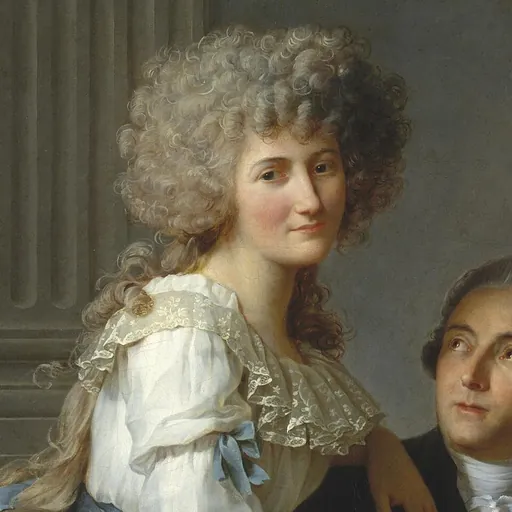
About Mary-Anne Paulzzze Lavoisier
Lived 1758 – 1836 (aged 78). Mary-Anne Paulzzze Lavoisier was a French chemist, illustrator, translator, naturalist and artist.
Marie-Anne Pierrette Paulze Lavoisier, later Countess of Rumford, (20 January 1758 – 10 February 1836) was a French chemist and noblewoman. Madame Lavoisier's first husband was the chemist and nobleman Antoine Lavoisier. She acted as his laboratory companion, using her linguistic skills to write up his work and bring it to an international audience.
At the age of thirteen, Paulze received a marriage proposal from the 50-year-old Count d'Amerval. Jacques Paulze tried to object to the union, but received threats about losing his job with the Ferme Générale. To indirectly thwart the marriage, Jacques Paulze made an offer to one of his colleagues to ask for his daughter's hand instead. This colleague was Antoine Lavoisier, a French nobleman and scientist. Lavoisier accepted the proposition, and he and Marie-Anne were married on 16 December 1771. Lavoisier was about 28, while Marie-Anne was about 13. By the time he had met the widowed Anne-Marie Lavoisier, he had become one of the most well-known physicists at the time. However, the marriage between the two was difficult and short-lived; they separated after three years. Paulze insisted throughout her life that she retain her first husband's last name, demonstrating her undying devotion to him. Rumford had moved to Paris where he continued his work until his death in 1814. He was buried at Auteuil, Paris.
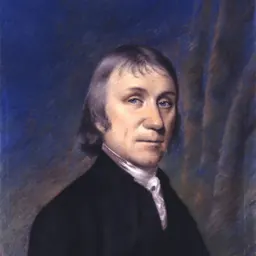
Marie died very suddenly in her home in Paris on 10 February 1836, at the age of 78. She also translated works by Joseph Priestley, Henry Cavendish, and others for Lavoisier's personal use. This was an invaluable service to Lavoisier, who relied on Paulze's translation of foreign works to keep abreast of current developments in chemistry. In the case of phlogiston, it was Paulze's translation that convinced him the idea was incorrect, ultimately leading to his studies of combustion and his discovery of oxygen gas.
Paulze was also instrumental in the 1789 publication of Lavoisier's groundbreaking Elementary Treatise on Chemistry, which presented a unified view of chemistry as a field. This work proved pivotal in the progression of chemistry, as it presented the idea of conservation of mass as well as a list of elements and a new system for chemical nomenclature. Paulze contributed thirteen drawings that showed all the laboratory instrumentation and equipment used by the Lavoisiers in their experiments. She also kept strict records of the procedures followed, lending validity to the findings Lavoisier published.
Before her death, Paulze was able to recover nearly all of Lavoisier's notebooks and chemical apparatuses, most of which survive in a collection at Cornell University, the largest of its kind outside of Europe. The year she died, a book was published showing that Marie-Anne had a rich theological library with books which included versions of The Bible, St. Augustine's Confessions, Jacques Saurin's Discours sur la Bible, Pierre Nicole's Essais de Morale, Blaise Pascal's Lettres provinciales, Louis Bourdaloue's Sermons, Thomas à Kempis's De Imitatione Christi, etc.
Artistic training and contributions
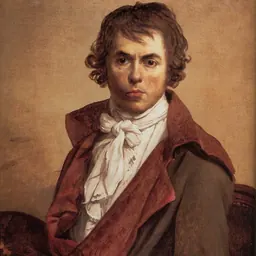
Paulze began receiving artistic instruction from the painter Jacques-Louis David in late 1785 or early 1786. Not long after, probably sometime in 1787, David painted a full-length double portrait of Paulze and her husband, foregrounding the former. Paulze's artistic training enabled her not only to document and illustrate her husband's experiments and publications (she even depicted herself as a participant in two drawings of her husband's experiments) but also to paint a portrait of Benjamin Franklin, one of the many scientific thinkers she hosted in her salons. Later, Paulze's ties with David were severed due to the radical politics of the latter in the context of the French Revolution.
Don’t just read it —
keep it.
Full-length biographies made to live with: read them, listen on the way to work, watch them tonight.
- E-book
- Audio
- Video
Instant download · yours to keep · every purchase keeps this site free
Important facts
People in Mary-Anne Paulzzze Lavoisier's life
Named in this biography and alive at the same time
Related people
Same field, nearest in time


Contemporaries
People whose lives overlapped Mary-Anne Paulzzze Lavoisier's




Frequently asked questions
Who was Mary-Anne Paulzzze Lavoisier?
French chemist and painter (1758-1836)
When was Mary-Anne Paulzzze Lavoisier born?
Mary-Anne Paulzzze Lavoisier was born on 20 January 1758 in Montbrison.
When did Mary-Anne Paulzzze Lavoisier die?
Mary-Anne Paulzzze Lavoisier died on 10 February 1836 in Paris.
What was Mary-Anne Paulzzze Lavoisier's occupation?
Mary-Anne Paulzzze Lavoisier was a chemist, illustrator, translator, naturalist and artist.
What nationality was Mary-Anne Paulzzze Lavoisier?
Mary-Anne Paulzzze Lavoisier was French.
Sources & further reading
· Wikipedia: Mary-Anne Paulzzze Lavoisier
· DBpedia: Marie-Anne Paulze Lavoisier
Cite this page
APA: Biography.guide. (2026). Mary-Anne Paulzzze Lavoisier. https://biography.guide/mary-anne-paulzzze-lavoisier/
MLA: "Mary-Anne Paulzzze Lavoisier." Biography.guide, https://biography.guide/mary-anne-paulzzze-lavoisier/.
Chicago: "Mary-Anne Paulzzze Lavoisier." Biography.guide. https://biography.guide/mary-anne-paulzzze-lavoisier/.
Data last updated: 2026-09-27 · Spot an error? Report a correction.
Portrait: Wikimedia Commons · author & licence
Page generated 2026-10-04 12:20 UTC