
About Martiros Saryan
Lived 1880 – 1972 (aged 92). Martiros Saryan was a Russian and Armenian painter, politician, illustrator, theatre designer and graphic artist.
Martiros Saryan (; ; – 5 May 1972) was an Armenian painter, People's Artist of the USSR, member of the USSR Academy of Fine Arts (1947), president of the Artists' Union of Soviet Armenia (1945-1951), the founder of a modern Armenian national school of painting.
Born in Nakhichevan-on-Don, Saryan attended the local school and graduated from the New Nakhichevan Russian-Armenian College. His works were mainly inspired by his travels to Armenia and the Middle East. His works were exhibited in Moscow, Venice, Yerevan, Paris, Brussels and other cities.
During one of his travels in Tbilisi, he met his future wife, Lusik Aghayan, the daughter of famous Armenian writer Ghazaros Aghayan. He immediately fell in love with her and married her a year later, on April 17, 1916. Together they had two sons, Sargis Saryan and Ghazaros Saryan. Lusik is said to have been Saryan's one and only romantic partner. His former home in Yerevan is now a museum dedicated to his work with hundreds of items on display. He was buried in Yerevan at the Pantheon next to Komitas Vardapet.
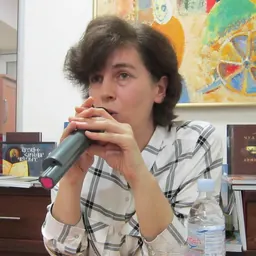
His son Ghazaros (Lazarus) Saryan was a composer and educator. His great-granddaughter Mariam Petrosyan is also a painter, as well as a cartoonist and award-winning novelist.
Travels and Inspirations Saryan's artistic journey evolved as he began traveling extensively. He first visited Armenia, then part of the Russian Empire, in 1901, visiting Lori, Shirak, Echmiadzin, Haghpat, Sanahin, Yerevan and Sevan. Saryan started his artistic research aiming for an inspiration from his homeland, which he was seeing for the first time.
In 1903, after he graduated from the Moscow School of Painting, Sculpture, and Architecture, he traveled to Armenia again, visiting Ani, Goshavank, Haghpat, Sanahin, and Gharakilisa (now Vanadzor), before also traveling to Georgia. From 1928 until his death, Saryan lived in Soviet Armenia.
With traveling and being inspired by the places and people he met, Saryan created around 4000 artworks in his lifetime.
Education and Career Saryan studied at the New Nakhichevan Russian-Armenian College for six years, completing his education there in 1895 at the age of 15.
He composed his first landscapes depicting Armenia: Makravank, 1902; Aragats, 1902; Buffalo. Sevan, 1903; Evening in the Garden, 1903; In the Armenian village, 1903, etc., which were highly praised in the Moscow press.
Following the Bolshevik seizure of power in 1917, he went with his family to live in Russia. Saryan permanently moved to Armenia after the establishment of the Armenian Soviet Socialist Republic.
In the 1930s, during Stalin's Great Purge, many Soviet intellectuals were considered "enemies of the state." Many of Saryan's works, including portraits of famous Armenian writers and artists, were taken from the National Gallery of Armenia and burned. However, one of the works that was supposed to be destroyed was in a different museum and survived. That work was the portrait of Yeghishe Charents, an Armenian poet, writer, and public activist.
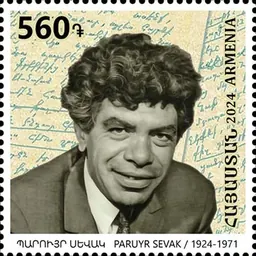
During those years, he mainly devoted himself again to landscape and portrait painting. He was also chosen as a deputy to the Supreme Soviet of the Soviet Union and was awarded the Order of Lenin three times along with other awards and medals. He was a member of the USSR Art Academy (1974) and Armenian Academy of Sciences (1956). In 1966, Saryan signed a petition supporting the unification of Nagorno-Karabakh with Soviet Armenia, alongside Yervand Kochar, Paruyr Sevak, Hamo Sahyan, and other major Armenian cultural figures.
In 1939, Saryan designed the set and costumes for "Almast" by Alexander Spendiaryan, the first opera staged in Armenia. Starting in 1916, Spendiaryan, Saryan, and Armenian writer Hovhannes Tumanyan began to work on the opera. Tumanyan inspired Spendiaryan to create the opera based on his poem "The Capture of Fort Tmuk." Saryan agreed to design the entire set, decorations, and costumes for it.
In around 80 years of creative career, Saryan worked with different genres as a painter, graphic artist, book illustrator, theater set, and monument panel designer.
Gallery
Don’t just read it —
keep it.
Full-length biographies made to live with: read them, listen on the way to work, watch them tonight.
- E-book
- Audio
- Video
Instant download · yours to keep · every purchase keeps this site free
Important facts
more
Martiros Sergeevitch Sarian, Martiros Sarian, Martiros Sergeyevich Sar'yan, Martiros Serguéévitch Sarian, Martiros Sergejevic Sarjan, Martiros Sergeevich Sar'yan, Martiros Ssarjan, Matiross Ssergejewitsch Ssarjan, Martiros Sergueevitch Sarian, Martinos Sarjan, Martiros S. SaryanPeople in Martiros Saryan's life
Named in this biography and alive at the same time

Related people
Same field, nearest in time


Contemporaries
People whose lives overlapped Martiros Saryan's




Frequently asked questions
Who was Martiros Saryan?
Armenian painter (1880–1972)
When was Martiros Saryan born?
Martiros Saryan was born on 16 February 1880 in Nakhichevan-on-Don.
When did Martiros Saryan die?
Martiros Saryan died on 5 May 1972 in Yerevan.
What was Martiros Saryan's occupation?
Martiros Saryan was a painter, politician, illustrator, theatre designer and graphic artist.
What nationality was Martiros Saryan?
Martiros Saryan was Russian and Armenian.
Sources & further reading
Cite this page
APA: Biography.guide. (2026). Martiros Saryan. https://biography.guide/martiros-saryan/
MLA: "Martiros Saryan." Biography.guide, https://biography.guide/martiros-saryan/.
Chicago: "Martiros Saryan." Biography.guide. https://biography.guide/martiros-saryan/.
Data last updated: 2026-09-20 · Spot an error? Report a correction.
Page generated 2026-09-27 05:20 UTC