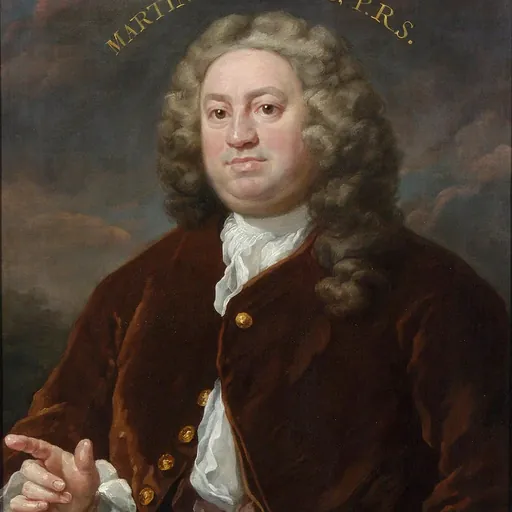
About Martin Folkes
Lived 1690 – 1754 (aged 63). Martin Folkes was a British mathematician, numismatist, astronomer and archaeologist.
Martin Folkes (29 October 1690 – 28 June 1754) was an English antiquary, numismatist, mathematician and astronomer who served as the president of the Royal Society from 1741 to 1752.
Life Folkes was born in Westminster on 29 October 1690, the eldest son of Martin Folkes, councillor at Law. Educated at Clare College, Cambridge, he so distinguished himself in mathematics that when only twenty-three years of age he was chosen a fellow of the Royal Society. He was elected one of the council in 1716, and in 1723 Sir Isaac Newton, president of the society, appointed him one of the vice-presidents. On the death of Newton he became a candidate for the presidency, but was defeated by Sir Hans Sloane, whom, however, he succeeded in 1741; in 1742 he was made a member of the French Royal Academy of Sciences; in 1746 he received honorary degrees from Oxford and Cambridge.
Folkes was a prominent Freemason, being appointed Deputy Grand Master of the Premier Grand Lodge of England during the year 1724–1725.
In 1733 he set out on a tour through Italy, in the course of which he composed his Dissertations on the weights and Values of Ancient Coins. Before the Society of Antiquaries, of which he was president from 1749 to 1754, he read in 1736 his Observations on the Trajan and Antonine Pillars at Rome and his Table of English Gold Coins from the 18th Year of King Edward III. In 1745 he printed the latter with another on the history of silver coinage. He also contributed both to the Society of Antiquaries and to the Royal Society other papers, chiefly on Roman antiquities. In 1739 he was elected one of the founding vice-presidents of London's charitable Foundling Hospital for abandoned children, a position he maintained until 1747.
Folkes was married in 1714 to Lucretia Bradshaw, an actress who had appeared at the Haymarket and Drury Lane (see Nichols's Lit. Anecdot. ii. 578–598). His portrait was painted and etched by William Hogarth (1697–1764).
Folkes was a noted atheist, and opposed racial prejudice. Some of his public statements have been interpreted as evidence of a Darwinian viewpoint. According to the archaeologist William Stukeley, he set up an Infidels Club in 1720, and caused several young noblemen of the Royal Society to jeer whenever scriptural material was injected into a scientific debate.
For Sir John Hill's attack on Folkes (Review of the Works of the Royal Soc., 1751), see Isaac D'Israeli, Calamities and Quarrels of Authors (1860), pp. 364–366.
There is a memorial to Folkes at Westminster Abbey.
Don’t just read it —
keep it.
Full-length biographies made to live with: read them, listen on the way to work, watch them tonight.
- E-book
- Audio
- Video
Instant download · yours to keep · every purchase keeps this site free
Important facts
People in Martin Folkes's life
Named in this biography and alive at the same time


Related people
Same field, nearest in time




Contemporaries
People whose lives overlapped Martin Folkes's



Frequently asked questions
Who was Martin Folkes?
British mathematician and astronomer (1690-1754)
When was Martin Folkes born?
Martin Folkes was born on 29 October 1690 in Westminster.
When did Martin Folkes die?
Martin Folkes died on 28 June 1754 in London.
What was Martin Folkes's occupation?
Martin Folkes was a mathematician, numismatist, astronomer and archaeologist.
What nationality was Martin Folkes?
Martin Folkes was British.
Sources & further reading
Cite this page
APA: Biography.guide. (2026). Martin Folkes. https://biography.guide/martin-folkes/
MLA: "Martin Folkes." Biography.guide, https://biography.guide/martin-folkes/.
Chicago: "Martin Folkes." Biography.guide. https://biography.guide/martin-folkes/.
Data last updated: 2026-09-21 · Spot an error? Report a correction.
Portrait: Wikimedia Commons · author & licence
Page generated 2026-09-27 05:00 UTC