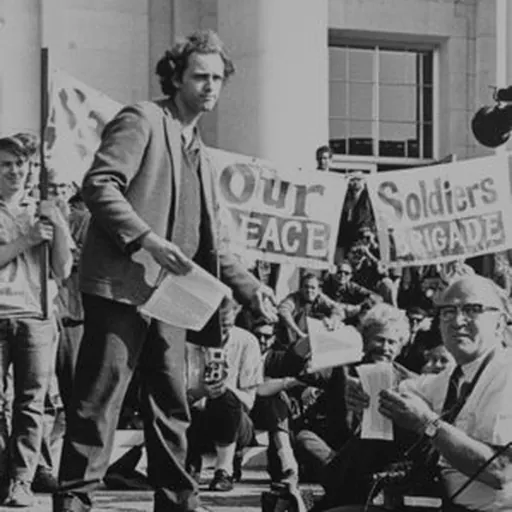
About Mario Savio
Lived 1942 – 1996 (aged 53). Mario Savio was an American university teacher and activist.
Mario Savio (December 8, 1942 – November 6, 1996) was an American activist and a key member of the Berkeley Free Speech Movement. He is most famous for his passionate speeches, especially the "Bodies Upon the Gears" address given at Sproul Hall, University of California, Berkeley on December 2, 1964.
Savio remains historically relevant as an icon of the earliest phase of the 1960s counterculture movement.
Early life Savio was born in New York City to an Italian father originally from Caltanissetta and an Italian mother originally from Veneto.
He graduated from Martin Van Buren High School in Queens at the top of his class in 1960. He went to Manhattan College on a full scholarship, and to Queens College. When he finished in 1963, he spent the summer working with a Catholic relief organization in Taxco, Mexico helping to improve the sanitary problems by building facilities in the slums.
His parents had moved to Los Angeles and in late 1963, he enrolled at the University of California, Berkeley. In March 1964, he was arrested while demonstrating against the San Francisco Hotel Association for excluding black people from non-menial jobs. He was charged with trespassing, along with 167 other protesters. While in jail, a cellmate asked if he was heading for Mississippi that summer to help with the Civil Rights project. He also taught at a freedom school for black children in McComb, Mississippi. Eventually one of the attackers was found, charged with misdemeanor assault and fined $50. When Savio returned to Berkeley after his time in Mississippi, he intended to raise money for the Student Nonviolent Coordinating Committee, but found that the university had banned all political activity and fundraising.
Savio's part in the protest on the Berkeley campus started on October 1, 1964, when former graduate student Jack Weinberg was staffing a table for the Congress of Racial Equality (CORE). The university police arrested Weinberg when he refused to provide identification, and just as they put him into a police car someone from the surrounding crowd yelled, “We can all see better if we sit down.” Soon those in front of and behind the police car starting sitting as the call "sit down" echoed through the crowd, trapping the car in the plaza. Savio, along with others during the 32-hour sit-in, climbed on top of the police car (after taking off his shoes, to avoid scratching the paint on the car ), and spoke with words that roused the crowd into a frenzy. Savio became the prominent leader of the newly formed Free Speech Movement. Negotiations failed to change the situation; therefore direct action began in Sproul Hall on December 2. There, Savio gave his most famous speech, "Bodies Upon the Gears," in front of 4,000 people. He and 800 others were arrested that day. In 1967, he was sentenced to 120 days at Santa Rita Jail. He told reporters that he "would do it again."
"Bodies Upon the Gears" speech Also known as "Operation of the Machine", this speech is possibly Savio's best-known work. He spoke on the steps of Sproul Hall, on December 2, 1964:
FBI surveillance In 1999, the media revealed that Savio had been tailed by the FBI from the moment he climbed onto the police car in which Jack Weinberg was detained. He was followed for more than a decade because he had emerged as the nation's most prominent student leader. To avoid harassing phone calls, Savio was in the habit of listing himself in the telephone book under aliases such as José Martí, Wallace Stevens, and David Bohm, and the FBI recorded that as well. There was no evidence to suggest that Savio was a national security risk, or that he had a connection with the Communist Party USA, but the FBI decided he merited their attention because they thought he could inspire students to rebel.
The FBI's Savio investigation finally ended at the beginning of 1975, when an investigation into the FBI's abuse of power began. Savio's ex-wife, Suzanne Goldberg, said that the "FBI's investigation of her and Savio [was] a waste of money and an invasion of privacy". He returned to study at San Francisco State University soon thereafter. In 1984, he received a summa cum laude bachelor's degree in physics and earned a master's degree in 1989. Savio was a good student and had a theorem named after him by a professor. In 1990, Savio and Hollander moved with their ten-year-old son to Sonoma County, California, where Savio taught mathematics, philosophy, and logic at Sonoma State University. Although Savio generally kept a low profile on campus, he joined students to protest a rise in student fees.
Savio had a history of heart problems and the day following a bitter and extended public debate with Sonoma State University's then-president, Ruben Armiñana, Savio had a heart attack.
Legacy A Memorial Lecture Fund was set up to honor Mario Savio upon his death. The Mario Savio Memorial Lecture Fund hosts an annual lecture on the University of California, Berkeley campus. Past lecturers include Howard Zinn, Winona LaDuke, Lani Guinier, Barbara Ehrenreich, Arlie Russell Hochschild, Cornel West, Christopher Hitchens, Adam Hochschild, Amy Goodman, Molly Ivins, Jeff Chang, Tom Hayden, Angela Davis, Seymour Hersh, Robert F. Kennedy, Jr., Naomi Klein, Elizabeth Warren, Robert Reich, and Van Jones.
The Memorial Fund also set up the Mario Savio Young Activist Award to honor an outstanding young activist with a deep commitment to human rights and social justice and the qualities of leadership ability, creativity, and integrity.
In 1997, the steps of Sproul Plaza, from which he had given his most famous speech, were officially renamed the "Mario Savio Steps". The Free Speech Movement Cafe on the Berkeley campus honors him.
On October 9, 2010, the American rock band Linkin Park released the song "Wretches and Kings," as a promotional single off their fourth studio album A Thousand Suns. The song features two excerpts at the beginning and end from Savio's "bodies upon the gears" speech.
On March 12, 2011, at the end of an announcement by hacktivist group Anonymous of an attack, called the Empire State Rebellion, on the Federal Reserve, the International Monetary Fund, the Bank of International Settlements and the World Bank, an excerpt of Savio's speech was included. Since the onset of the Occupy movement in the United States in late 2011, Savio's speech and his activism have been cited many times.
On October 16, 2012, the Sebastopol City Council rededicated the Downtown Plaza as the "Mario Savio Free Speech Plaza". On November 15, 2012, the "Mario Savio Speakers' Corner" was dedicated on the campus of Sonoma State University. At the ceremony, Lynne Hollander Savio told the audience, "I hope you will use this free speech corner often, to advocate and organize with dignity and responsibility for the causes you believe in."
Footage of Mario Savio is prominently featured in the 1990 documentary film Berkeley in the Sixties.
Don’t just read it —
keep it.
Full-length biographies made to live with: read them, listen on the way to work, watch them tonight.
- E-book
- Audio
- Video
Instant download · yours to keep · every purchase keeps this site free
Important facts
People in Mario Savio's life
Named in this biography and alive at the same time






Related people
Same field, nearest in time

Contemporaries
People whose lives overlapped Mario Savio's


Frequently asked questions
Who was Mario Savio?
American activist (1942–1996)
When was Mario Savio born?
Mario Savio was born on 8 December 1942 in New York City.
When did Mario Savio die?
Mario Savio died on 6 November 1996 in Sebastopol.
What was Mario Savio's occupation?
Mario Savio was a university teacher and activist.
What nationality was Mario Savio?
Mario Savio was American.
Sources & further reading
Cite this page
APA: Biography.guide. (2026). Mario Savio. https://biography.guide/mario-savio/
MLA: "Mario Savio." Biography.guide, https://biography.guide/mario-savio/.
Chicago: "Mario Savio." Biography.guide. https://biography.guide/mario-savio/.
Data last updated: 2026-09-23 · Spot an error? Report a correction.
Portrait: Wikimedia Commons · author & licence
Page generated 2026-09-27 05:06 UTC