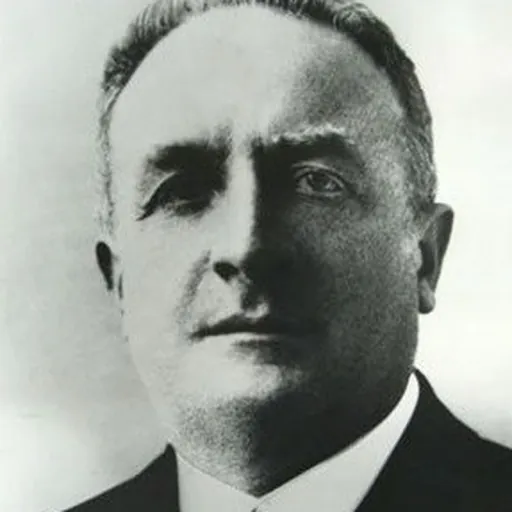
About Mario Falangola
Lived 1880 – 1967 (aged 86). Mario Falangola was an Italian military personnel.
Mario Falangola (9 August 1880 – 14 July 1967) was an Italian admiral during World War II.
Early life and career
Mario Falangola was born in Rome in 1880 and was admitted to the Italian Naval Academy in Livorno in 1899, graduating as ensign in 1902. In 1911-1912, with the rank of Lieutenant, he participated in the Italo-Turkish War aboard the armored cruiser Giuseppe Garibaldi. He was later given command of the submarine Lorenzo Marcello; in total, for his actions in command of submarines during World War I, Falangola received three Silver Medals of Military Valor and two Bronze Medals of Military Valor, as well as two promotions for war merit. The positive results of the test led him to order the building of a further two SLCs. In 1937 it became Admiral, and in 1939 he was briefly given command of the Corps of Port Captaincies. On 9 December 1941, immediately after writing a long report which highlighted deficiencies of the Italian submarine branch (in terms of training, technical characteristics of submarines, operational doctrine, cooperation with the Air Force), Falangola was removed from office and appointed commander of the Corps of Port Captaincies, and was replaced in command of the submarine fleet by Admiral Antonio Legnani.
A fervent Fascist, after the 8 September 1943 armistice Falangola immediately spoke out in favor of cooperation with the German forces, and during meetings at the Ministry of the Navy he tried – without much success – to convince other officers to do the same. He left this office on 25 December 1943, again assuming the general command the Port Captaincies that had remained in the territory of Italian Social Republic; he held this role until April 1945.
Having joined the German troops in their retreat towards Brenner Pass, at the beginning of May 1945 Falangola gave himself up in Bolzano to the Northern Italy National Liberation Committee, which in turn handed him over to the local U.S. command, that interned him in a POW camp in Coltano, Pisa, where he remained for a short time. After his release, he was deprived of his rank by the Italian authorities for having adhered to the Italian Social Republic, and he was sentenced to four years in jail (later condoned) by a military court in Rome. The sentence, however, was repealed once by the Supreme Military Court "for not having committed the crime", and then a second time for an amnesty. He was discharged from the Navy in June 1945.
In 1955, his service record was reviewed and the cancellation from the rolls with loss of rank was revoked. He died in Rome on 14 July 1967.
Don’t just read it —
keep it.
Full-length biographies made to live with: read them, listen on the way to work, watch them tonight.
- E-book
- Audio
- Video
Instant download · yours to keep · every purchase keeps this site free
Important facts
People in Mario Falangola's life
Named in this biography and alive at the same time
Related people
Same field, nearest in time





Contemporaries
People whose lives overlapped Mario Falangola's




Frequently asked questions
Who was Mario Falangola?
Italian admiral (1880–1967)
When was Mario Falangola born?
Mario Falangola was born on 9 August 1880 in Rome.
When did Mario Falangola die?
Mario Falangola died on 14 July 1967 in Rome.
What was Mario Falangola's occupation?
Mario Falangola was a military personnel.
What nationality was Mario Falangola?
Mario Falangola was Italian.
Sources & further reading
Cite this page
APA: Biography.guide. (2026). Mario Falangola. https://biography.guide/mario-falangola/
MLA: "Mario Falangola." Biography.guide, https://biography.guide/mario-falangola/.
Chicago: "Mario Falangola." Biography.guide. https://biography.guide/mario-falangola/.
Data last updated: 2026-09-20 · Spot an error? Report a correction.
Portrait: Wikimedia Commons · author & licence
Page generated 2026-09-27 04:58 UTC