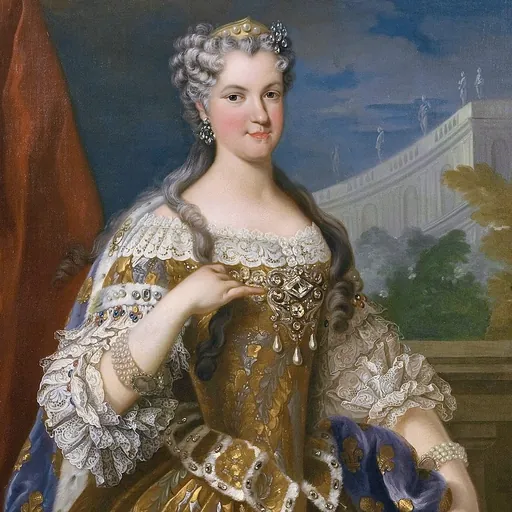
About Marie Leszczyńska
Lived 1703 – 1768 (aged 65). Marie Leszczyńska was a French and Polish writer.
Marie Leczinska (born Maria Karolina Zofia Felicja Leszczyńska; 23 June 1703 – 24 June 1768) was Queen of France as the wife of King Louis XV from their marriage on 4 September 1725 until her death in 1768. The daughter of Stanislaus I Leszczyński, the deposed King of Poland, and Catherine Opalińska, her 42-years and 9 months service was the longest of any queen in French history. A devout Catholic throughout her life, Marie was popular among the French people for her numerous charitable works and introduced many Polish customs to the royal court at Versailles. She was the grandmother of the French kings Louis XVI, Louis XVIII and Charles X.
Early life Born as a member of the House of Leszczyński, Maria Karolina Zofia Felicja Leszczyńska (Wieniawa) was the second daughter of Stanislaus I Leszczyński and his wife, Countess Catherine Opalińska. She had an elder sister, Anna Leszczyńska, who died of pneumonia in 1717.
Maria's early life was troubled by her father's political misfortune. Ironically, the hopeless political career of King Stanislaus was eventually the reason why his daughter Maria was chosen as the bride of King Louis XV of France. Devoid of political connections, his daughter was viewed by the French as being free from the burden of international alliances.
She was born in Trzebnica in Lower Silesia, the year before her father was made King of Poland by Charles XII of Sweden, who had invaded the country in 1704. In 1709, her father was deposed when the Swedish army lost the military upper hand in Poland, and the family was granted refuge by Charles XII in the Swedish city of Kristianstad in Scania. During the escape, Maria was separated from the rest of her family; she was later found with her nurse hiding in a crib in a stable, although another version claims it was actually a cave in an old mineshaft.
In 1718, with the support of the Duke of Lorraine, the family was allowed to settle in Wissembourg in the province of Alsace, which had been annexed by France, a place suggested by Philippe II, Duke of Orléans, a nephew of Louis XIV and Regent of the Kingdom of France during Louis XV's minority. The family lived a modest life in a large town house at the expense of the French Regent.
Their lifestyle in Wissembourg was regarded as very below standard for a royal at that time; they lived in a small house, and could not pay the salary of their small retinue from which a few "served as an apology for a guard of honour", and the jewels of the former Queen Catherine were reportedly held as security by a moneylender.
While her mother Catherine and grandmother Anna Leszczyńska reportedly suffered from a certain degree of bitterness over their exile and loss of position which worsened their relationship with Stanislaus, whom they occasionally blamed for their exile, Maria was close to her father and spent a lot of time conversing with him, though she was evidently of a different nature as she "possessed the gift of suffering in silence and of never wearying others with her troubles" and was said to have developed "a profound and intense piety", which gave "to her youthful mind the maturity of a woman who no longer demands happiness".
When the list of 17 was further reduced to four, the preferred choices still presented numerous problems. Anne and Amelia of Great Britain, who were considered with the understanding that they would convert to the Catholic faith upon marriage, were favored by the Duke of Bourbon and Madame de Prie because they were supported by their political financiers, the firm of Paris Brothers. Cardinal Fleury easily prevented the British match because of religious reasons. The other two women on the list were the sisters of the Duke of Bourbon, Henriette-Louise and Élisabeth-Alexandrine, whom the King refused to marry because of the disapproval of Cardinal Fleury.
Queen Marie eventually did manage to win the respect of the court nobility by her strict adherence to court etiquette, which made her opinion at least formally important. In 1747, Voltaire was banished from the royal court through her influence. The reason were two incidents, both of which insulted the queen: During one long night of gambling, Voltaire's lover, Emilie du Chatelet, lost a fortune at the Queen's gambling table, during which Voltaire whispered to her in English that she had been cheated. This was regarded as an insult to the Queen, because it denounced her guests as cheats; Voltaire could have been arrested for his ill-timed remark. Shortly afterward, Voltaire wrote a poem in honor of his patron, the royal mistress Madame de Pompadour, in which he alluded to the sexual relationship between Pompadour and the King. This insulted Marie and led to the banishment of Voltaire from court.
When her first daughter-in-law died in 1746, the Queen, very fond and loving of her only son, opposed the selection of his next spouse, the Duchess Marie-Josèphe of Saxony, because she was the daughter of her father's rival, King Augustus III of Poland. Her dislike of the match was known but ignored, as she had no dynastic connections. She also excelled in embroidery and needlework, and gave her work pieces to poor churches.
Marie was a great lover of music, and was skilled at the hurdy gurdy, harpsichord, and guitar. In 1737, the Queen invited the castrato Farinelli to Versailles, whom she received singing lessons from. Marie also met a young Mozart, who made an appearance at Versailles in 1764, whom she found very charming. During his visit to the palace, Marie acted as an interpreter for the King and his family, who did not understand German. Contemporaries of the Queen noted that Marie was fluent in seven languages such as Italian, German, French, Latin, Swedish, and English aside from her native Polish and was very useful when receiving foreign ambassadors. A major contribution to cultural enrichment at Versailles was the weekly Polish choral concerts.
The Queen was also noted for having an influence on the interior design of Versailles. The Duke de Luynes credits Marie for having originally introduced Sèvres porcelain flowers to courtiers by displaying them in her apartments. She is also known for popularising the bed à la Polonaise at Versailles. In the culinary realm, Marie made eating lentils popular in France and was also noted for inventing along with her chefs the now famous French meat pastry called "bouchée à la reine" in 1735.
Death and burial Marie Leszczyńska died on 24 June 1768, one day after her birthday, at the age of 65. She had enjoyed great popularity among the public in her early and later years. She was buried at the Basilica of St Denis, and her heart was entombed at the Church of Notre-Dame-de-Bonsecours in Nancy.
Children
Name Portrait Lifespan Notes Marie Louise ÉlisabethDuchess of Parma 100px14 August 1727 – 6 December 1759Married Philip, Duke of Parma. Had issue. Died at age 32. Anne Henriette Madame 100px14 August 1727 – 10 February 1752 Died at age 24 without marrying; no issue. Marie Louise 100px 28 July 1728 – 19 February 1733 Died in childhood; no issue. Louis Ferdinand, Dauphin of France 100px 4 September 1729 – 20 December 1765 Married María Teresa Rafaela of Spain; had issue. Upon the death of María Teresa, however, he married Maria Josepha of Saxony; had issue including future Louis XVI, Louis XVIII and Charles X Philippe Louis, Duke of Anjou 100px 30 August 1730 – 7 April 1733 Died in childhood; no issue. Marie Adélaïde Duchess of Louvois 100px 23 March 1732 – 27 February 1800 Died at age 67 without marrying; no issue. Marie Louise Thérèse Victoire 100px 11 May 1733 – 7 June 1799 Died at age 66 without marrying; no issue. Sophie Philippine Élisabeth Justine Fille de France Duchess of Louvois 100px 27 July 1734 – 2 March 1782 Died at age 47 without marrying; no issue. Marie Thérèse Félicité 100px 16 May 1736 – 28 September 1744 Died in childhood; no issue. Louise-MarieSister Thérèse of Saint Augustine, formerly princess Louise Marie of France 100px 15 July 1737 – 23 December 1787 Died at age 50 without marrying; no issue.
Ancestry
Don’t just read it —
keep it.
Full-length biographies made to live with: read them, listen on the way to work, watch them tonight.
- E-book
- Audio
- Video
Instant download · yours to keep · every purchase keeps this site free
Important facts
Family & relationships
People in Marie Leszczyńska's life
Named in this biography and alive at the same time

Related people
Same field, nearest in time


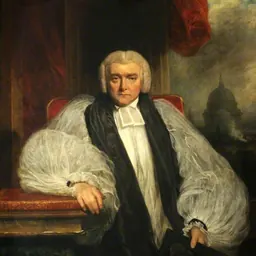


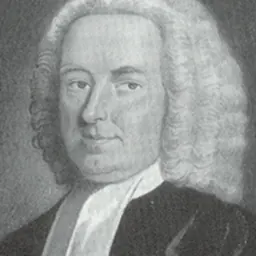
Contemporaries
People whose lives overlapped Marie Leszczyńska's



Frequently asked questions
Who was Marie Leszczyńska?
Queen Consort of France (1703–1768)
When was Marie Leszczyńska born?
Marie Leszczyńska was born on 23 June 1703 in Poznań.
When did Marie Leszczyńska die?
Marie Leszczyńska died on 24 June 1768 in Palace of Versailles, Versailles.
What was Marie Leszczyńska's occupation?
Marie Leszczyńska was a writer.
What nationality was Marie Leszczyńska?
Marie Leszczyńska was French and Polish.
Sources & further reading
· Wikipedia: Marie Leszczyńska
Cite this page
APA: Biography.guide. (2026). Marie Leszczyńska. https://biography.guide/marie-leszczynska/
MLA: "Marie Leszczyńska." Biography.guide, https://biography.guide/marie-leszczynska/.
Chicago: "Marie Leszczyńska." Biography.guide. https://biography.guide/marie-leszczynska/.
Data last updated: 2026-09-22 · Spot an error? Report a correction.
Portrait: Wikimedia Commons · author & licence
Page generated 2026-09-27 05:03 UTC