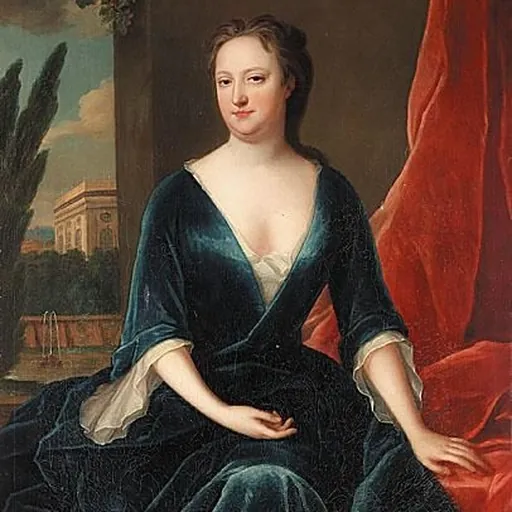
About Maria Verelst
Lived 1680 – 1744 (aged 63–64). Maria Verelst was a British painter.
Maria Verelst (1680-1744) was supposedly an English artist born in Vienna and died in London after a career of portrait painting. This biography has been questioned with archival evidence supporting the view that “Maria Verelst” was Adriana Verelst (daughter of Herman Verelst), a fashionable portrait painter of the 1720s.
Biography There is no archival evidence for a "Maria Verelst", neither is there any contemporary documentary evidence for the life of a person named “Maria Verelst”.
The Christian name "Maria" first appeared in Matthew Bryan’s Dictionary of 1816. The earliest reference to an artistic daughter of Herman Verelst was made by Jacob Campo Weyerman in 1729. He refers to her as "Juffrow Verelst" ("Miss Verelst") and "N. Verelst"; he used "N." as an abbreviation where he did not know the name of an artist whether female or male. Authors writing between 1729 and 1816 refer to her as "Demoiselle Verelst", "N. Verelst", "Mlle Vérelst", "Madamoiselle Verelst" or Mademoiselle N. Verelst” No archival evidence for a birth or baptism in Antwerp has been found. Horace Walpole, writing in 1762, was the first to make the association with Herman Verelst as the father of this artist, previous biographers stating only that she was taught by her uncle. Later authors, knowing from Walpole and later biographies that Herman Verelst had fled from the siege of Vienna in 1683, reasoned that with a date of birth of 1680, Maria Verelst must have been born in Vienna.
Weyerman (1729) stated that he did not know if this artist were still living but hoped she was ("Wy hebben van haar dood niets gehoort, en verhoopen dat zy noch woont onder levenden"). The first reference to 1744 as the date of death seems to occur as late as 1859 in Mrs. Ellet’s Women artists in all ages and countries. Later biographies do not give a source for this date.
Weyerman gave an account of a visit to a Drury Lane theatre with her aunt. Maria overheard some German nobles commenting on her beauty and upbraided them for discussing her in her hearing. The men excused themselves and later continued, speaking in Italian. She again admonished them. Later they continued in Latin. Maria complained that women’s opportunities were limited and that she shouldn’t be barred from using her linguistic abilities. The nobles were so impressed they inquired of her occupation and, on finding that she was a painter, visited her the following day bearing gifts and to have their portraits made. Weyerman also recorded her exceptional ability in playing several musical instruments. John Hayes described Maria Verelst’s earliest works as being in the Kneller baroque tradition. By the 1720s, she was working in the manner of William Aikman and Charles Jervas. In the 1730s her style was closer to that of Thomas Hudson. Hayes wrote "her designs and poses are conventional; her modeling is firm, but her handling of drapery is somewhat primitive."
It has been suggested that Maria also worked with Sir James Thornhill at Northaw Place between 1728–32. Murals have been preserved in England that have been attributed as a joint effort between the two painters.
Attributed artistic works Anne Blackett, Mrs John Trenchard afterwards Mrs Thomas Gordon, (Wikimedia) Duke of Chandos in the dressing room Marriage portrait of Penelope Smith holding a lamb, (Wikimedia) Nature morte aux huitres et aux crabs ‘’’Grisell Baillie, later Lady Murray’’’, 1725, Mellerstain House. (Wikimedia) Portrait of Duchess of Marlboro with Lady Diana Spencer, (Wikimedia) Portrait of Duke of Marlborough Portrait of Henrietta, Lady Luxborough, Lydiard Park, Swindon (Wikimedia) Portrait of a lady, half-length, in a silver white gown Portrait of a lady in a yellow dress seated, with a wooded landscape beyond Portrait of a Lady with a Country Estate in the Distance Portrait of a woman, Lady Middleton Portrait of Elizabeth Johnson, wife of Samuel Johnson, (Wikimedia) Portrait of Jane Stebbing, wife of Thomas Aynscombe, 1706 (possibly painted by John Verelst) (Wikimedia) Portrait of Lady Smythe, three-quarter-length
Don’t just read it —
keep it.
Full-length biographies made to live with: read them, listen on the way to work, watch them tonight.
- E-book
- Audio
- Video
Instant download · yours to keep · every purchase keeps this site free
Important facts
People in Maria Verelst's life
Named in this biography and alive at the same time




Related people
Same field, nearest in time




Contemporaries
People whose lives overlapped Maria Verelst's




Frequently asked questions
Who was Maria Verelst?
18th-century English painter (1680-1744)
When was Maria Verelst born?
Maria Verelst was born in 1680 in Vienna.
When did Maria Verelst die?
Maria Verelst died in 1744 in London.
What was Maria Verelst's occupation?
Maria Verelst was a painter.
What nationality was Maria Verelst?
Maria Verelst was British.
Sources & further reading
Cite this page
APA: Biography.guide. (2026). Maria Verelst. https://biography.guide/maria-verelst/
MLA: "Maria Verelst." Biography.guide, https://biography.guide/maria-verelst/.
Chicago: "Maria Verelst." Biography.guide. https://biography.guide/maria-verelst/.
Data last updated: 2026-09-20 · Spot an error? Report a correction.
Portrait: Wikimedia Commons · author & licence
Page generated 2026-09-27 04:57 UTC