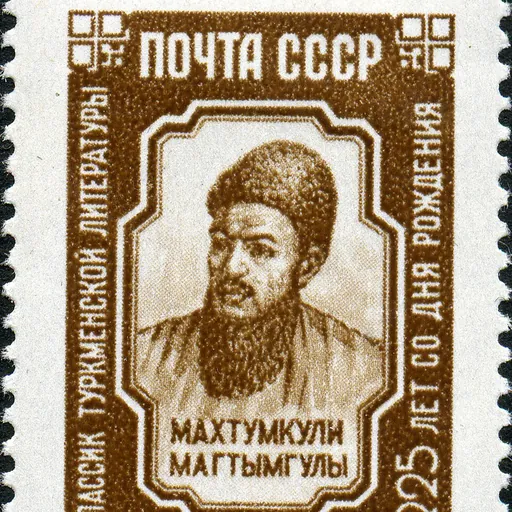
About Magtymguly Pyragy
Lived 1733 – 1782 (aged 48–49). Magtymguly Pyragy was a poet, spiritual teacher, writer and sufi.
Magtymguly Pyragy ( Makhdumqoli Farāghi; , ; , born Magtymguly, was an Iranian-Turkmen spiritual leader, philosophical poet, Sufi and traveller, who is considered one of the most famous figures in Turkmen literary history.
Magtymguly is credited with the creation of Turkmen written literature, and his literary form became a symbol of the historical and the incipient national consciousness of the Turkmen people. He is part of a unique period in the cultural history of Central Asia, with his personal poetic synthesis being influential to following generations of poets of the region. The poems of the Turkmen poet have been translated into many languages including English, Russian, Romanian.
In a wider context, Magtymguly is often placed alongside major figures of the Turkic literary world such as Hoja Ahmad Yasawi, Yunus Emre, Ali-Shir Nava'i and Fizuli.
Biography Early life and education Magtymguly was born in Haji Qushan, a village near the city of Gonbad-e Qabus in the modern-day province of Golestan, Iran, the northern steppes of which are known as Turkmen Sahra (Turkmen steppes). It was part of the extensive Safavid Empire in the first half of the 18th century.
Magtymguly's name, signifying "slave of Magtym," derives from one of the revered lineages within the Turkmen community. In addition to his given name, the poet adopted a distinctive pen name or makhlas, "Feraghi," in his literary works. It comes from Arabic and means "the one separated from" happiness, or union with his beloved.
Magtymguly's father was , himself an educated poet. His father was also a local teacher and mullah, and was highly regarded by his people.
Magtymguly received his early education in the Turkmen, Persian and Arabic languages from his father. He also learned ancestral trades such as felt-making and, according to some sources, jewellery.
.
I'd like to feel the wind of dawn, On the hills of Dehestan, I'd like to see Zengi Baba, Bahauddin, Mirkulal.
Political ideals Magtymguly lived at a time when Turkmen tribes were displaced from their homeland, and plundered as a result of constant clashes with Iran and Khiva. He deeply resented it and expressed his feelings of repentance in his poems. Indeed, Magtymguly express strong social protest in his poems, but his political thought is mostly directed towards the unification of the Turkmen tribes and the establishment of an independent polity for Turkmens.
Poetry
Magtymguly was one of the first Turkmen poets to introduce the use of classical Chagatai, the court language of the Khans of Central Asia, as a literary language, incorporating many Turkmen linguistic features. His poetry exemplifies a trend towards increased use of Turkic languages rather than Persian; he is revered as the founder of Turkmen poetry, literature and language. Magtymguly's poetry also gave start to an era litterateurs depict as the "Golden age" in Turkmen literature. His literary form became a powerful symbol of the historical and the incipient national consciousness of the Turkmen people.
Unlike his father and another prominent Turkmen poet of the era, Andalib, Magtymguly employed strophic form, usually quatrains (qoshuk) for his poems making them syllabic. Vast majority of his poems are in the form of folk Turkmen songs, qoshuk and aydish, with the latter being a form of musical contest usually involving two poets.
Legacy Magtymguly wrote during a period of cultural change in Central Asia, and his work influenced subsequent generations of poets in the region.
Magtymguly is often placed alongside major figures of the Turkic literary world such as Hoja Ahmad Yasawi, Yunus Emre, Ali-Shir Nava'i and Fizuli.
27 June is celebrated in Turkmenistan as "the Day of Workers of Culture and Arts and the poetry of Magtymguly Fragi".
The International Organization of Turkic Culture declared 2024 the "Year of the Great Poet and Thinker of the Turkic World Magtymguly Pyragy", the anniversary of Magtymguly Pyragy is also included in the list of significant dates celebrated jointly with UNESCO in 2024-2025. In connection with the anniversary, a large-scale plan of festive events was approved in Turkmenistan and other countries, including Uzbekistan.
Monuments In May 2024, a monument dedicated to the 300th anniversary of the birth of Turkmen poet and philosopher Magtymguly Pyragy was unveiled in Ashgabat at the foot of the Kopetdag mountain range. The 60-meter sculpture of the poet stands on a 20-meter pedestal, to which a majestic staircase with massive granite bowls leads.
A monument to Magtymguly made of concrete and natural stone was erected in Magtymguly Square on Magtymguly Avenue in the center of Ashgabat in 1971. He is also one of several statues that surround the Independence Monument in Ashgabat. The statues depict people praised in the Ruhnama, a spiritual guide written by Turkmenistan president Saparmurat Niyazov.
Monuments to Magtymguly Pyragy are installed in cities across the former USSR. These include including monument in Astana, Kyiv, Astrakhan (Russia), bas-relief in Tashkent, and Khiva, as well as in Iran and Ankara (Turkey).
A bust of Magtymguly Pyragy was unveiled at Margarita Rudomino All-Russia State Library for Foreign Literature in Moscow, Russia in 2024.
Toponyms Magtymguly is a city in far south-western Turkmenistan in Balkan Province, the administrative center of Magtymguly District. Magtymguly is a zone in a gas and oil field in Turkmenistan.
Institutions and organizations
The following are named after Magtymguly: Turkmen State University Magtymguly National Institute of Language, Literature and Manuscripts Magtymguly Musical and Drama Theater in Ashgabat. Youth Organization of Turkmenistan A library in Kyiv, Ukraine Municipal state general education institution School named after Magtymguly Pyragy in the village of Funtovo-1 (Astrakhan Oblast of Russia). Secondary school named after Magtymguly Pyragy in the daikhan association "Ergesh Sultanov" of the Dusti district (Khatlon region of Tajikistan).
Cinema Makhtumkuli (1968, producer Alti Karliyev) — the role was played by Hommat Mulluk. Fragi – Razluchyonnyy so schastyem (1984, producer Khodzhakuli Narliev) — the role was played by Annaseid Annamuhammedov.
Postage
In 1959, the USSR issued a postage stamp to mark the 225th anniversary of the birth of Magtymguly. In 1983, the USSR issued another stamp to mark the 250th anniversary of his birth. Turkmenistan issued a 10 manat banknote bearing his likeness in 2009.
Other In 1974, an orchestral composition by Veli Mukhatov was created "In memory of Magtymguly". In 1992, the Magtymguly International Prize was established. In 2013, the composer Mamed Huseynov wrote an opera called "Monologues of Magtymguly Pyragy". From 2002 to 2008, the month of May in Turkmenistan bore the name "Magtymguly". In 2014, the Magtymguly Pyragy Medal was established as a reward for great achievements in the study, dissemination and promotion of the creative heritage of Magtymguly. A Turkmen dry cargo ship is named "Magtymguly".
Don’t just read it —
keep it.
Full-length biographies made to live with: read them, listen on the way to work, watch them tonight.
- E-book
- Audio
- Video
Instant download · yours to keep · every purchase keeps this site free
Important facts
Related people
Same field, nearest in time


Contemporaries
People whose lives overlapped Magtymguly Pyragy's






Frequently asked questions
Who was Magtymguly Pyragy?
Turkmen spiritual leader and philosophical poet
When was Magtymguly Pyragy born?
Magtymguly Pyragy was born in 1733 in Hajji Qushan.
When did Magtymguly Pyragy die?
Magtymguly Pyragy died in 1782 in Golestan Province.
What was Magtymguly Pyragy's occupation?
Magtymguly Pyragy was a poet, spiritual teacher, writer and sufi.
What nationality was Magtymguly Pyragy?
Magtymguly Pyragy's recorded nationality: Safavid Iran, Afsharid dynasty, Zand Iran.
Sources & further reading
· Wikipedia: Magtymguly Pyragy
Cite this page
APA: Biography.guide. (2026). Magtymguly Pyragy. https://biography.guide/magtymguly-pyragy/
MLA: "Magtymguly Pyragy." Biography.guide, https://biography.guide/magtymguly-pyragy/.
Chicago: "Magtymguly Pyragy." Biography.guide. https://biography.guide/magtymguly-pyragy/.
Data last updated: 2026-09-20 · Spot an error? Report a correction.
Page generated 2026-09-27 05:09 UTC