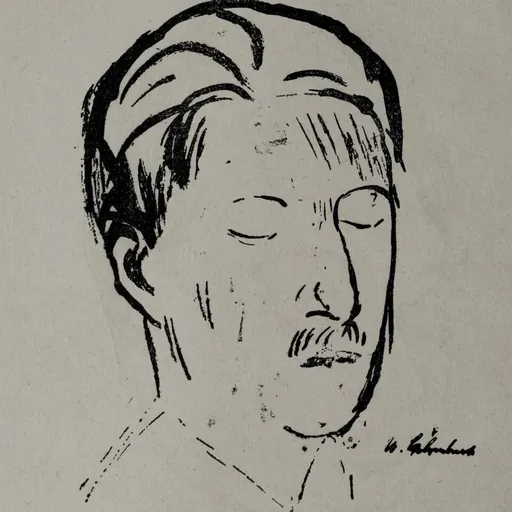
About Ludwig Rubiner
Lived 1881 – 1920 (aged 38). Ludwig Rubiner was a German translator, poet, literary critic, playwright and writer.
Ludwig Rubiner (12 June 1881 – 27 February 1920) was a German poet, literary critic and essayist, generally seen as a representative of the expressionist movement that originated in Germany at the beginning of the 20th century. His most important works include a manifesto entitled, "Der Dichter greift in die Politik" ("The poet engages in politics", 1912) and a stage-drama, "Die Gewaltlosen" ("Men of non-violence", 1919), which he dedicated to "dem Kameraden, meiner Frau Frida" (loosely, "My comrade wife Frida").
Sources may also identify him by his literary pseudonym as Ernst Ludwig Grombeck.
Biography Provenance and early years Ludwig Rubiner was born in Berlin. Wilhelm Rubiner, his father, was a journalist and popular novelist who had migrated from Galicia, which at that time was a crown land of Austria-Hungary. His mother's name is not known. Although his family provenance was Ashkenazi Jewish, Ludwig Rubiner attended a Protestant secondary school in Berlin. Several of the radical intellectuals whom Rubiner got to know during this period went on to become important expressionist writers. These included Erich Mühsam, Paul Scheerbart, René Schickele, Ferdinand Hardekopf, Wilhelm Herzog and Herwarth Walden. It was his friendship with Walden that made possible the launch of Rubiner's own literary career.
Paris In 1910, using the pseudonym Ernst Ludwig Grombeck, he published "Die indischen Opale" ("The Indian Opal"), described in sources as a "Criminal Novel" (or, more loosely, a work of police/detective fiction). He worked closely with Franz Pfemfert on Pfemfert's magazine, Die Aktion, between 1911 and 1918. In November 1912 he relocated to Paris where he lived with the critic-journalist Carl Einstein in a small hotel near Saint-Sulpice, along the Rue de Veaugirard. Fellow writer Max Cahén reported later that the two of them "described themselves as the 'Klub der Neupythagoräer' ("Neopythagoreanist Club"). Invoking Neopythagoreanism in this way highlights Einstein's and Rubiner's attachment at the time to mystical Kabbalah.
Marc Chagall wrote his autobiography "My Life" in 1921/22, shortly before he left Moscow. His wife's translation of it for French readers appeared as "Ma vie" in 1931:
"All my pre-war pictures stayed behind in Berlin or Paris where, including plenty of sketches and unfinished works, my studio awaits my return. From Germany my good friend, the poet Rubiner has written to me: 'Are you still alive? They say that you fell in the war. Do you know that you have become a celebrity here? Your paintings have invented expressionism. They are traded for very high prices. All the same, do not count on Walden to pay you the money he owes you. He will pay you nothing, because he asserts that your fame is quite enough for you.'" "Toutes mes toiles d'avant-guerre sont restées à Berlin et à Paris où mon atelier, plein d'esquisses, de tableaux inachevés, m'attend. D'Allemagne, le poète Rubiner, mon bon ami, m'a écrit: "Es-tu vivant? On prétend que tu as été tué à la guerre. "Sais-tu que tu es célèbre ici? Tes tableaux ont créé l'espressionisme. Ils se vendent fort cher. Toutefois, ne compte pas sur l'argent que te doit Walden. Il ne te paiera pas, car il soutient que la gloire te suffit." There he wrote for the Neue Zürcher Zeitung and also, during 1917/18, published "Zeit-Echo", a pacifist news magazine produced primarily for Switzerland's international community of exiles.
Zürich For their voluntary Swiss exile the Rubiners settled at Hadlaubstraße 11, near the centre of Zürich. Rubiner now became a central figure in a group of exiled French and Russian pacifist intellectuals such as Romain Rolland, Henri Guilbeaux and Anatoly Lunacharsky. Ferruccio Busoni, one of the Rubiner's closest friends during their Swiss exile, wrote a letter to his agent, Albert Biolley, in which he confided that he had himself been "left behind in Zurich" and that his friend Rubiner had left suddenly, without being able to explain why. On 24 December 1918, thanks to his family's Galician provenance, Ludwig Rubiner was issued with an Austrian passport by Austrian consular authorities who appear still to have been present in Zürich. On 30 January 1919 he left Switzerland and headed for Berlin, travelling via Munich. His wife's involvement in the revolutionary events the took place in Munich during the first half of 1919 vindicate official suspicions at the time that Frida Rubiner, for one, was among those actively working for a soviet style revolution in Germany. Rubiner took a job as an editor with the Kiepenhauer publishing house in Potsdam. The league was consciously modelled on the Russian Proletkult movement inspired by Alexander Bogdanov. At least one source states that by this time Rubiner had probably joined the recently launched Communist Party of Germany (KPD). The league also founded a short-lived proletarian theatre, intended to provide proletarian culture for the public. Performances were to take place in factories and other industrial locations. A performance of "Freedom" by Herbert Kranz took place on 14 December 1919. However, the league broke up as a result of "differences of opinion" during 1920 before it had been possible to stage Rubiner's own drama "Die Gewaltlosen" ("Men of non-violence").
Ludwig Rubiner spent the final months of his life working on translating the novels and stories of Voltaire into German. One year earlier he had published in "Die Weißen Blätter" a substantial article on "Voltaire the poet" ("Der Dichter Voltaire") and this was now recycled as a foreword for the first volume of translated works which he published shortly before his death.
Death Ludwig Rubiner died after six weeks in a Berlin clinic overnight on 27/28 February 1920 as the result of pneumonia. A few days before he had been presented with an award by "Das junge Deutschland Gesellschaft" ("The Young Germany Society") in celebration of his literary activities.
At his funeral, which took place on 3 March 1920, funeral orations were delivered by Franz Pfemfert and Felix Holländer.
Don’t just read it —
keep it.
Full-length biographies made to live with: read them, listen on the way to work, watch them tonight.
- E-book
- Audio
- Video
Instant download · yours to keep · every purchase keeps this site free
Important facts
Family & relationships
People in Ludwig Rubiner's life
Named in this biography and alive at the same time




Related people
Same field, nearest in time


Contemporaries
People whose lives overlapped Ludwig Rubiner's




Frequently asked questions
Who was Ludwig Rubiner?
German translator and writer (1881–1920)
When was Ludwig Rubiner born?
Ludwig Rubiner was born on 12 July 1881 in Berlin.
When did Ludwig Rubiner die?
Ludwig Rubiner died on 28 February 1920 in Berlin.
What was Ludwig Rubiner's occupation?
Ludwig Rubiner was a translator, poet, literary critic, playwright and writer.
What nationality was Ludwig Rubiner?
Ludwig Rubiner was German.
Sources & further reading
Cite this page
APA: Biography.guide. (2026). Ludwig Rubiner. https://biography.guide/ludwig-rubiner/
MLA: "Ludwig Rubiner." Biography.guide, https://biography.guide/ludwig-rubiner/.
Chicago: "Ludwig Rubiner." Biography.guide. https://biography.guide/ludwig-rubiner/.
Data last updated: 2026-09-22 · Spot an error? Report a correction.
Portrait: Wikimedia Commons · author & licence
Page generated 2026-09-27 05:02 UTC