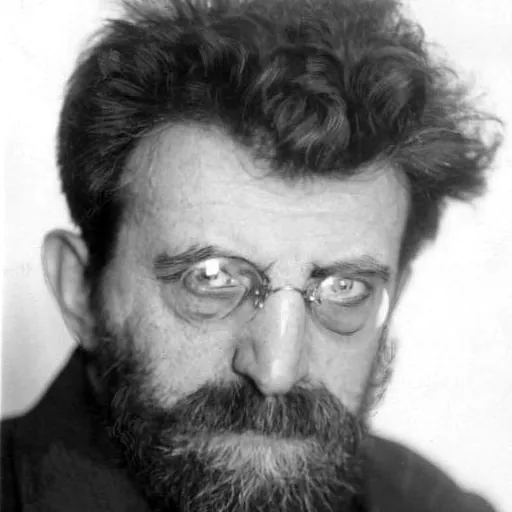
About Erich Mühsam
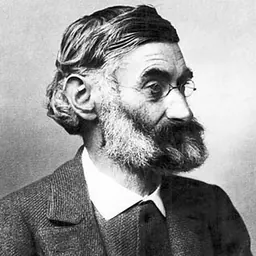
Lived 1878 – 1934 (aged 56). Erich Mühsam was a German writer, poet, journalist, politician, editing staff and editor.
Erich Mühsam (6 April 1878 – 10 July 1934) was a German antimilitarist anarchist essayist, poet and playwright. He emerged at the end of World War I as one of the leading agitators for a federated Bavarian Soviet Republic, for which he served five years in prison.
Also a cabaret performer, he achieved international prominence during the years of the Weimar Republic for works which, before Adolf Hitler came to power in 1933, condemned Nazism and satirized the future dictator. Mühsam was tortured and murdered in the Oranienburg concentration camp in 1934.
Biography
Early life: 1878–1900 The third child born to Siegfried Seligmann Mühsam, a middle-class Jewish pharmacist, and his wife Rosalie (née Cohn), Erich Mühsam was born in Berlin on 6 April 1878. He had two siblings Hans and Charlotte. Soon after, the family moved to the city of Lübeck.
Mühsam was educated at the Katharineum-Gymnasium in Lübeck, a school known for its authoritarian discipline and corporal punishment, which served as the model for several of the settings in Thomas Mann's novel Buddenbrooks (1901). The young student Erich, who was by nature rebellious and resisted the school's regimented programme, was often physically punished. It was in the spirit of this resistance that, in January 1896, Mühsam authored an anonymous submission to the Lübecker Volksboten, denouncing one of the school's more unpleasant teachers, which caused a scandal. When his identity became known, Mühsam was expelled from the Katharineum-Gymnasium for sympathising and participating in socialist activities. He completed his education in Parchim.
From an early age, Mühsam displayed a talent for writing and desired to become a poet – a career aspiration his father sought to beat out of him. His juvenilia consisted of animal fables, and he was first published at the age of 16, earning small amounts of money for satirical poems based on local news and political happenings. However, at the insistence of his father, young Erich set out to study pharmacy, a profession which he quickly abandoned to return to his poetic and literary ambitions. Mühsam left Lübeck for Berlin to pursue a literary career, later writing of his youth that " hatred grows when I look back on it and visualise the unspeakable flailings which were supposed to beat out of me all my innate feelings."
Poet, writer and anarchist: 1900–1918
Mühsam moved to Berlin in 1900, where he soon became involved in a group called Neue Gemeinschaft (New Society) under the direction of Julius and Heinrich Hart which combined socialist philosophy with theology and communal living in the hopes of becoming "a forerunner of a socially united great working commune of humanity." Within this group, Mühsam became acquainted with Gustav Landauer who encouraged his artistic growth and compelled the young Mühsam to develop his own activism based on a combination of communist and anarchist political philosophy that Landauer introduced to him. Desiring more political involvement, in 1904, Mühsam withdrew from Neue Gemeinschaft and relocated temporarily to an artists commune in Ascona, Switzerland where vegetarianism was mixed with communism and socialism. It was here that he began writing plays, the first Die Hochstapler (The Con Men), juxtaposing new modern political theory within traditional dramatic forms, which became a typical trademark of his dramatic work. During these years, Mühsam began contributing to and editing several anarchist journals. These writings made Mühsam the target of constant police surveillance and arrests as he was considered among the most dangerous anarchist agitators in Germany. The press seized the opportunity to portray him as a villain accused of anarchist conspiracies and petty crimes.
In 1908, Mühsam relocated to Munich, where he became heavily involved in cabaret. While Mühsam did not particularly care for his work in writing cabaret songs, it would become among his most famous creations.
In 1911, Mühsam founded the newspaper, Kain (Cain), as a forum for anarcho-communist ideologies, stating that it would "be a personal organ for whatever the editor, as a poet, as a citizen of the world, and as a fellow man had on his mind." Mühsam used Kain to ridicule the German state and what he perceived as excesses and abuses of authority, standing out in favour of abolishing capital punishment, and opposing the government's attempt at censoring theatre, and offering prophetic and perceptive analysis of international affairs. For the duration of World War I, publication was suspended to avoid government-imposed censorship often enforced against private newspapers that disagreed with the imperial government and the war.
Mühsam married Kreszentia Elfinger (nickname Zenzl), the widowed daughter of a Bavarian farmer, in 1915.
World War I would see the international anarchist community starkly divided into pro-war and anti-war positions, some hyper-nationalistically supporting Germany, others desiring that Germany's enemies (the United Kingdom, France, and later the United States of America) would be victorious. Mühsam became extremely nationalistic and militant in his support of Germany in the war, writing in his diaries: "And I the anarchist, the anti-militarist, the enemy of national slogans, the anti-patriot and implacable critic of the armament furies, I discovered myself somehow possessed by the common intoxication, fired by an irate passion."
On 2 February 1934, Mühsam was transferred. The beatings and torture continued, until finally on the night of 9 July 1934, Mühsam was tortured and murdered by the guards, his battered corpse found hanging in a latrine the next morning.
Mühsam's gravestone in Berlin, Waldfriedhof Dahlem. In memoriam his wife Zenzl Mühsam
An official Nazi report dated 11 July stated that Erich Mühsam committed suicide, hanging himself while in "protective custody" at Oranienburg. However, a report from Prague on 20 July 1934 in The New York Times stated otherwise
His widow declared this evening that, when she was first allowed to visit her husband after his arrest, his face was so swollen by beating that she could not recognise him. He was assigned to the task of cleaning toilets and staircases and Storm Troopers amused themselves by spitting in his face, she added. On 8 July she saw him for the last time alive. Despite the tortures he had undergone for fifteen months, she declared, he was cheerful, and she knew at once when his "suicide" was reported to her three days later that it was untrue. When she told the police that they had "murdered" him, she asserted they shrugged their shoulders and laughed. A post mortem examination was refused, according to Frau Mühsam, but Storm Troopers, incensed with their new commanders, showed her the body which bore unmistakable signs of strangulation, with the back of the skull shattered as if Herr Mühsam had been dragged across the parade ground.
After the death, publications would accuse Theodor Eicke, the former commander of the concentration camp at Dachau, as the murderer, aided by two Sturmabteilung (Storm Troopers) officers identified as Ehrath and Konstantin Werner. It was alleged that he was tortured and beaten until he lost consciousness, followed by an injection that killed him, and that Mühsam's body was taken to a latrine in the rear of the building and hung on a rafter so as to create the impression that Mühsam had committed suicide.
In 2019, Berlin street artist Lacuna painted several portraits at houses in Berlin, where Mühsam once lived.
Don’t just read it —
keep it.
Full-length biographies made to live with: read them, listen on the way to work, watch them tonight.
- E-book
- Audio
- Video
Instant download · yours to keep · every purchase keeps this site free
Important facts
People in Erich Mühsam's life
Named in this biography and alive at the same time


Related people
Same field, nearest in time


Contemporaries
People whose lives overlapped Erich Mühsam's



Frequently asked questions
Who was Erich Mühsam?
German-Jewish anarchist writer (1878–1934)
When was Erich Mühsam born?
Erich Mühsam was born on 6 April 1878 in Berlin.
When did Erich Mühsam die?
Erich Mühsam died on 10 July 1934 in Oranienburg concentration camp, Oranienburg.
What was Erich Mühsam's occupation?
Erich Mühsam was a writer, poet, journalist, politician, editing staff and editor.
What nationality was Erich Mühsam?
Erich Mühsam was German.
Sources & further reading
Cite this page
APA: Biography.guide. (2026). Erich Mühsam. https://biography.guide/erich-muhsam/
MLA: "Erich Mühsam." Biography.guide, https://biography.guide/erich-muhsam/.
Chicago: "Erich Mühsam." Biography.guide. https://biography.guide/erich-muhsam/.
Data last updated: 2026-09-20 · Spot an error? Report a correction.
Page generated 2026-09-27 05:09 UTC