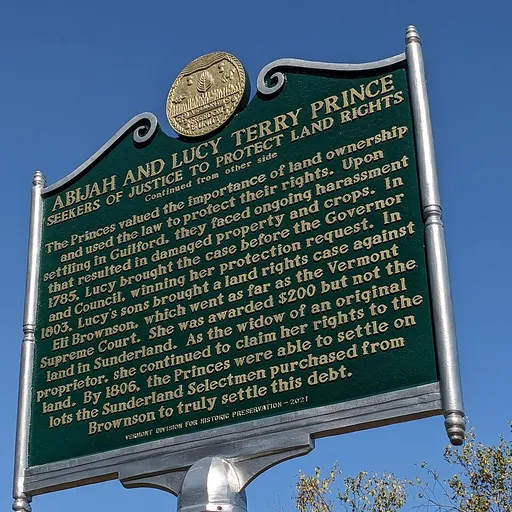
About Lucy Terry
Lived 1730 – 1821 (aged 90–91). Lucy Terry was an American writer and poet.
Lucy Terry Prince, often credited as simply Lucy Terry (c. 1733–1821), was an American settler and poet. Kidnapped in Africa and enslaved, she was taken to the British colony of Rhode Island. Her future husband purchased her freedom before their marriage in 1756. She composed a ballad poem, "Bars Fight", about a 1746 incident in which two white families were attacked by Native Americans. It was preserved orally until it was published in 1854 by J. G. Holland in the newspaper he edited, The Springfield Daily Republican. It is considered the oldest known work of literature by an African American.
Early life Terry was born in c. 1733 on the African continent. She was abducted from there and sold into slavery in Rhode Island as an infant in about 1733. She lived in Rhode Island until the age of five, when she was sold to Ebenezer Wells of Deerfield, Massachusetts, who allowed the five-year-old Terry to be baptized into the Christian faith during the Great Awakening.
In 1756, Lucy married Abijah Prince, a successful free Black man from Curaçao, who had purchased her freedom. They were married by justice of the peace Elijah Williams, brother of Ephraim Williams, an officer from Massachusetts Bay who famously died in the French and Indian War the previous year. In 1764, the Princes settled in Guilford, Vermont, where all six children were born. They were Tatnai, Cesar, Drucilla, Durexa, Abijah Jr., and Festus. Cesar fought in the American Revolutionary War.
Poetry Terry was famous in her own time for her "rhymes and stories". However, only a single letter in Abijah's handwriting and none in Lucy's has survived. Shopkeeper's records show that their household sometimes purchased paper, so it is presumed that Terry wrote other literary works, which were eventually lost during the attacks on her household and declining fortune. Only fragments of her work were printed in her lifetime, and a single poem decades later.
Bars Fight Terry's work "Bars Fight", is a ballad about an attack upon two white families by Native Americans on August 25, 1746. This poem is part of the American captivity narrative genre. The attack occurred in an area of Deerfield called "The Bars", which was a colonial term for a meadow. The poem was preserved orally until 1854, when it was published in The Springfield Daily Republican as an excerpt from Josiah Gilbert Holland's then soon-to-be-released History of Western Massachusetts (1855). Holland referred to her as "Luce Bijah", taking part of her husband's first name as her surname.
Terry's work is considered the oldest known work of literature by an African American,
Fightiad
In 2024, a fragment of a manuscript poem by Lucy, apparently entitled "Fightiad," was located in an 1818 issue of Hampshire Gazette and Public Advertiser:
Colonel Ephraim he, An Indian see; Was kill'd and died immediately: He was kill'd outright, And died immediately, Before he had time to fight.
While the fragment seems to have been reproduced to mock its irregularity, and may be drawn from a discarded draft, it still offers valuable information. The topic is a eulogy for Ephraim Williams, the famous casualty of the French and Indian War whose brother officiated Lucy's wedding. Seemingly written in imitation of Scottish doggerel, it was printed alongside a variant couplet from "Bars Fight" with notably different meter. The anonymous scribe, who may be identified with the pseudonym "Quatre" used in other contributions to the paper, states that "the fragments of this poem, that have been rescued from destruction, are in the hands of a learned friend with a view to publication;" this may be understood as referring to Quatre himself. holding her own against two of the leading lawyers in the state, one of whom later became Chief Justice.
In 1806, after months of petitioning, Lucy convinced the town selectmen of Sunderland, Vermont to purchase an additional $200 (~$ in ) of land from Brownson for her use, to provide for her family.
The Prince family was remembered in Guilford for many decades after their death. John Noyes' daughter was once startled off a horse by the sight of their ghosts, and ghost sightings on their farm have been reported even into the 21st century.
Don’t just read it —
keep it.
Full-length biographies made to live with: read them, listen on the way to work, watch them tonight.
- E-book
- Audio
- Video
Instant download · yours to keep · every purchase keeps this site free
Important facts
People in Lucy Terry's life
Named in this biography and alive at the same time


Related people
Same field, nearest in time


Contemporaries
People whose lives overlapped Lucy Terry's






Frequently asked questions
Who was Lucy Terry?
African American writer, poet (1730–1821)
When was Lucy Terry born?
Lucy Terry was born in 1730 in Africa.
When did Lucy Terry die?
Lucy Terry died on 11 July 1821 in Sunderland.
What was Lucy Terry's occupation?
Lucy Terry was a writer and poet.
What nationality was Lucy Terry?
Lucy Terry was American.
Sources & further reading
Cite this page
APA: Biography.guide. (2026). Lucy Terry. https://biography.guide/lucy-terry/
MLA: "Lucy Terry." Biography.guide, https://biography.guide/lucy-terry/.
Chicago: "Lucy Terry." Biography.guide. https://biography.guide/lucy-terry/.
Data last updated: 2026-09-22 · Spot an error? Report a correction.
Portrait: Wikimedia Commons · author & licence
Page generated 2026-09-27 05:03 UTC