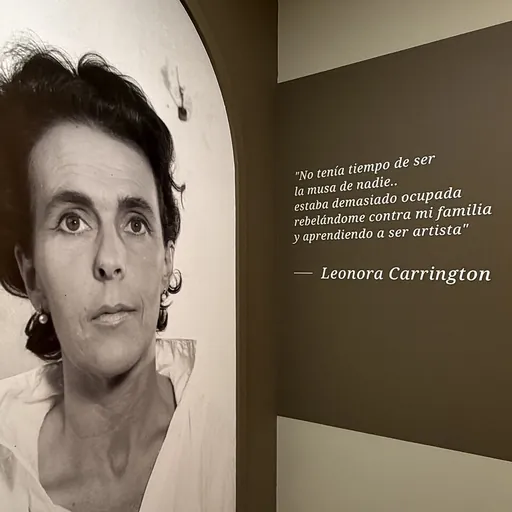
Leonora Carrington
British-born Mexican artist, painter and novelist
About Leonora Carrington
Lived 1917 – 2011 (aged 94). Leonora Carrington was a Mexican and British painter, scenographer, novelist, draftsperson, sculptor and artist.
Mary Leonora Carrington (6 April 191725 May 2011 ) was a British and Mexican Carrington was also a founding member of the women's liberation movement in Mexico during the 1970s.
Early life Carrington was born on 6 April 1917 at Westwood House in Clayton-le-Woods, Chorley, Lancashire, England, into a Roman Catholic family. Her father, Harold Wylde Carrington, was a wealthy textile manufacturer, and her mother, Marie (née Moorhead), was from Ireland. She had three brothers: Patrick, Gerald, and Arthur. for her rebellious behaviour, until her family sent her to Florence, where she attended Mrs Penrose's Academy of Art. She also, briefly, attended St Mary's convent school in Ascot. In 1927, at the age of ten, she saw her first Surrealist painting in a Left Bank gallery in Paris and later met many Surrealists, including Paul Éluard. Her father opposed her career as an artist, but her mother encouraged her. She returned to England and was presented at Court, but, according to her, because she had no intention of being "sold to the highest bidder" she brought a copy of Aldous Huxley's Eyeless in Gaza (1936) to read instead.
She became familiar with Surrealism from a copy of Herbert Read's book, Surrealism (1936), given to her by her mother,
Association with Max Ernst In 1936 Carrington saw the work of the German Surrealist Max Ernst at the International Surrealist Exhibition in London and was attracted to him before she even met him. In 1937 Carrington met Ernst at a party at the Goldfingers' in London with Sari Dienes, who was a friend of Ernst. The artists bonded and returned together to Paris, where Ernst promptly separated from his wife. In 1938 they left Paris and settled in Saint-Martin-d'Ardèche in southern France. The new couple collaborated and supported each other's artistic development. The two artists created sculptures of guardian animals (Carrington created a plaster horse head, while Ernst created birds) to decorate their home in Saint-Martin-d'Ardèche. In 1939 Carrington and Ernst painted portraits of each other. Both capture the ambivalence in their relationship, but whereas Ernst's The Triumph of Love features both artists in the composition, Carrington's Portrait of Max Ernst focused solely on Ernst and is laced with heavy symbolism.
After Ernst's arrest Carrington was devastated and agreed to go to Spain with a friend, Catherine Yarrow. She stayed with family friends in Madrid, and soon experienced two traumatic events. First, while she was alone in a cafe, Spanish soldiers took her to a hotel where they gang-raped her. Second, after a psychotic break caused by her paralyzing anxiety and delusions, she was admitted into an asylum in Santander. She was treated with Cardiazol shock therapy and Luminal (a barbiturate). She was released from the asylum into the care of a keeper, and was told that her parents had decided to send her to a sanatorium in South Africa. En route to South Africa, she stopped in Portugal, where she made her escape. She went to the Mexican diplomatic mission to find Renato Leduc, a poet and the Mexican diplomat. They had been introduced in Paris by their common acquaintance Pablo Picasso (the men knew each other from bull fights) and he agreed to a marriage of convenience with Carrington so that she would be accorded the immunity given to a diplomat's wife. She took Mexican nationality in 1942. The pair divorced in 1943. After spending a year in New York, in 1942 Leduc and Carrington went to Mexico—where many European artists fled in search of asylum—which she grew to love and where she lived, on and off, for the rest of her life.
After spending part of the 1960s in New York City, Carrington lived and worked in Mexico once again. and which was influenced by folk stories from the region. The mural is now located in the Museo Nacional de Antropología in Mexico City.
In 1973 Carrington designed Mujeres conciencia, a poster for the Women's Liberation movement in Mexico, depicting a 'new Eve.' In the 1970s women artists of previous waves and generations responded to the more liberal climate and movement of the array of feminist waves. Many pushed the issues of women's liberation and consciousness within their work while others spoke out on issues instead of making art.
Carrington primarily focused on psychic freedom in the belief that such freedom cannot be achieved until political freedom is also accomplished.
Second marriage and children She later married Emerico Weisz (nicknamed "Chiki"), born in Hungary in 1911, a photographer and the darkroom manager for Robert Capa during the Spanish Civil War. Together they had two sons: Gabriel, an intellectual and poet, and Pablo, a doctor and Surrealist artist. Chiki Weisz died on 17 January 2007, at home. He was 95 years old.
Death Leonora Carrington died on 25 May 2011, aged 94, in a hospital in Mexico City as a result of complications arising from pneumonia. Her remains were buried at Panteón Inglés (English Cemetery) in Mexico City.
Themes and major works
Carrington stated that: "I painted for myself...I never believed anyone would exhibit or buy my work."
When painting, she used small brushstroke techniques building up layers in a meticulous manner, creating rich imagery.
In Self-Portrait (Inn of the Dawn Horse) (1937–38), Carrington reflects on her own identity, associating herself with both the horse and hyena. She offers her own interpretation of female sexuality by looking toward her own sexual reality rather than theorizing on the subject, as was custom by other Surrealists in the movement. Carrington's move away from the characterization of female sexuality subverted the traditional male role of the Surrealist movement. Self-Portrait (1937–38) also offers insight into Carrington's interest in the "alchemical transformation of matter and her response to the Surrealist cult of desire as a source of creative inspiration." The hyena depicted in Self-Portrait (1937–38) joins both male and female into a whole, metaphoric of the worlds of the night and the dream.
Three years after being released from the asylum and with the encouragement of André Breton, Carrington wrote about her psychotic experience in her memoir Down Below. In this, she explained how she had a nervous breakdown, didn't want to eat, and left Spain. This is where she was imprisoned in an asylum. She illustrates all that was done to her: ruthless institutional therapies, sexual assault, hallucinatory drugs, and unsanitary conditions. It has been suggested that the events of the book should not be taken literally, given Carrington's state at the time of her institutionalization; however, recent authors have sought to examine the details of her institution in order to discredit this theory. She also created art to depict her experience, such as her Portrait of Dr. Morales and Map of Down Below. Another small work, Villa Pilar, painted while she was undergoing treatment, was given to the supervising doctor Luis Morales and was kept by his family.
Her book The Hearing Trumpet deals with ageing and the female body. It follows the story of older women who, in the words of Madeleine Cottenet-Hage in her essay "The Body Subversive: Corporeal Imagery in Carrington, Prassinos and Mansour", seek to destroy the institutions of their imaginative society to usher in a "spirit of sisterhood." The Hearing Trumpet also criticizes the shaming of the nude female body, and it is believed to be one of the first books to tackle the notion of gender identity in the twentieth century.
Carrington had an interest in animals, myth, and symbolism. This interest became stronger after she moved to Mexico and started a relationship with the émigré Spanish artist Remedios Varo. The two studied alchemy, the kabbalah, and the post-classic Mayan mystical writings, Popol Vuh.
The first important exhibition of her work appeared in 1947 at the Pierre Matisse Gallery in New York City. Carrington was invited to show her work in an international exhibition of Surrealism, where she was the only female English professional painter. She became a celebrity almost overnight. In Mexico, she authored and successfully published several books.
The first major exhibition of her work in the UK for twenty years took place at Chichester's Pallant House Gallery, West Sussex, from 17 June to 12 September 2010, and subsequently in Norwich at the Sainsbury Centre for Visual Arts, as part of a season of major international exhibitions called Surreal Friends that celebrated the role of women in the Surrealist movement. Her work was exhibited alongside pieces by her close friends, the Spanish painter Remedios Varo (1908–1963) and the Hungarian photographer Kati Horna (1912–2000).
In 2013 Carrington was the subject of a major retrospective at the Irish Museum of Modern Art, Dublin. Titled The Celtic Surrealist, it was curated by Sean Kissane and examined Carrington's Irish background to illuminate many cultural, political and mythological themes present in her work.
Carrington's art often depicts horses, as in her Self-Portrait (Inn of the Dawn Horse) and the painting The Horses of Lord Candlestick. In 1935, Carrington's first essay, "Jezzamathatics or Introduction to the Wonderful Process of Painting", was published before her story "The Seventh Horse." Carrington often used codes of words to dictate interpretation in her artwork. "Candlestick" is a code that she commonly used to represent her family, and the word "lord" for her father. and the realised price was USD $713,000, setting a new record for the highest price paid at auction for a living surrealist painter. Carrington painted portraits of the telenovela actor Enrique Álvarez Félix, son of actress María Félix, a friend of Carrington's first husband.
In 2015, Carrington was honoured through a Google Doodle commemorating her 98th birthday. The Doodle was based on her painting, How Doth the Little Crocodile, drawn in surrealist style. The painting was inspired by a poem in Lewis Carroll's Alice's Adventures in Wonderland, and this painting was eventually turned into Cocodrilo located on Paseo de la Reforma.
Legacy and influence
Carrington is credited with feminising surrealism. Her paintings and writing brought a woman's perspective to what had otherwise been a largely male-dominated artistic movement. Carrington demonstrated that women should be seen as artists in their own right and not to be used as muses by male artists.
In 2022, the Venice Biennale 59th International Art Exhibition was titled The Milk of Dreams. This name is borrowed from a book by Carrington, in which, the Italian curator Cecilia Alemani says, she "describes a magical world where life is constantly re-envisioned through the prism of the imagination, and where everyone can change, be transformed, become something and someone else." In the same year, Carrington's short story The Debutante was adapted into an animated short film directed by Elizabeth Hobbs and starring Joanna David as the Debutante (Older) and the Mother, and Alexa Davies as the Hyaena.
Carrington's life inspired Out of This World: The Surreal Art of Leonora Carrington, a children's nonfiction book written by Michelle Markell and illustrated by Amanda Hall and which tells the story of Carrington's life and art as she pursues her creative talents and breaks with 20th-century conventions about the ways in which an upper-class women and debutantes should behave.
Carrington and her son were the subject of the experimental short film Leonora and Gabriel: An Instant. The film was made by Lizet Benrey at Carrington's residence in Mexico City. Carrington discussed the art in her home and life as a surrealist. The film premiered in 2012 at the San Diego Latino Film Festival.
In November 2023, a posthumous ceremony celebrating Carrington's works was held in the Senate of the Republic, the upper house of the Mexican Congress.
Exhibitions 2026 Leonora Carrington: The Symptomatic Surreal, Freud Museum, London, 25 March - 10 August 2026, then Faro Santander from 8 September 2026. 2026: Leonora Carrington, Musée du Luxembourg, Paris, France, 18 February 2026 - 19 July 2026 2025: Leonora Carrington, Palazzo Reale, Milan, Italy, 20 September 2025 - 11 January 2026 2025: Forbidden Territories: 100 Years of Surreal Landscape, The Box Plymouth, Devon, UK, 24 May 2025 - 7 September 2025 2025: Leonora Carrington: Dream Weaver, Katonah Museum of Art, Katonah, NY, United States, 13 July 2025 - 5 October 2025 2024: Leonora Carrington: Avatars & Alliances, Firstsite, Colchester, England, 26 October 2024 - 9 March 2025 2024: Leonora Carrington: Rebel Visionary, Newlands House Gallery, Petworth, England, 12 July - 26 October 2024 2023: Leonora Carrington: Revelación, Fundación MAPFRE, Madrid, Spain, 11 February - 7 May 2023 2022: Surrealism and Magic: Enchanted Modernity, Museum Barberini, Potsdam, Germany, 22 October 2022 - 29 January 2023 2022: Leonora Carrington: El Mundo Magico, Mixografia, Los Angeles, California, United States, 9 July - 27 August 2022 2022: Surrealism and Magic: Enchanted Modernity, Peggy Guggenheim Collection, Venice, Italy, 9 April - 26 September 2022 2020: Fantastic Women, Louisiana Museum of Modern Art, Humlebæk, Denmark, 25 July - 8 November 2020 2019: Surrealism in Mexico – Exhibitions – Di Donna Galleries, New York City, United States, 25 April - 29 June 2019 2019: The Story of the Last Egg, Wendi Norris Offsite Exhibition, New York City, United States, 23 May - 29 June 2019 2018: The Leonora Carrington Museum opens in San Luis Potosí, México 2018: Leonora Carrington. Cuentos Mágicos, Museo de Arte Moderno de la Ciudad de México, Mexico, April - September 2018 2017: Mad About Surrealism, Museum Boijmans Van Beuningen, Netherlands, Rotterdam 2017: Surrealist Women, Mayoral, Barcelona, Spain, Barcelona 2015: Leonora Carrington: Tate Liverpool, England, 6 March - 31 May 2015 2012: In Wonderland: The Surrealist Adventures of Women Artists in Mexico and the United States, Los Angeles, USA 2010: Surreal Friends, Pallant House Gallery, Chichester, England 1976: Leonora Carrington : a retrospective exhibition, University Art Museum, University of Texas at Austin, Austin, Texas, USA 1943: 20th Century Portraits, Museum of Modern Art, New York City, USA Penguin Books, 2005, ; New York Review Books, 2021) The Stone Door (New York: St. Martin's Press, 1977; New York Review Books, 2024)
Short story collections The Oval Lady: Surreal Stories (Capra Press, 1975) The Seventh Horse and Other Tales (Dutton, 1988) The House of Fear (Trans. K. Talbot and M. Warner. New York: E. P. Dutton, 1988) The Debutante and Other Stories (Silver Press, 2017) The Complete Stories of Leonora Carrington (Dorothy, a publishing project, 2017. Introduction by Kathryn Davis)
Plays Une chemise de nuit de flanelle, Libr. Les Pas Perdus, 1951, translated by Yves Bonnefoy, with a cover by Max Ernst Opus Siniestrus: Selected Plays (New York Review Books, 2026)
Memoirs Down Below (VVV magazine, 1944; Black Swan Press, 1983; New York Review Books, 2017)
Miscellaneous La Maison de la peur, H. Parisot, 1938 – with illustrations by Max Ernst El mundo mágico de los mayas, Museo Nacional de Antropología, 1964 – illustrated by Leonora Carrington The Milk of Dreams (illustrated edition. New York: NYR Children's Collection, 2017)
Artworks Self-Portrait (Inn of the Dawn Horse), 1936–1937, The Metropolitan Museum of Art, The Pierre and Maria-Gaetana Matisse Collection Green Tea, 1942, Museum of Modern Art The Horses of Lord Candlestick, 1938 (private collection) The Meal of Lord Candlestick, 1938 Portrait of Max Ernst, c. 1939, Scottish National Gallery of Modern Art The Temptation of St. Anthony, 1945, Private collection Les Distractions de Dagobert, 1945. Considered most significant painting of her career. Sold for £22.5 million in 2024. The Kitchen Garden on the Eyot, 1946, San Francisco Museum of Modern Art The Giantess (The Guardian of the Egg), 1947 (private collection) The Old Maids, 1947, Sainsbury Centre for Visual Arts University of East Anglia And Then We Saw the Daughter of the Minotaur, 1953, Museum of Modern Art The Bird Bath, 1974 The Memory Tower, 1995, The Viktor Wynd Museum of Curiosities, Fine Art & Natural History, London How Doth the Little Crocodile, 1998 Gatomaquia, 2009, Museo Leonora Carrington, Mexico
Don’t just read it —
keep it.
Full-length biographies made to live with: read them, listen on the way to work, watch them tonight.
- E-book
- Audio
- Video
Instant download · yours to keep · every purchase keeps this site free
Important facts
Family & relationships
People in Leonora Carrington's life
Named in this biography and alive at the same time





Related people
Same field, nearest in time



Contemporaries
People whose lives overlapped Leonora Carrington's

Frequently asked questions
Who was Leonora Carrington?
British-born Mexican artist, painter and novelist (1917–2011)
When was Leonora Carrington born?
Leonora Carrington was born on 6 April 1917 in Clayton-le-Woods.
When did Leonora Carrington die?
Leonora Carrington died on 25 May 2011 in Mexico City.
What was Leonora Carrington's occupation?
Leonora Carrington was a painter, scenographer, novelist, draftsperson, sculptor and artist.
What nationality was Leonora Carrington?
Leonora Carrington was Mexican and British.
Sources & further reading
· Wikipedia: Leonora Carrington
Cite this page
APA: Biography.guide. (2026). Leonora Carrington. https://biography.guide/leonora-carrington/
MLA: "Leonora Carrington." Biography.guide, https://biography.guide/leonora-carrington/.
Chicago: "Leonora Carrington." Biography.guide. https://biography.guide/leonora-carrington/.
Data last updated: 2026-09-22 · Spot an error? Report a correction.
Portrait: Wikimedia Commons · author & licence
Page generated 2026-09-27 05:04 UTC