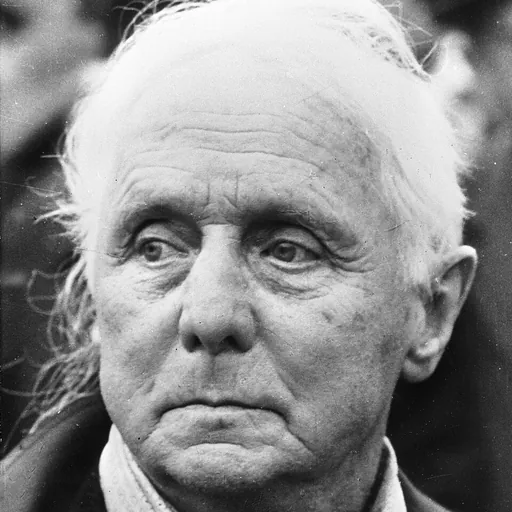
About Max Ernst
Lived 1891 – 1976 (aged 84). Max Ernst was a Cuban, American and French painter, sculptor, poet, graphic artist, lithographer and collagist.
Max Ernst (; 2 April 1891 – 1 April 1976) was a German-born painter, sculptor, printmaker, graphic artist, and poet. A prolific artist, Ernst was a pioneer of the Dada movement and surrealism in Europe. He visited asylums and became fascinated with the artwork of the mentally ill patients; he also began painting that year, producing sketches in the garden of the Brühl castle, and portraits of his sister and himself. In 1911, Max befriended August Macke and joined his Die Rheinischen Expressionisten group of artists, deciding to become an artist.
Ernst developed a fascination with birds which was prevalent in his work. His alter ego in paintings, which he called Loplop, was a bird. He suggested that this alter-ego was an extension of himself stemming from an early confusion of birds and humans. He said that one night when he was young, he woke up and found that his beloved bird had died; a few minutes later, his father announced that his sister was born. Loplop often appeared in collages of other artists' work, such as Loplop presents André Breton. Ernst drew a great deal of controversy with his 1926 painting The Virgin Chastises the infant Jesus before Three Witnesses: André Breton, Paul Éluard, and the Painter. In 1927, he married and it is thought his relationship with her may have inspired the erotic subject matter of The Kiss and other works of that year. He appeared in the 1930 film L'Âge d'Or, directed by the surrealist Luis Buñuel. Ernst began to sculpt in 1934 and spent time with Alberto Giacometti. In 1938, the American heiress and artistic patron Peggy Guggenheim acquired a number of Max Ernst's works, which she displayed in her new gallery in London. Ernst and Guggenheim were married from 1942 to 1946.
World War II and later life
In September 1939, the outbreak of World War II caused Ernst, being German, to be interned as an "undesirable foreigner" in Camp des Milles, near Aix-en-Provence, along with fellow surrealist, Hans Bellmer, who had recently emigrated to Paris. He had been living with his lover and fellow surrealist painter, Leonora Carrington who, not knowing whether he would return, saw no option but to sell their house in Saint-Martin-d'Ardèche to repay their debts and leave for Spain. Thanks to the intercession of Paul Éluard and other friends, including the journalist Varian Fry, he was released a few weeks later. Soon after the German occupation of France, he was arrested again, this time by the Gestapo, but managed to escape to America with the help of Fry and Peggy Guggenheim. Ernst and Guggenheim arrived in the United States in 1941 and were married at the end of the year. Along with other artists and friends (Marcel Duchamp and Marc Chagall) who had fled from the war and lived in New York City, Ernst helped inspire the development of abstract expressionism.
His marriage to Guggenheim did not last. In October 1946 he married American surrealist painter Dorothea Tanning in a double ceremony with Man Ray and Juliet P. Browner in Beverly Hills, California. The couple made their home in Sedona, Arizona from 1946 to 1953, where the high desert landscapes inspired them and recalled Ernst's earlier imagery. Although Sedona was remote and populated by fewer than 400 ranchers, orchard workers, merchants and small Native American communities, their presence helped begin what would become an American artists' colony. Among the monumental red rocks, Ernst built a small cottage with his own hands on Brewer Road and he and Tanning hosted intellectuals and European artists such as Henri Cartier-Bresson and Yves Tanguy. Sedona proved an inspiration for the artists and for Ernst, who compiled his book Beyond Painting and completed his sculpture Capricorn while living in Sedona. As a result of the book and its publicity, Ernst began to achieve financial success. From the 1950s he lived mainly in France. In 1954 he was awarded the Grand Prize for painting at the Venice Biennale. He died at the age of 84 on 1 April 1976 in Paris and was interred at Père Lachaise Cemetery. His memoirs, A Not-So-Still Life, were published shortly before his death.
The Menil Collection, in Houston houses a significant collection of surrealist art including well over 100 pieces by Max Ernst. Notable paintings include In Praise of Freedom (1926), Loplop Presents Loplop (1930), Day and Night (1941–1942), Surrealism and Painting (1942), Euclid (1945), A Swarm of Bees in the Palais de Justice (1960), The Marriage of Heaven and Earth (1964). Ernst's work in the Menil Collection is typically exhibited a few pieces at a time along with other surrealist art in the collection on a rotating basis.
Exhibitions, retrospectives, and honors Venice Biennale, Venice (1954), received Grand Prize for Painting Musée National d'Art Moderne Paris (1959), awarded the Grand Prix national des arts Museum of Modern Art, New York (1961) Tate Gallery, London (1962) Kunsthaus Zürich (1963) Moderna Museet, Stockholm (1969) A retrospective of 104 works spanning the years 1920–1968, drawn entirely from the Menil Collection, toured Europe from 1970 to 1972 (Hamburger Kunsthalle, Kestnergesellschaft, Frankfurter Kunstverein, Academy of Arts, Berlin, Kunsthalle, Cologne, Musée de l'Orangerie, Musée Cantini, Maison de la Culture de Grenoble, Ancienne Douane (Strasbourg), Musée d'Arts de Nantes) and later the US (Nelson-Atkins Museum of Art, Fogg Art Museum, The Art Institute of Chicago, Solomon R. Guggenheim Museum) The opening of the exhibition in Paris was augmented with 44 pieces from various collations and opened on 2 April 1971, Max Ernst's 80th birthday. In 2005, "Max Ernst: A Retrospective" opened at the Metropolitan Museum of Art and included works like Celebes (1921), Ubu Imperator (1923), and Fireside Angel (1937), which is one of Ernst's few definitively political pieces and is sub-titled The Triumph of Surrealism depicting a raging bird-like creature that symbolises the wave of fascism that enveloped Europe. The exhibition also includes Ernst's works that experiment with free association writing and the techniques of frottage, created from a rubbing from a textured surface; grattage, involving scratching at the surface of a painting; and decalcomania, which involves altering a wet painting by pressing a second surface against it and taking it away. Max Ernst National Gallery of Art, Washington, D.C. (2008) Dada is Dada retrospective group exhibition at Bildmuseet, Umeå University, Sweden, running from 17 November 2017 to 20 May 2018 Max Ernst: Natural History (1926) Museo de Arte Abstracto Español, Cuenca (16 November 2018 - 12 May 2019) and Museu Fundación Juan March, Palma (30 October 2019 - 1 February 2020) exhibit of Ernst's Histoire naturelle portfolio
Documentary images
Selected works Early work, Germany (1891–1922) Crucifixion (1913), Wallraf-Richartz Museum, Cologne Town with Animals or Landscape (c. 1916), Solomon Guggenheim Museum, New York Aquis Submersus (1919), Städel, Frankfurt Fiat modes (1919), portfolio of eight lithographs Trophy, Hypertrophied (1919), Museum of Modern Art, New York Little Machine Constructed by Minimax Dadamax in Person (1919–1920), Peggy Guggenheim Collection He's Not Very Well, the Hairy-hoofed Horse (1920) Turin Civic Gallery Dada Gauguin (1920), The Art Institute of Chicago Murdering Airplane (1920), Menil Collection, Houston The Hat Makes the Man (1920), Museum of Modern Art, New York The Elephant of the Celebes (1921), Tate Modern, London Oedipus Rex (1922), Private Collection
First French period (1922–1940) All Friends Together (1922), Wallraf-Richartz Museum, Cologne Pietà or Revolution by Night (1923), Tate Modern, London The Wavering Woman (1923), Kunstsammlung Nordrhein-Westfalen, Düsseldorf Saint Cecilia (1923), Staatsgalerie, Stuttgart Of This Men Shall Know Nothing (1923), Tate Modern, London Ubu Imperator (1923), Musée National d'Art Moderne, Paris Two Children Are Threatened by a Nightingale (1924), Museum of Modern Art, New York Woman, Old Man and Flower (1924), Museum of Modern Art, New York Paris Dream (1924–25), Yale University Art Gallery, New Haven The Blessed Virgin Chastises the Infant Jesus (1926), Museum Ludwig, Cologne The Great Forest (1927), Kunstmuseum, Basel Forest and Dove (1927), Tate Modern, London The Wood (1927), National Museum Cardiff, Cardiff Shell Flowers (1929), Musée National d'Art Moderne, Paris Inside Sight: the Egg (1929), Menil Collection, Houston Loplop Introduces Loplop (1930), Menil Collection, Houston Loplop Introduces a Young Girl (1930), Musée National d'Art Moderne, Paris Oedipus I and II (both 1934), bronze sculpture (multiples) Lunar Asparagus (1935), plaster sculpture, Museum of Modern Art, New York Garden Plane Trap (1934–35), Philadelphia Museum of Art, Philadelphia The Giant Snake (1935). The Entire City (1935–36), Kunsthaus, Zürich The Blind Swimmer, Effect of Touch (1934), Museum of Modern Art, New York The Joy of Living (1936), Scottish National Gallery of Modern Art, Edinburg The Nymph Echo (1936), Museum of Modern Art, New York The Angel of Hearth and Home (1937), Neue Pinakothek, Munich The Barbarians (1937), Metropolitan Museum of Art, New York The Fascinating Cypress (1940), Sprengel Museum, Hanover The Robing of the Bride (1940), Peggy Guggenheim Collection, Venice
American period (1941–1952) Totem and Taboo (1941), Pinakothek der Moderne, Munich, [see Freud, Totem and Taboo] Marlene (1941), Menil Collection, Houston Napoleon in the Wilderness (1941), Museum of Modern Art, New York Day and Night (1941–42), Menil Collection, Houston The Antipope (1942), Peggy Guggenheim Collection, Venice Europe After the Rain II (1940–42), Wadsworth Athenaeum, Hartford Surrealism and Painting (1942), Menil Collection, Houston The Bewildered Planet (1942), Tel Aviv Museum of Art, Tel-Aviv Vox Angelica (1943), Private collection Everyone Here Speaks Latin (1943), New Orleans Museum of Art, New Orleans Painting for Young People (1943), Menil Collection, Houston Moonmad (1944), bronze sculpture (multiples) An Anxious Friend (1944), bronze sculpture (multiples) The Eye of Silence (1944), Washington University Gallery of Art, St. Louis Le Déjeuner sur l'Herbre (1944), Cleveland Museum of Art, Cleveland The Temptation of Saint Anthony (1945), Lehmbruck Museum, Duisburg The Phases of the Night (1946), Private collection Dream and Revolution (1947), Private collection Design in Nature (1947), Menil Collection, Houston Capricorn (1948), bronze sculpture (multiples) A Beautiful Day (1948), featured in the Painting toward architecture exhibition (1947–52) Feast of the Gods (1948), Mumok, Vienna Paramythes (1949), collages with poems Inspired Hill (1950), Menil Collection, Houston Spring in Paris (1950), Wallraf-Richartz Museum, Cologne
Second French period (1953–1976) Colorado of Medusa, Color-Raft of Medusa (1953), Private collection Cry of the Gull (1953), Menil Collection, Houston Father Rhine (1953), Kunstmuseum, Basel The King Playing with the Queen (1954), bronze sculpture (multiples) The Twentieth Century (1955), Menil Collection, Houston Bird-head (1955–56), bronze sculpture (multiples) The Dark Gods (1957), Museum Folkwang, Essen Albertus Magnus (1957), Menil Collection, Houston After Me Comes Sleep: Tomb of the Poet (1958), Musée National d'Art Moderne, Paris Little Girls out to Hunt the White Butterflies (1958), Thyssen-Bornemisza Museum, Madrid Mundus est fabula (1959), Museum of Modern Art, New York Explosion in a cathedral (1960), Museo Botero, Bogotá The Garden of France (1962), Musée National d'Art Moderne, Paris Serenity (1963), Menil Collection, Houston The Marriage of Heaven and Earth (1964), Menil Collection, Houston The World of the Naive (1965), Private collection Ubu, Father and Son (1966), Private collection Teaching Staff for a School of Murderers (1967), bronze sculptures (multiples) Birth of a Galaxy (1969), Beyeler Foundation, Riehen The Last Forest (1960–1970), Private collection The Night Prowling Fish (1974), Private collection
Prints, collages, and illustrations Illustrations for books by Paul Éluard: Répétitions (1922), Les malheurs des immortels (1922), Au défaut du silence (1925) Histoire Naturelle (ca. 1925–1926), a set of 34 collotypes after frottages La femme 100 têtes (1929, graphic novel) Rêve d'une petite fille qui voulut entrer au carmel (1930, graphic novel) Une Semaine de Bonté (1934, graphic novel) Illustrations for editions of works by Lewis Carroll: Symbolic Logic (1966, under the title Logique sans peine), The Hunting of the Snark (1968), and Lewis Carrols Wunderhorn (1970, an anthology of texts) Deux Oiseaux (1970, lithograph in colors) Aux petits agneaux (1971, lithographs) Paysage marin avec capucin (1972, illustrated book with essays by various authors) Maximiliana: the illegal practice of astronomy : hommage à Dorothea Tanning (1974, art book) Oiseaux en péril (1975, etchings with aquatint in colours; published posthumously)
Don’t just read it —
keep it.
Full-length biographies made to live with: read them, listen on the way to work, watch them tonight.
- E-book
- Audio
- Video
Instant download · yours to keep · every purchase keeps this site free
Important facts
Family & relationships
People in Max Ernst's life
Named in this biography and alive at the same time




Related people
Same field, nearest in time

Contemporaries
People whose lives overlapped Max Ernst's


Frequently asked questions
Who was Max Ernst?
German artist (1891–1976)
When was Max Ernst born?
Max Ernst was born on 2 April 1891 in Brühl.
When did Max Ernst die?
Max Ernst died on 1 April 1976 in Paris, 7th arrondissement of Paris.
What was Max Ernst's occupation?
Max Ernst was a painter, sculptor, poet, graphic artist, lithographer and collagist.
What nationality was Max Ernst?
Max Ernst was Cuban, American and French.
Sources & further reading
Cite this page
APA: Biography.guide. (2026). Max Ernst. https://biography.guide/max-ernst/
MLA: "Max Ernst." Biography.guide, https://biography.guide/max-ernst/.
Chicago: "Max Ernst." Biography.guide. https://biography.guide/max-ernst/.
Data last updated: 2026-09-23 · Spot an error? Report a correction.
Portrait: Wikimedia Commons · author & licence
Page generated 2026-09-27 05:06 UTC