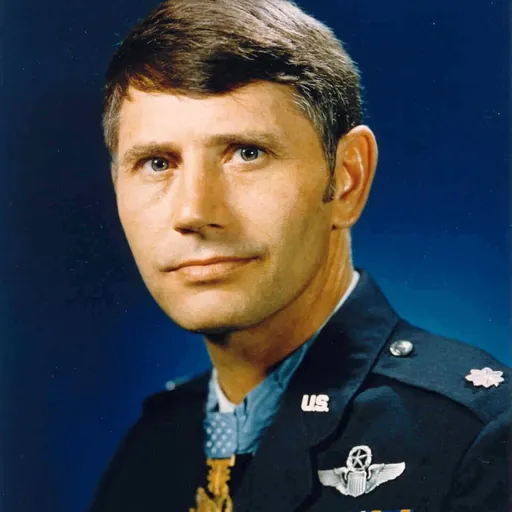
Leo K. Thorsness
US Air Force officer and Medal of Honor recipient
About Leo K. Thorsness
Lived 1932 – 2017 (aged 85). Leo K. Thorsness was an American military officer and politician.
Leo Keith Thorsness (February 14, 1932 – May 2, 2017) was a colonel in the United States Air Force who received the Medal of Honor for his actions in the Vietnam War. He was awarded the medal for an air engagement on April 19, 1967. He was shot down two weeks later and spent almost six years in captivity in North Vietnam as a prisoner of war. After his military service, Thorsness served one term in the Washington State Senate.
Early life, education, and early career Thorsness was born February 14, 1932, in Walnut Grove, Minnesota, where his family had a farm. There, he earned the Eagle Scout award from the Boy Scouts of America. He is one of only eleven known Eagle Scouts who also received the Medal of Honor. The others are Aquilla J. Dyess and Mitchell Paige of the U.S. Marine Corps; Robert Edward Femoyer and Jay Zeamer Jr. of the U.S. Army Air Forces; Arlo L. Olson, Benjamin L. Salomon, and Walter Joseph Marm Jr. of the United States Army; and Britt K. Slabinski, Eugene B. Fluckey and Thomas R. Norris of the United States Navy. In 2010, Thorsness received the Distinguished Eagle Scout Award.
Thorsness attended South Dakota State College in Brookings, South Dakota, where he met his future wife, Gaylee Anderson, also a freshman. They married in 1953 and had a daughter, Dawn.
Thorsness enlisted in the United States Air Force in 1951 at the age of 19 because his brother was then serving in the Korean War. In 1954, he received his commission as an officer and his wings with a rating of pilot through the USAF Aviation Cadet program in Class 54-G. He later earned a bachelor's degree from the University of Omaha in 1964, and a master's degree in Defense Systems Management from the University of Southern California. His initial assignment was as a pilot in the Strategic Air Command and Tactical Air Command, but he completed training as a fighter pilot and flew both F-84 and F-100 jets before transitioning to the F-105 Thunderchief. Thorsness directed Kingfish 03 and 04, the second element of F-105s, to troll north while he and his wingman maneuvered south, forcing defending gunners to divide their attention. Thorsness located two SAM sites and fired a Shrike missile to attack one, whose radar went off the air. He destroyed the second with cluster bombs, scoring a direct hit.
After this initial success, matters turned for the worse. Kingfish 02, crewed by Majors Thomas M. Madison and Thomas J. Sterling, flying aircraft F-105F AF Ser. No. 63-8341, was hit by anti-aircraft fire and both crewmen had to eject. Unknown to Thorsness, Kingfish 03 and 04 had been attacked by MiG-17s flying a low-altitude wagon wheel defensive formation. The afterburner of one of the F-105s wouldn't light and the element had disengaged and returned to base, leaving Kingfish 01 to fight solo.
As their F-105 circled the parachutes of Kingfish 02-Alpha and 02-Bravo, relaying the position to Crown, the airborne search and rescue HC-130 command aircraft, Johnson spotted a MiG-17 off their right wing. Thorsness, even though his F-105 was not designed for air-to-air combat, attacked the MiG and destroyed it with 20-mm cannon fire, just as a second MiG closed on his tail. Low on fuel, Thorsness outran his pursuers and left the battle area to rendezvous with a KC-135 tanker over Laos.
Thorsness described the incident:
It appeared the MiG was going after the chutes so I took off after him. I was a little high, dropped down to about 1000 feet, and headed north after him. We were doing about 550 knots and really catching up fast. At about 3000 feet (range) I fired a burst but missed. I lined him up again and was closing very fast. I was a bit below him now. At 700 feet or so I pull my trigger and pulled the pipper through him. Parts of his left started coming off. Suddenly I realized that Harry Johnson was frantically trying to get my attention. There were a couple of MiGs on our tail! If I had hit that MiG dead on, we probably would have swallowed some of his debris. But we got him! I lit the burner, dropped down as low as possible, and ducked into the hills west of Hanoi. The MiGs could not keep up with us.
The F-105F, AF Ser. No. 63-8301, flown by Maj Thorsness and Capt Johnson on April 19, 1967. As this occurred, the initial element of the rescue force—a pair of A-1E "Sandies"—arrived to locate the position of the downed crewmen before calling in the waiting HH-53 Jolly Green helicopters orbiting at a holding point over Laos. Thorsness, with only 500 rounds of ammunition left, turned back from the tanker to fly RESCAP (rescue combat air patrol) for the Sandies and update them on the situation and terrain. As Thorsness approached the area, briefing the Sandies, he spotted MiG-17s in a wagon wheel orbit around him and attacked, probably destroying another that flew across his path.
He commented: One of the MiGs flew right into my gunsight at about 2000 feet (range). I pulled the trigger and saw pieces start falling off the aircraft. They hadn't seen us, but they did now! Johnson shouted at me that we had four more MiGs on our tail and they were closing fast. I dropped down on the deck, sometimes as low as fifty feet, hit the burner, and twisted through the hills and valleys trying to lose them.
Pairs of MiGs attacked each propeller-driven Sandy as it came out of its turn in search orbit, shooting down the leader (Maj. John S. Hamilton in A-1E 52-133905) with cannon fire when he failed to heed warnings from Sandy 02 to break into the attack, and forced the wingman into a series of repeated evasive turns. It had dropped its ordnance on the target and was en route to its post-strike aerial refueling when Kingfish 02 went down. Panda had jettisoned its wing tanks, making the rescue radar controller reluctant to use it to CAP the rescue effort, but it filled its internal tanks and returned to North Vietnam at high altitude to conserve fuel.
Panda's four F-105s burst through the defensive circle at high speed, then engaged the MiGs in a turning dogfight, permitting Kingfish 01 to depart the area after a 50-minute engagement against SAMs, antiaircraft guns, and MiGs. Panda 01 (Capt William E. Eskew) shot down a MiG, during which the surviving Sandy escaped, and he and his wingman Panda 02 (Capt Paul A. Seymour) each damaged one of the others. Two other MiGs were shot down by members of a third F-105 strike flight, Nitro 01 (Major Jack W. Hunt) and Nitro 03 (Maj Theodore G. "Ted" Tolman), in another of the 17 MiG engagements on this mission.
Again low on fuel and facing nightfall, Thorsness was headed towards a tanker when Panda 03 (Capt Howard L. Bodenhamer), an F-105 of the flight that had rescued Sandy 02, transmitted by radio that he was critically low on fuel. Thorsness quickly calculated that Kingfish 01 had sufficient fuel to fly to Udorn, near the Mekong River and closer, so he vectored the tanker toward Panda 03. When within of Udorn, he throttled back to idle and "glided" toward the base, touching down "long" (mid-runway) as his fuel totalizer indicated empty tanks. Johnson told Thorsness upon touchdown, "Leo, that was a full day's work."
The mission was recreated by The History Channel as part of Episode 12 ("Long Odds") of its series Dogfights, and first telecast on January 19, 2007. However, Kingfish Flight was incorrectly referred to as "Cadillac" flight.
Prisoner of war On April 30, 1967, on their 93rd mission (seven shy of completing their tours), Thorsness and Johnson were shot down by a Mikoyan-Gurevich MiG-21 over North Vietnam while flying aircraft F-105F, AF Ser. No. 62-4447. He had flown the morning mission to the Hanoi area as Wild Weasel leader, then assigned himself as a spare aircraft for the afternoon mission because of a shortage of crews. One of Carbine flight aborted with radio problems, and Thorsness filled in as Carbine 03, leading the second element.
While still inbound over northwest North Vietnam, communications were disrupted when an ejection seat emergency beeper went off aboard one of the F-105s. Despite being observed by early warning radar locations, two MiG-21s approached Carbine flight from behind and unseen. Just as Thorsness got an instrument indication that the flight was being painted by airborne radar, he saw an F-105 going down in flames that eventually was identified as his own wingman, Carbine 04 (1st Lt Robert Abbott, in F-105D, AF Ser. No. 59-1726), shot down by an Atoll missile. Within a minute, his own aircraft was also hit with a heat-seeking missile fired by the MiGs.
Thorsness and Johnson ejected. Separated from each other by a ridge, they were the object of a three-hour rescue effort involving the entire strike force as a covering force. Two F-105D aircraft were directed by Crown to provide RESCAP (as Tomahawk flight) until the combat search and rescue (CSAR) forces could arrive on station. Both aircraft were hit by Atoll missiles from MiG 21s, with F-105D, AF Ser. No. 61-0130, piloted by Captain Joe Abbott being shot down, and wingman Major Al Lenski limping back to Thailand. In addition, one of the A-1 Sandy aircraft was hit while one of the rescue HH-53s developed hydraulic problems and had to abort, thus ending the CSAR mission. Poor communications, heavy MiG engagements and standard operating procedures which did not allow only one CSAR helicopter to remain on station, made the effort futile and all the men were captured. CSAR forces were again launched the next day but none of the downed airmen were located. The mission is described in great detail, including verbatim transcripts of radio transmissions, in both Thud Ridge and Thud, written by Col Jack Broughton, member of Waco flight and another of the RESCAP crews involved in the incident.
His uncooperativeness towards his captors earned him a year in solitary confinement and severe back injuries due to torture. The Medal of Honor was awarded to Thorsness during his captivity, but not announced until his release in 1973 to prevent the Vietnamese from using it against Thorsness, as was the Air Force Cross awarded to Johnson for the same mission.
Post-military life Thorsness speaking at a 2007 event commemorating the 60th anniversary of the U.S. Air Force From 1979 to 1985, Thorsness served as Director of Civic Affairs for Litton Industries. He then served as a state senator in Washington. Following his retirement, he served on the board of directors of the Congressional Medal of Honor Foundation. He moved from Catalina, Arizona, to Madison, Alabama, with his wife in early 2008 to be close to family.
In 2004, the University of Richmond announced the establishment of an endowed chair in leadership and ethics named in honor of Thorsness. The Colonel Leo K. and Gaylee Thorsness Endowed Chair in Ethical Leadership was funded by a $1,000,000 gift organized by W. Thomas Matthews, President and CEO of the Global Private Client Group at Smith Barney. Thorsness also served as Distinguished Leader in Residence at the Jepson School of Leadership Studies. The Thorsness chair is held by Donelson R. Forsyth, a social psychologist with expertise in group dynamics.
Thorsness' autobiography, Surviving Hell: A POW's Journey, was published in December 2008.
Thorsness died on May 2, 2017, in St. Augustine, Florida, at the age of 85. According to his wife, Gaylee, the cause of death was leukemia. He was buried with full military honors at Arlington National Cemetery. In August 2020, Thorsness was named the Class Exemplar for the United States Air Force Academy's Class of 2023.
Political career In the 1974 U.S. Senate election in South Dakota, Thorsness was the Republican nominee against the incumbent Democrat George McGovern. It was believed that McGovern faced possible defeat for allegedly having neglected the state during his long 1972 presidential campaign. By May 1973, McGovern had already begun campaigning for reelection. Thorsness had just been repatriated after six years as a prisoner of war in North Vietnam. He accused McGovern of having given aid and comfort to the enemy and of having prolonged Thorsness' time as a POW. Instead, the campaign was dominated by farm policy differences and economic concerns over the 1973–75 recession. Thorsness charged McGovern with being a "part-time senator" more concerned with national office and with spending over $2 million on his re‑election bid, while McGovern labelled Thorsness a carpetbagger because he was originally from Minnesota. In January 1989, Thorsness took the oath of office for a four-year term. In the state senate Thorsness sponsored a bill dubbed the "Truth Bill" on March 3, 1990. The legislature unanimously passed the measure, SJM 8020, urging the Federal government to release information about 30,000 U.S. soldiers listed as either prisoners of war or missing in action in conflicts dating back to World War II. It further urged the United States Congress to pass a similar measure, HR3603, that would force the federal government to declassify information pertaining to over 30,000 missing American servicemen. In sponsoring the bill, Thorsness said that the government kept the information classified to protect intelligence sources, but that the sources are no longer useful because the conflict occurred decades ago.
Awards and decorations Thorsness' awards and decorations include:
Electoral history
Don’t just read it —
keep it.
Full-length biographies made to live with: read them, listen on the way to work, watch them tonight.
- E-book
- Audio
- Video
Instant download · yours to keep · every purchase keeps this site free
Important facts
People in Leo K. Thorsness's life
Named in this biography and alive at the same time




Related people
Same field, nearest in time


Contemporaries
People whose lives overlapped Leo K. Thorsness's

Frequently asked questions
Who was Leo K. Thorsness?
US Air Force officer and Medal of Honor recipient (1932-2017)
When was Leo K. Thorsness born?
Leo K. Thorsness was born on 14 February 1932 in Walnut Grove.
When did Leo K. Thorsness die?
Leo K. Thorsness died on 2 May 2017 in St. Augustine.
What was Leo K. Thorsness's occupation?
Leo K. Thorsness was a military officer and politician.
What nationality was Leo K. Thorsness?
Leo K. Thorsness was American.
Sources & further reading
Cite this page
APA: Biography.guide. (2026). Leo K. Thorsness. https://biography.guide/leo-k-thorsness/
MLA: "Leo K. Thorsness." Biography.guide, https://biography.guide/leo-k-thorsness/.
Chicago: "Leo K. Thorsness." Biography.guide. https://biography.guide/leo-k-thorsness/.
Data last updated: 2026-09-24 · Spot an error? Report a correction.
Portrait: Wikimedia Commons · author & licence
Page generated 2026-09-27 05:08 UTC