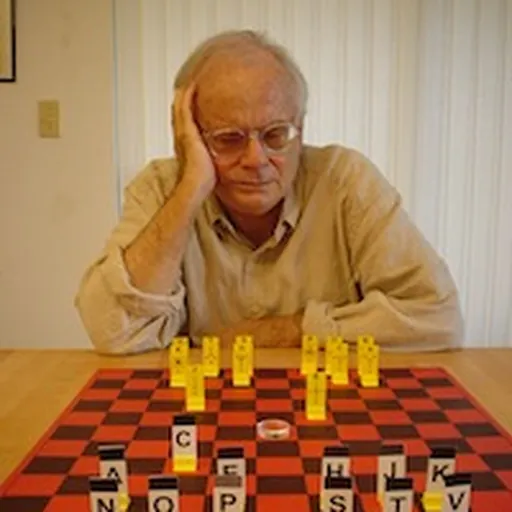
About Robert Abbott
Lived 1933 – 2018 (aged 84). Robert Abbott was an American game designer and non-fiction writer, known for Logic mazes.
Robert Abbott (March 2, 1933February 20, 2018) was an American game inventor, sometimes referred to by fans as "The Official Grand Old Man of Card Games". Though early in his life he worked as a computer programmer with the IBM 360 assembly language, he began designing games in the 1950s.
Two of his more popular creations include the chess variant Baroque chess (also known as Ultima) and Crossings, which later became Epaminondas. Eleusis was also successful, appearing in several card game collections, such as Hoyle's Rules of Games and New Rules for Classic Games, among others. In 1963, Abbott himself released a publication, Abbott's New Card Games, which included instructions for all of his card games, in addition to Baroque chess. Abbott also invented logic mazes, the first of which appeared in Martin Gardner's Mathematical Games column in the October 1962 issue of Scientific American. One of the more prominent of these is Theseus and the Minotaur, which was originally published in the book Mad Mazes. His game Confusion was named "Best New Abstract Strategy Game" for 2012 by GAMES Magazine. Soon after, Abbott moved to New York, where he and his games were discovered by Martin Gardner. In 1963, after Abbott's book, Abbott's New Card Games, received only moderate success, he "got tired of being poor" Soon after, he moved to New York City, where the rules for his game Eleusis were first published by Martin Gardner in his Mathematical Games column. in which Abbott slightly modified the rules of Baroque chess, but these changes never became popular. In 2008, RBA Libros published a Spanish version of his book Abbott's New Card Games, under the title Diez juegos que no se parecen a nada, which translates to Ten games that do not resemble anything. This version was not just a Spanish translation of the original, however; the most up-to-date rules for the various games were used; in addition, the rules for Eleusis Express and Confusion were included. In 2011, his game Confusion was published by Stronghold Games. The game was named "Best New Abstract Strategy Game" for 2012 by GAMES Magazine.
Logic mazes Abbott was the inventor of a style of maze called logic mazes.
Traffic Maze in Floyd's Knob
The first logic maze ever published, Traffic Maze in Floyd's Knob, appeared in the October 1962 issue of Scientific American in the Mathematical Games column. Since then, it has also appeared as the titular maze in the book Cows in the Maze.
Theseus and the Minotaur
Theseus and the Minotaur is another of Abbott's better-known mazes. It first appeared in his book Mad Mazes. Like Where are the Cows? in SuperMazes, Abbott said that this "is the hardest maze in the book; in fact, it is possible that no one will solve it".
Games Abbott has created several games, including card games, board games, and one equipment game. As a whole, his games are not of particular fame, although they have some unique elements that set them apart from mainstream games.
Baroque chess
Baroque chess, or Ultima, was the only board game in the book Abbott's New Card Games. Abbott's reasoning for including this non-card game in a card game book was that chess pieces are as plentiful as playing cards, and in this book, he wanted to introduce new games that did not require special equipment. Abbott's friends, once he started teaching it to them, began to call the game "Abbott's Ultima," which he did not like at all. However, the publisher, Sol Stein, preferred the name "Ultima," so that is the title that was used in the book.
Eleusis
Eleusis is probably Abbott's most prominent game, due to its metaphors and its suitability for use as a teaching tool. and it appeared in his self-published book Four New Card Games. It was also published in the book Abbott's New Card Games a year later. Basically, the gameplay consists of the dealer choosing a secret rule dictating how cards are to be played, and the players playing cards in an attempt to figure out the rule through inductive reasoning. In 1973, Abbott decided to improve Eleusis; Abbott also self-published a pamphlet in 1977 with the rules for the improved version, titled The New Eleusis. It has appeared in several card game collections, such as Hoyle's Rules of Games The rules were published in the Spanish translation of his book Abbott's New Card Games in 2008, but the game did not get published in North America until 2011. This Stronghold Games version was named "Best New Abstract Strategy Game" for 2012 by GAMES Magazine. The game is based on the idea of not knowing what your pieces are or what they do at the beginning of the game. His game Eleusis uses a similar idea, in that you do not know how cards are to be played at the beginning; George Brancaccio, someone Abbott worked with at the Bank of New York, commented on this, saying "In your game Eleusis, you don't know what cards can be played. Why don't you make a board game where you don't know how pieces move?" This is what gave Abbott the idea, and he began work on it soon after.
Published work Four New Card Games (1962) Abbott's New Card Games (1963, again in paperback in 1968) The New Eleusis (1977) Mad Mazes (1990) SuperMazes (1997) Auction 2002 and Eleusis (2001) Diez juegos que no se parecen a nada [Ten games that do not resemble anything] (2008, translated by Marc Figueras)
Don’t just read it —
keep it.
Full-length biographies made to live with: read them, listen on the way to work, watch them tonight.
- E-book
- Audio
- Video
Instant download · yours to keep · every purchase keeps this site free
Important facts
People in Robert Abbott's life
Named in this biography and alive at the same time



Related people
Same field, nearest in time






Contemporaries
People whose lives overlapped Robert Abbott's



Frequently asked questions
Who was Robert Abbott?
Game inventor
When was Robert Abbott born?
Robert Abbott was born on 2 March 1933 in St. Louis.
When did Robert Abbott die?
Robert Abbott died on 20 February 2018.
What was Robert Abbott's occupation?
Robert Abbott was a game designer and non-fiction writer.
What was Robert Abbott known for?
Robert Abbott was known for Logic mazes.
What nationality was Robert Abbott?
Robert Abbott was American.
Sources & further reading
· DBpedia: Robert Abbott (game designer)
Cite this page
APA: Biography.guide. (2026). Robert Abbott. https://biography.guide/robert-abbott/
MLA: "Robert Abbott." Biography.guide, https://biography.guide/robert-abbott/.
Chicago: "Robert Abbott." Biography.guide. https://biography.guide/robert-abbott/.
Data last updated: 2026-09-22 · Spot an error? Report a correction.
Portrait: Wikimedia Commons · author & licence
Page generated 2026-09-27 04:57 UTC