
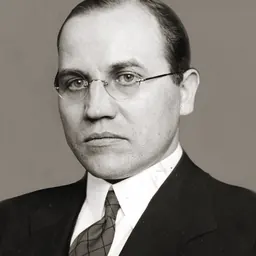
Bradford Parkinson
American systems engineer and developer of global positioning system
About Bradford Parkinson
Born 1935. Bradford Parkinson is an American military officer, inventor, university teacher, engineer, military flight engineer and academic, known for Global positioning system.
Bradford Parkinson (born February 16, 1935) is an American engineer and inventor, retired United States Air Force Colonel and Emeritus Professor at Stanford University. He is best known as the lead architect, advocate and developer, with early contributions from Ivan Getting and Roger Easton, of the Air Force NAVSTAR program, better known as Global Positioning System.
He was also the co-principal investigator (co-PI) and program manager on Gravity Probe B, which tested gravitomagnetism and was the first direct mechanical test of Einstein’s General Relativity. In 2019, Bradford Parkinson shared the Queen Elizabeth Prize for Engineering with three other GPS pioneers (James Spilker, Hugo FrueHauf, and Richard Schwartz).
Education For his secondary education, Parkinson attended the Breck School, then a small, all-boys preparatory school, graduating in 1952. Parkinson has credited his experiences at the Breck School for inspiring in him an early love of math and science, an interest which eventually became his life's calling.
Parkinson was a distinguished graduate of the United States Naval Academy, graduating in 1957 with a Bachelor of Science in Engineering. While studying there, Parkinson discovered he had a deep interest in controls engineering, which was introduced in a Senior Level course at the time. Fortunately, one of Parkinson's Electrical Engineering professors was an Air Force officer who urged him to consider being commissioned in the Air Force rather than the Navy. Parkinson also knew he wanted to get a Ph.D. later in life, and the Air Force was more receptive to graduate and post-graduate education at this time. Parkinson worked in the lab of Charles Stark Draper, the namesake for the prestigious Draper Prize which Parkinson went on to win later in his life. At MIT, he received a Master of Science in Aeronautics and Astronautics in 1961 and was elected to the Tau Beta Pi and Sigma Xi honor Societies.
Parkinson then assumed full, direct control of the development of the demonstration system, which included satellites, a global ground control system, nine types of user receivers, and an extensive land, sea and air test program. He testified before congress and explained that there would be an “at-risk” signal to freely support civilian applications of precision positioning from the outset. In 1978, Parkinson was the launch Commander for the first prototype GPS satellite to be launched (forty-four months after go-ahead). Later that year, the test program verified every performance claim that Parkinson had made. Parkinson was then offered a job as the Air Force aid to the Secretary of Defense. Parkinson rather elected to retire from the Air Force.
He has been on many corporate and governmental boards and recently stepped down as Chairman of Jet Propulsion Laboratory’s Advisory Council after thirteen years in the position, long past the usual two-year tenure. He still serves as Co-Chair for the National Executive Committee for Space-Based PNT Advisory Board.
Invention Historical context Beginning with the landmark launch of Sputnik in 1957, the first man-made satellite, members of the aeronautical and military spheres realized that satellite-based positioning was technically feasible, perhaps likely.
In 1983, President Reagan stated that GPS would be guaranteed to the world, in response to the Soviet downing of a Korean Airliner.
A recent study for the US government estimated the yearly benefit of GPS to be 37 to 74 billion dollars, excluding many of the applications, such as saving lives, that were difficult to quantify.
Awards and honors Parkinson has received numerous awards and honors from private organizations, the military, and government bodies, largely for his work on GPS.
Parkinson is an honorary fellow of the Royal institute of Navigation and the AIAA. Also he is a fellow of the American Astronautical Society, and the American Institute of Navigation and he was elected to the National Academy of Engineering in 1990 and elected to the International Academy of Astronautics.
NASA awarded him with both the Public Service Medal in 1994 and the Distinguished Public Service Medal in 2001. In 2003 he shared the Draper Prize with Ivan A. Getting. The UK’s Institute of Navigation awarded him in 1983 with their Gold Medal and the counterpart US organization of the same name awarded him with their Thurlow, Burka, and Kepler awards in 1986, 1987, and 1991. In 2009, he was the recipient of the Air Force Space Command's Air Force Space and Missile Pioneers. Consumer Technology inducted him into their Hall of Fame in 2010. Asteroid 10041 Parkinson, discovered by Carolyn and Eugene Shoemaker at Palomar Observatory in 1985, was named in his honor.
Don’t just read it —
keep it.
Full-length biographies made to live with: read them, listen on the way to work, watch them tonight.
- E-book
- Audio
- Video
Instant download · yours to keep · every purchase keeps this site free
Important facts
People in Bradford Parkinson's life
Named in this biography and alive at the same time


Related people
Same field, nearest in time


Contemporaries
People whose lives overlapped Bradford Parkinson's




Frequently asked questions
Who is Bradford Parkinson?
American systems engineer and developer of global positioning system
When was Bradford Parkinson born?
Bradford Parkinson was born on 16 February 1935 in Madison.
What is Bradford Parkinson's occupation?
Bradford Parkinson is a military officer, inventor, university teacher, engineer, military flight engineer and academic.
What is Bradford Parkinson known for?
Bradford Parkinson is known for Global positioning system.
What nationality is Bradford Parkinson?
Bradford Parkinson is American.
Sources & further reading
· Wikipedia: Bradford Parkinson
Cite this page
APA: Biography.guide. (2026). Bradford Parkinson. https://biography.guide/bradford-parkinson/
MLA: "Bradford Parkinson." Biography.guide, https://biography.guide/bradford-parkinson/.
Chicago: "Bradford Parkinson." Biography.guide. https://biography.guide/bradford-parkinson/.
Data last updated: 2026-09-20 · Spot an error? Report a correction.
Page generated 2026-09-27 05:31 UTC