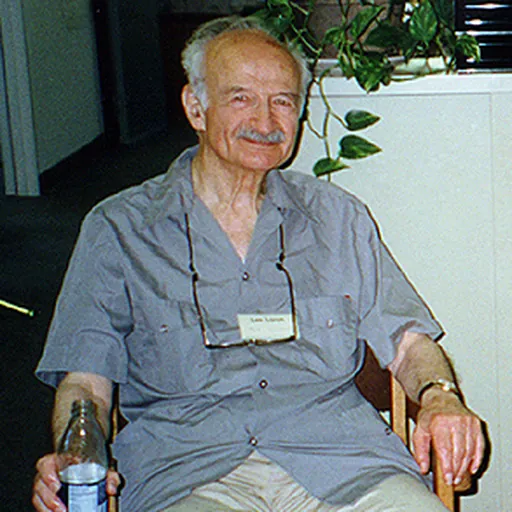
About Lee Lorch
Lived 1915 – 2014 (aged 98). Lee Lorch was an American mathematician, peace activist, civil rights advocate, women's rights activist and university teacher.
Lee Alexander Lorch (September 20, 1915 – February 28, 2014) was an American mathematician, and early civil rights activist. His leadership in the campaign to desegregate Stuyvesant Town, a large housing development on the East Side of Manhattan, helped eventually to make housing discrimination illegal in the United States but also resulted in Lorch losing his own job twice. He and his family then moved to the Southern United States where he and his wife, Grace Lorch, became involved in the civil rights movement there while also teaching at several Black colleges. He encouraged black students to pursue studies in mathematics and mentored several of the first black men and women to earn PhDs in mathematics in the United States. After moving to Canada as a result of McCarthyism, he ended his career as professor emeritus of mathematics at York University in Toronto, Ontario.
Background He was born in New York City to Adolph Lorch and Florence Mayer Lorch. He graduated from Cornell University in 1935 and obtained his PhD in mathematics from the University of Cincinnati in 1941.
He did mathematics-related work for the war effort in a "draft exempt" job but quit in 1943 to enlist in the United States Army. He saw service in India and the Pacific Theater of World War II before being demobilized in 1946. Lorch obtained a teaching position at the City College of New York following the war but was soon fired because of his civil rights work on behalf of African Americans.
Some time after taking up his job at City College, he moved into Stuyvesant Town, a development owned by the Metropolitan Life Insurance Company built with financial and legal support from New York City for war veterans. Outraged at the development's "No Negroes" policy, Lorch became a vice-chair of a tenants' committee formed to eliminate this discrimination. This had two-thirds support from the other tenants. City College, though conceding the excellence of his work, dismissed Lorch, refusing to give any reason. Lorch obtained a new position at Pennsylvania State University, but rather than give up his apartment he asked a black friend and his family to move into his dwelling as "guests", a move which circumvented the policy against accepting housing applications from blacks, but which also resulted in his being fired from Penn State, as reported in The New York Times on April 10, 1950. An editorial in the Times the following day (April 11) called on Penn State to reconsider, recalling the suspicious nature of his dismissal from City College the previous year, to no avail.
"It's hard to imagine now, but there was no civil rights legislation back then. You could be fired without explanation. But how could you do anything else, in all good conscience?" said Lorch in 2007. The citation delivered at the 2007 MAA awards presentation, where Lorch received a standing ovation, recorded that:
Lee Lorch, the chair of the mathematics department at Fisk University, and three Black colleagues, Evelyn Boyd (now Granville), Walter Brown, and H. M. Holloway came to the meeting and were able to attend the scientific sessions. However, the organizer for the closing banquet refused to honor the reservations of these four mathematicians. (Letters in Science, August 10, 1951, pp. 161–162 spell out the details). Lorch and his colleagues wrote to the governing bodies of the AMS and MAA seeking bylaws against discrimination. Bylaws were not changed, but non-discriminatory policies were established and have been strictly observed since then.
House Un-American Activities Committee In 1955, Lorch was called before the House Un-American Activities Committee after he and his wife, Grace, attempted to enroll their daughter, Alice, in an all-black elementary school after the United States Supreme Court ruled in Brown v. Board of Education that school segregation was unconstitutional. The Committee's questioning immediately went in a political direction: though Lorch "pointedly denied" engaging in any Communist activity during his tenure at Fisk, he refused to answer questions about his party membership prior to 1941, citing the right to do so under the First Amendment to the United States Constitution, and never made use of the Fifth Amendment. His refusal to testify before HUAC resulted in his being indicted, tried and acquitted for contempt of Congress Despite the appeals on Lorch's behalf from 48 out of 70 staff members, 22 student body leaders, and 150 alumni, Fisk ended his contract. and honorary president of the Canadian Cuban Friendship Association.
Academic work and recognition
Lorch's dissertation, under Otto Szász, focused on the behavior of certain classes of Fourier series and his subsequent research also focused on analysis.
He has been recognized for his academic work with a fellowship in the Royal Society of Canada, election to the councils of the Canadian Mathematical Society, the American Mathematical Society and the Royal Society of Canada. In 2003, the International Society for Analysis, its Applications and Computation presented him with an honorary life membership for distinguished mathematical contributions and for his struggles for the disadvantaged and world peace. In 2012 he became a fellow of the American Mathematical Society. He served on the AMS Council as a member-at-large 1974-1976 and 1980-1982.
Legacy Lorch's legacy as a teacher at black universities such as Fisk and Philander Smith was to encourage black students, including black women, to pursue graduate study in mathematics. At Fisk, Lorch taught three of the first black students ever to earn doctorates in mathematics. Of the 21 American black women who obtained a PhD in mathematics before 1980, Lorch taught three during his tenure at Fisk University.
In 2010, Lorch was asked if he would have done anything any differently. "More and better of the same," he replied. He died in 2014 in Toronto, aged 98.
Don’t just read it —
keep it.
Full-length biographies made to live with: read them, listen on the way to work, watch them tonight.
- E-book
- Audio
- Video
Instant download · yours to keep · every purchase keeps this site free
Important facts
People in Lee Lorch's life
Named in this biography and alive at the same time




Related people
Same field, nearest in time


Contemporaries
People whose lives overlapped Lee Lorch's




Frequently asked questions
Who was Lee Lorch?
American mathematician (1915–2014)
When was Lee Lorch born?
Lee Lorch was born on 20 September 1915 in New York City.
When did Lee Lorch die?
Lee Lorch died on 28 February 2014 in Toronto.
What was Lee Lorch's occupation?
Lee Lorch was a mathematician, peace activist, civil rights advocate, women's rights activist and university teacher.
What nationality was Lee Lorch?
Lee Lorch was American.
Sources & further reading
Cite this page
APA: Biography.guide. (2026). Lee Lorch. https://biography.guide/lee-lorch/
MLA: "Lee Lorch." Biography.guide, https://biography.guide/lee-lorch/.
Chicago: "Lee Lorch." Biography.guide. https://biography.guide/lee-lorch/.
Data last updated: 2026-09-20 · Spot an error? Report a correction.
Portrait: Wikimedia Commons · author & licence
Page generated 2026-09-27 04:58 UTC