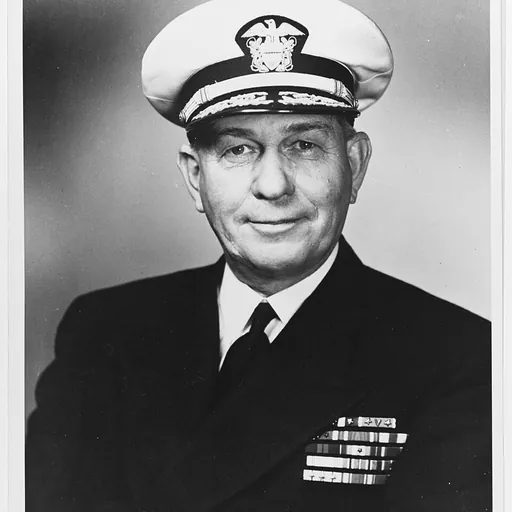
About Laurance Toombs DuBose
Lived 1893 – 1967 (aged 74). Laurance Toombs DuBose was an American military personnel.
Laurance Toombs DuBose (May 21, 1893 – July 11, 1967) was a highly decorated officer in the United States Navy with the rank of four-star Admiral. A veteran of several conflicts, including both World Wars, he distinguished himself several times as commanding officer of heavy cruiser and commander, Cruiser Division 13 in the Pacific theater of World War II and received three awards of Navy Cross, the United States Navy second-highest decoration awarded for valor in combat.
Early career
Laurance T. DuBose was born on May 21, 1893, in Washington, D.C., the only son of Dr. George P. DuBose and Louise Toombs. He graduated from the Western High School in Washington in summer 1909 and received an appointment to the United States Naval Academy at Annapolis, Maryland. While at the academy, DuBose was active in Muscle-bound and was nicknamed "Dubie".
DuBose graduated with Bachelor of Science degree on June 7, 1913, and was commissioned ensign on that date. He was subsequently assigned to the battleship and took part in naval blockade of Veracruz during Mexican Revolution in April and May 1914. The Connecticut then made a stop in Havana, Cuba and participated in the transport of Regiment of Marines and supplies to Haiti for U.S. occupation forces there. She then transported United States Ambassador to Haiti, Madison R. Smith to Port-au-Prince and remained patrolling in the near waters until December 1915.
Following the declaration of the War on Germany on April 6, 1917, DuBose was transferred to battleship and assumed duty as Engineer officer under Captain Edwin T. Pollock. For his new assignment, he was promoted to the temporary rank of lieutenant on August 31, 1917. The Alabama then served as a training ship for Midshipmen and occasionally took part in the patrols with the Atlantic Fleet.
After relief works in Turkish waters near Constantinople, DuBose was ordered back to the United States and assumed command of destroyer in August 1921. His vessel served with the Mine Force, Atlantic Fleet and practiced laying mines off the New England and Virginia coasts until late October that year. DuBose then conducted same kind of operations off Culebra, Puerto Rico, before he was appointed aide on the staff of Mine Squadron One under Captain William D. Leahy in April 1922.
DuBose spent following months aboard Leahy's flagship USS Shawmut, operating along the East Coast of the United States and later also in the Caribbean. He was ordered back to Washington, D.C., in July 1923 and assigned to the Administrative Division of the Bureau of Aeronautics under Rear Admiral William A. Moffett.
In July 1926, DuBose assumed duty as a Navigator of light cruiser under Captain Alfred Wilkinson Johnson. The Richmond served as flagship of commander, light cruiser division, Rear Admiral Thomas P. Magruder and DuBose participated in the exercises in Hawaiian waters and then in the patrolling near Shanghai, China.
DuBose was ordered back to the Naval Academy at Annapolis in May 1929 and served as an instructor in the Department of Seamanship and Flight Tactics until June 1932, when he assumed command of destroyer operating with the Destroyer, Scouting Force in the Atlantic and the Caribbean. He completed his tour aboard Schenck in June 1934 and returned to the Naval Academy as an instructor in the Department of Economics and Government. DuBose was promoted to commander on April 1, 1934.
In July 1937, DuBose was ordered to the New York Navy Yard for duty in connection with fitting out of light cruiser and upon her commissioning on September 30, 1937, he assumed duty as her executive officer to ship's captain William W. Smith. He participated in her shakedown cruise to Guantanamo Bay, Cuba, and then in the patrols with Atlantic Fleet.
DuBose was ordered to the Naval War College in Newport, Rhode Island, in July 1939 and completed the Senior course one year later. He was promoted to captain on July 1, 1940, and remained on the staff of the college under Rear Admiral Edward C. Kalbfus.
The Portland then embarked as the part of admiral Frank J. Fletcher's Task Force 17 to intercept Japanese forces near Midway Atoll. During the ensuing battle there on June 4–7, 1942, Portland provided anti-aircraft defense for aircraft carrier , which was struck several times with Japanese torpedoes and sunk. DuBose then commanded rescue operation of surviving Yorktown crew members and transported them aboard Portland to Pearl Harbor two days later.
The CruDiv 13 was subsequently transferred to the Pacific theater and reorganized, now comprising cruisers (flagship), Santa Fe, and . DuBose and his cruisers supported landings on Tarawa and Bougainville in late 1943 and then covered aircraft carriers during the strikes on Truk in February 1944 and received his second Legion of Merit.
During July and August 1944, DuBose and his division provided air cover for Fast Carrier Task Force during the strikes on Iwo Jima, where participated in destroying of Japanese airfield and intercepting of supply convoy north of Bonin Islands. Despite heavy fire from enemy shore batteries, DuBose and his cruisers bombarded the harbor and shipping at Chichijima and later directed the fleet planes attached to his cruisers in rescuing downed pilots and aircrewmen from carrier planes. He was decorated with third Legion of Merit for his service.
He finished his service as commander, Cruiser Division 13 during the Invasion of Leyte, Philippines, in late October and early November 1944 and was relieved by Rear Admiral Morton L. Deyo. DuBose received his second Navy Commendation Medal and returned to the United States after consecutive 30 months of service at sea.
Retirement
DuBose retired from active duty on June 1, 1955, after 42 years of service and was advanced to the rank of admiral on the retired list for having been specially commended in combat.
Admiral Laurance T. DuBose died on July 11, 1967, aged 74, in Charleston, South Carolina, and was buried with full military honors at Arlington National Cemetery, Virginia. His wife, Gertrude Thompson DuBose, is buried with him.
Awards and decorations
Here is the ribbon bar of Admiral DuBose:
Don’t just read it —
keep it.
Full-length biographies made to live with: read them, listen on the way to work, watch them tonight.
- E-book
- Audio
- Video
Instant download · yours to keep · every purchase keeps this site free
Important facts
People in Laurance Toombs DuBose's life
Named in this biography and alive at the same time

Related people
Same field, nearest in time





Contemporaries
People whose lives overlapped Laurance Toombs DuBose's


Frequently asked questions
Who was Laurance Toombs DuBose?
American military personnel
When was Laurance Toombs DuBose born?
Laurance Toombs DuBose was born on 21 May 1893 in Washington, D.C..
When did Laurance Toombs DuBose die?
Laurance Toombs DuBose died on 11 July 1967 in Charleston.
What was Laurance Toombs DuBose's occupation?
Laurance Toombs DuBose was a military personnel.
What nationality was Laurance Toombs DuBose?
Laurance Toombs DuBose was American.
Sources & further reading
· Wikipedia: Laurance Toombs DuBose
Cite this page
APA: Biography.guide. (2026). Laurance Toombs DuBose. https://biography.guide/laurance-toombs-dubose/
MLA: "Laurance Toombs DuBose." Biography.guide, https://biography.guide/laurance-toombs-dubose/.
Chicago: "Laurance Toombs DuBose." Biography.guide. https://biography.guide/laurance-toombs-dubose/.
Data last updated: 2026-09-23 · Spot an error? Report a correction.
Portrait: Wikimedia Commons · author & licence
Page generated 2026-09-27 05:07 UTC