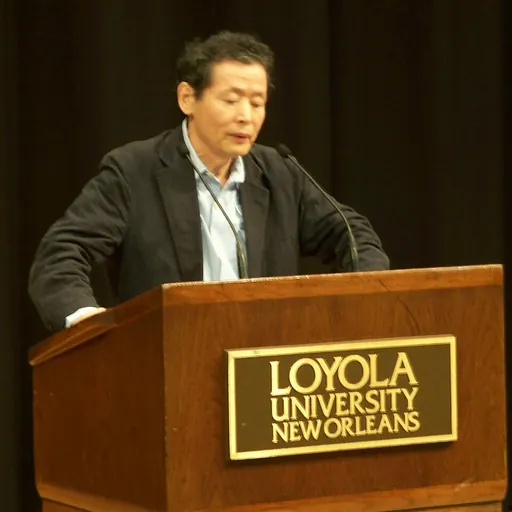
About Kojin Karatani
Born 1941. Kojin Karatani is a Japanese philosopher, writer, university teacher, literary critic and literary scholar.
is a Japanese philosopher and literary critic.
Biography
Karatani entered the University of Tokyo in 1960, where he joined the radical Marxist Communist League, better known as "The Bund," and participated in the massive 1960 Anpo protests against the U.S.-Japan Security Treaty, which he would later come to view as a formative political experience.
Karatani graduated with a B.A. in economics in 1965, and added an M.A. in English literature in 1967. The Gunzō Literary Prize, which he received at the age of 27 for an essay on Natsume Sōseki, was his first critical acclaim as a literary critic. While teaching at Hosei University, Tokyo, he wrote extensively about modernity and postmodernity with a particular focus on language, number, and money, concepts that form the subtitle of one of his central books: Architecture as Metaphor.
In 1975, he was invited to Yale University to teach Japanese literature as a visiting professor, where he met Paul de Man and Fredric Jameson and began to work on formalism. He started from a study of Natsume Sōseki.
Karatani collaborated with novelist Kenji Nakagami, to whom he introduced the works of Faulkner. With Nakagami, he published Kobayashi Hideo o koete (Overcoming Kobayashi Hideo). The title is an ironic reference to “Kindai no chokoku” (Overcoming Modernity), a symposium held in the summer of 1942 at Kyoto Imperial University (now Kyoto University) at which Hideo Kobayashi (whom Karatani and Nakagami did not hold in great esteem) was a participant.
He was also a regular member of ANY, the international architects' conference that was held annually for the last decade of the 20th century and that also published an architectural/philosophical series with Rizzoli under the general heading of Anyone.
Since 1990, Karatani has been regularly teaching at Columbia University as a visiting professor.
Karatani founded the New Associationist Movement (NAM) in Japan in the summer of 2000. NAM was conceived as a counter–capitalist/nation-state association, inspired by the experiment of LETS (Local Exchange Trading Systems, based on non-marketed currency). He was also the co-editor, with Akira Asada, of the Japanese quarterly journal Hihyōkūkan (Critical Space), until it ended in 2002.
In 2006, Karatani retired from the chair of the International Center for Human Sciences at Kinki University, Osaka, where he had been teaching.
In 2022, Karatani was awarded the $1 million Berggruen Prize for Culture and Philosophy.
Philosophy Karatani has produced philosophical concepts, such as "the will to architecture", which he calls the foundation of all Western thinking, but the best-known of them is probably that of "transcritique", which he proposed in his book Transcritique, where he reads Kant through Marx and vice versa. Writing about Transcritique in the New Left Review of January–February 2004, Slavoj Žižek brought Karatani's work to greater critical attention. Žižek borrowed the concept of "parallax view" (which is also the title of his review) for the title of his own 2006 book, The Parallax View.
Karatani has interrogated the possibility of a (de Manian) deconstruction and engaged in a dialogue with Jacques Derrida at the Second International Conference on Humanistic Discourse, organized by the Université de Montréal. Derrida commented on Karatani's paper "Nationalism and Ecriture" with an emphasis on the interpretation of his own concept of écriture.
Don’t just read it —
keep it.
Full-length biographies made to live with: read them, listen on the way to work, watch them tonight.
- E-book
- Audio
- Video
Instant download · yours to keep · every purchase keeps this site free
Important facts
People in Kojin Karatani's life
Named in this biography and alive at the same time

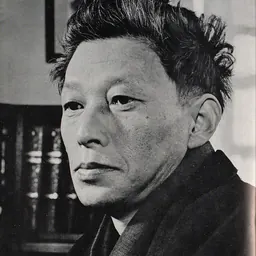

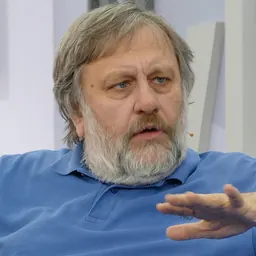



Related people
Same field, nearest in time

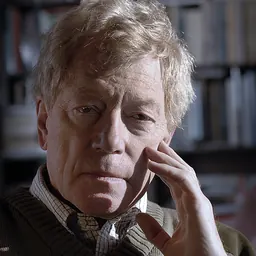

Contemporaries
People whose lives overlapped Kojin Karatani's


Frequently asked questions
Who is Kojin Karatani?
Japanese philosopher
When was Kojin Karatani born?
Kojin Karatani was born on 6 August 1941 in Amagasaki.
What is Kojin Karatani's occupation?
Kojin Karatani is a philosopher, writer, university teacher, literary critic and literary scholar.
What nationality is Kojin Karatani?
Kojin Karatani is Japanese.
Sources & further reading
Cite this page
APA: Biography.guide. (2026). Kojin Karatani. https://biography.guide/kojin-karatani/
MLA: "Kojin Karatani." Biography.guide, https://biography.guide/kojin-karatani/.
Chicago: "Kojin Karatani." Biography.guide. https://biography.guide/kojin-karatani/.
Data last updated: 2026-09-22 · Spot an error? Report a correction.
Portrait: Wikimedia Commons · author & licence
Page generated 2026-09-27 05:01 UTC