
About Kazimierz Sosnkowski
Lived 1885 – 1969 (aged 83). Kazimierz Sosnkowski was a Polish military personnel and politician.
General Kazimierz Sosnkowski (; 19 November 1885 – 11 October 1969) was a Polish independence fighter, general, diplomat, and architect.
He was a major political figure and an accomplished commander, notable in particular for his contributions during the Polish–Soviet War and World War II. After the death of General Władysław Sikorski in July 1943, Sosnkowski became Commander-in-chief of the Polish Armed Forces.
Sosnkowski was an intellectual who was able to speak Latin, Greek, English, French, German, Italian, and Russian.
Early years
Born in Warsaw, Sosnkowski grew up in the Russian Partition of Poland. His father, Józef Sosnkowski of the Godziemba coat of arms, was a wealthy nobleman and owner of several villages. His mother was Zofia Drabińska. In 1896 he attended the V Gimnasium (secondary school) in Warsaw, where he participated in a secret organization of progressive youth. To avoid persecution he moved in 1904 to Saint Petersburg, where in 1905 he finished the XII Gimnasium. The same year he passed the entrance exam to the Department of Architecture at Warsaw Polytechnic. In 1906, a boycott of the school by the students was declared and the polytechnic was closed, which prevented Sosnkowski from studying there.
Polish Socialist Party and paramilitary organizations
Already in 1904, having met Józef Piłsudski, the future leader of Poland, and influenced by him, Sosnkowski joined the Polish Socialist Party (PPS). In February 1906, he participated in the VIII Congress of the PPS in Lwów. Sosnkowski joined the Combat Organization of the Polish Socialist Party and quickly advanced there. He became the commandant of the organization's Warsaw District. He led a series of attacks on Russian police posts. In 1907, he enrolled as a student at Lwów Polytechnic. At that time he led the military works of the Polish Socialist Party – Revolutionary Faction. He became close to Piłsudski. He was criticized in the PPS for his risky tactics, which caused him to be pursued by the tsar's secret police. He hid in Radom and then in the Dąbrowski Basin (Zagłębie Dąbrowskie), where he also led the Combat Organization's districts. In Lwów, his studies were interrupted by his intense political involvement. In 1908, he became a member of the main council of the Union of Active Struggle (Związek Walki Czynnej). Sosnkowski implemented socially radical elements in the program of the new organization, but Piłsudski wanted them removed. In 1910, the union created paramilitary units the Riflemen's Association (Związek Strzelecki) (in Lwów) and Strzelec (in Kraków). After the Riflemen's Association was formed as a legal front, Sosnkowski became its chief of staff. He readily accepted Piłsudski's idea of fighting on the side of Austria-Hungary in the emerging world conflict. In 1914, he finished his studies of architecture but the war prevented him from taking final exams. even though he was considered to be primarily an army organizer, with limited field experience. Sosnkowski then assumed overall responsibility for supply, logistics, recruitment and rear echelon organization. He commanded defense units in Warsaw in August. For his wartime contributions Sosnkowski received the Virtuti Militari Class II cross. He was among the negotiators of the Peace of Riga.
By 1925, Sosnkowski and Piłsudski parted ways. Sosnkowski was not informed by Piłsudski about his plans for the 1926 coup. When President Stanisław Wojciechowski demanded during the coup that military forces come to the government's aid, Sosnkowski dispatched the units under his command accordingly. On 13 May he tried to commit suicide, which he felt was the only honorable way out of his predicament. After recuperation, he returned to military service in 1927. Despite the cooling of relations with Piłsudski, Sosnkowski retained his trust. In 1927 he was appointed inspector of Army Podole and Army Wołyń, and in 1928 of Army Polesie. He became head of the Committee for Matters of Armaments and Equipment and remained in that position until the outbreak of World War II. After Piłsudski's death in 1935 Sosnkowski, unable to reconcile his differences with Marshal Rydz-Śmigły, was pushed aside. In the Sanation camp, he favored dialogue with opposition groups. This approach was rejected by Rydz-Śmigły and President Ignacy Mościcki. Sosnkowski strongly criticized their policies, including the annexation of Trans-Olza in 1938, which he steadfastly opposed. Sosnkowski was not assigned a military role in the plans for the 1939 defense of the country.
Some Poles protested, including Prime Minister Ignacy Daszyński, who called the order shameful and demanded the Polish-Jewish inmates’ immediate release and return to active duty. Jewish members of Polish parliament expressed outrage, writing to Sosnkowski on 19 August 1920 that "such orders instill the conviction that Jews are enemies of the state…". By 9 September 1920, when Sosnkowski ordered the release of all Polish-Jewish soldiers at Jabłonna, about 17,680 had been interned. No deaths or injuries were reported.
World War II
During the German invasion which began on 1 September 1939, Sosnkowski proposed forming a group of armies in the region of Warsaw and Kutno, in order to tie up the German forces there. His ideas were rejected by Rydz-Śmigły, which may have resulted in uncoordinated military activity and eventually the Polish defeat in the Battle of the Bzura. Only on 11 September was Sosnkowski appointed commander of the Southern Front. Retreating toward Lwów, he conducted several victorious engagements with German forces. The Soviet invasion of 17 September made further southeasterly withdrawal impossible, and Sosnkowski ordered his army, defeated by 22 September, to disperse. Disguised, he crossed the Soviet-occupied territory and reached Hungary. Because of his unyielding attitude toward the Soviet Union, until 1949 he was denied American and British visas.
After the war
Between 1952 and 1954 Sosnkowski was active in the unification movement of the various Polish émigré groups and was instrumental in the signing of the 1954 Act of National Unification in London. Toward the end of his life, he enjoyed considerable respect in the Polish émigré community. Polonia's stadium in Warsaw, opened in 1928, is named after General Sosnkowski.
Over his career, Sosnkowski used a number of noms de guerre, including Baca (Polish mountaineer term for shepherd), Godziemba (the name of his hereditary coat-of-arms), Józek (Polish nickname for Joseph), Ryszard (Richard), Szef (Chief).
Sosnkowski was married to Jadwiga Sosnkowska. They had five sons: Alexander, Peter, Anthony, John and Joseph. The last three lived in Canada, whereas Alexander lived in the U.S. and Peter split his time between the U.S. and France. John died in Cornwall, Ontario, Canada, on 25 April 2009; Anthony in Charlottetown, Prince Edward Island, Canada, 26 June 2012; Joseph, in Victoria, British Columbia, Canada, 6 November 2011; Alexander in Quincy, Illinois, U.S.A., 30 March 2015.
Promotions
Honours and awards
60px Academic Golden Laurel of the Polish Academy of Literature for oratory.
Don’t just read it —
keep it.
Full-length biographies made to live with: read them, listen on the way to work, watch them tonight.
- E-book
- Audio
- Video
Instant download · yours to keep · every purchase keeps this site free
Important facts
People in Kazimierz Sosnkowski's life
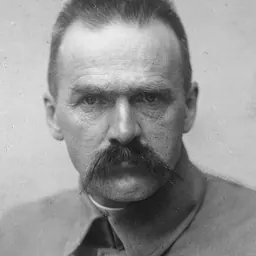
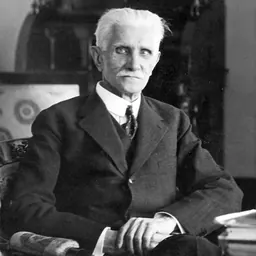
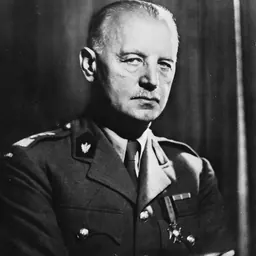
Named in this biography and alive at the same time





Related people
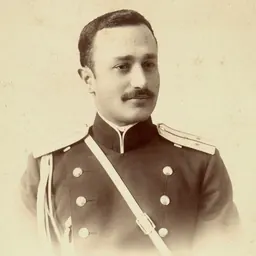
Same field, nearest in time




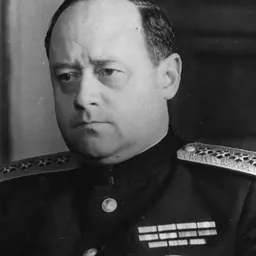
Contemporaries
People whose lives overlapped Kazimierz Sosnkowski's
Frequently asked questions
Who was Kazimierz Sosnkowski?
Polish general and politician (1885-1969)
When was Kazimierz Sosnkowski born?
Kazimierz Sosnkowski was born on 19 November 1885 in Warsaw.
When did Kazimierz Sosnkowski die?
Kazimierz Sosnkowski died on 11 October 1969 in Arundel.
What was Kazimierz Sosnkowski's occupation?
Kazimierz Sosnkowski was a military personnel and politician.
What nationality was Kazimierz Sosnkowski?
Kazimierz Sosnkowski was Polish.
Sources & further reading
· Wikipedia: Kazimierz Sosnkowski
· DBpedia: Kazimierz Sosnkowski
Cite this page
APA: Biography.guide. (2026). Kazimierz Sosnkowski. https://biography.guide/kazimierz-sosnkowski/
MLA: "Kazimierz Sosnkowski." Biography.guide, https://biography.guide/kazimierz-sosnkowski/.
Chicago: "Kazimierz Sosnkowski." Biography.guide. https://biography.guide/kazimierz-sosnkowski/.
Data last updated: 2026-09-20 · Spot an error? Report a correction.
Page generated 2026-09-27 05:32 UTC