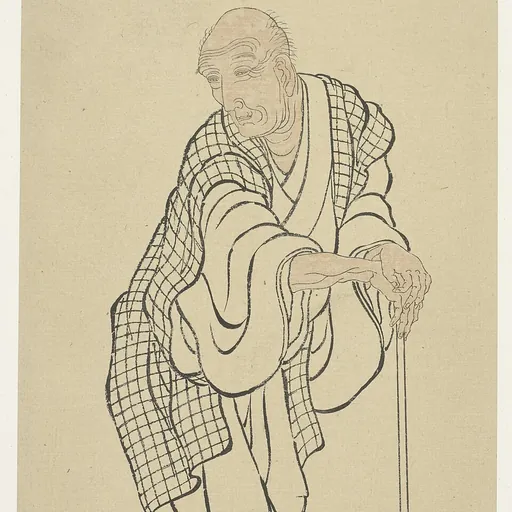
About Katsushika Hokusai
Lived 1760 – 1849 (aged 88). Katsushika Hokusai was a Japanese painter, xylographer, illustrator, ukiyo-e artist, artist and graphic artist.
was a Japanese ukiyo-e artist of the Edo period, active as a painter and printmaker. His woodblock print series Thirty-Six Views of Mount Fuji includes the iconic print The Great Wave off Kanagawa. Hokusai was instrumental in developing ukiyo-e from a style of portraiture largely focused on courtesans and actors into a much broader style of art that focused on landscapes, plants, and animals. His works had a significant influence on Vincent van Gogh and Claude Monet during the wave of Japonisme that spread across Europe in the late 19th century.
Hokusai created the monumental Thirty-Six Views of Mount Fuji as a response to a domestic travel boom in Japan and as part of a personal interest in Mount Fuji.
Hokusai was best known for his woodblock ukiyo-e prints, but he worked in a variety of mediums including painting and book illustration. Starting as a young child, he continued working and improving his style until his death, aged 88. In a long and successful career, Hokusai produced over 30,000 paintings, sketches, woodblock prints, and images for picture books. Innovative in his compositions and exceptional in his drawing technique, Hokusai is considered one of the greatest masters in the history of art.
Early life
Hokusai's date of birth is unclear, but is often stated as the 23rd day of the 9th month of the 10th year of the Hōreki era (in the old calendar, or 31 October 1760) to an artisan family, in the Katsushika[ja] district of Edo, the capital of the ruling Tokugawa shogunate (currently Katsushika-ku, Tokyo).
Hokusai was known by at least thirty names during his lifetime. While the use of multiple names was a common practice of Japanese artists of the time, his number of pseudonyms exceeds that of any other major Japanese artist. His name changes are so frequent, and so often related to changes in his artistic production and style, that they are used for breaking his life up into periods. Fireworks in the Cool of Evening at Ryogoku Bridge in Edo dates from this period of Hokusai's life.
Upon the death of Shunshō in 1793, Hokusai began exploring other styles of art, including European styles he was exposed to through French and Dutch copper engravings he was able to acquire. That year, he published two collections of landscapes, Famous Sights of the Eastern Capital and Eight Views of Edo (modern Tokyo). He also began to attract students of his own, eventually teaching 50 pupils over the course of his life. Another story places him in the court of the shōgun Tokugawa Ienari, invited there to compete with another artist who practised more traditional brushstroke painting. Hokusai painted a blue curve on paper, then chased a chicken whose feet had been dipped in red paint across the image. He described the painting to the shōgun as a landscape showing the Tatsuta River with red maple leaves floating in it, winning the competition. Hokusai's collaboration with the kabuki actor Onoe Baikō also began inauspiciously, as Hokusai initially declined a commission for a ghost painting the actor wished to use in his stage performances. Hokusai also created several albums of erotic art (shunga). His most famous image in this genre is The Dream of the Fisherman's Wife, which depicts a young woman entwined sexually with a pair of octopuses, from Kinoe no Komatsu, a three-volume book of shunga from 1814.
Hokusai paid close attention to the production of his work. In letters during his involvement with Toshisen Ehon, a Japanese edition of an anthology of Chinese poetry, Hokusai wrote to the publisher that the blockcutter Egawa Tomekichi, with whom Hokusai had previously worked and whom he respected, had strayed from Hokusai's style in the cutting of certain heads. He also wrote directly to another blockcutter involved in the project, Sugita Kinsuke, stating that he disliked the Utagawa school style in which Kinsuke had cut the figure's eyes and noses and that amendments were needed for the final prints to be true to his style. In his letter, Hokusai included examples of both his style of illustrating eyes and noses and the Utagawa school style.
In 1811, at the age of 51, Hokusai changed his name to Taito and entered the period in which he created the Hokusai Manga and various etehon, or art manuals. By 1820, he had produced twelve volumes (with three more published posthumously) which include thousands of drawings of objects, plants, animals, religious figures, and everyday people, often with humorous overtones. Although the original was destroyed in 1945, Hokusai's promotional handbills from that time survived and are preserved at the Nagoya City Museum.
In 1820, Hokusai changed his name yet again, this time to Iitsu, a change which marked the start of a period in which he secured fame as an artist throughout Japan. His most celebrated work, Thirty-six Views of Mount Fuji, including the famous The Great Wave off Kanagawa and Red Fuji was produced in the early 1830s. The results of Hokusai's perspectival studies in Manga can be seen here in The Great Wave where he uses what would have been seen as a western perspective to represent depth and volume. It proved so popular that ten more prints were later added to the series. Among the other popular series of prints he made during this time are A Tour of the Waterfalls of the Provinces, Oceans of Wisdom and Unusual Views of Celebrated Bridges in the Provinces. generally considered "the masterpiece among his landscape picture books".
A True Mirror of Chinese and Japanese Poetry (Shika shashin kyo), produced in about 1833 to 1834, was printed in extra-long vertical formats resembling the form of Chinese hand scrolls. Prints in this series include poems by Chinese and Japanese poets combined with scenes in those countries, and scenes from Noh plays (a form of dance theater predating kabuki). Ten designs in this series survive. Hokusai's Great Picture Book of Everything, now in the British Museum, a set of drawings from the 1820s to the 1840s, offers unique insights into his practices since the book was never made, so the drawings never destroyed as typically happened in the woodblock making process. These images focus on Buddhist India, ancient China and the natural world.
Hokusai's final print series, produced around 1835 to 1836, was called One Hundred Poems Explained by a Nurse (Hyakunin isshu tuba ga etoki). The series was never published in full, perhaps due to financial hardships faced by Hokusai's publishers during Japan's economic downturn in the mid-1830s. These prints featured scenes with the poems inscribed in a square. Each print also contains the series title listed in its own vertical rectangle.
In 1839, a fire destroyed Hokusai's studio and much of his work. By this time, his career was beginning to fade as younger artists such as Andō Hiroshige became increasingly popular. At the age of 83, Hokusai traveled to Obuse in Shinano Province (now Nagano Prefecture) at the invitation of a wealthy farmer, Takai Kozan, where he stayed for several years. During his time in Obuse, he created several masterpieces, including the Masculine Wave and the Feminine Wave. Hokusai continued working almost until the end, painting The Dragon of Smoke Escaping from Mt Fuji and Tiger in the Snow in early 1849.
Constantly seeking to produce better work, he apparently exclaimed on his deathbed, "If only Heaven will give me just another ten years ... Just another five more years, then I could become a real painter". He died on 10 May 1849 and was buried at the Seikyō-ji (誓教寺) in Tokyo (Taito Ward). Hokusai was an early experimenter with western linear perspective among Japanese artists. Hokusai himself was influenced by Sesshū Tōyō and other styles of Chinese painting. Félix Bracquemond first came across a copy of a Hokusai sketchbook at the workshop of August Dalatre, his printer.
With the sketchbook as his influence Bracquemond designed the "Rousseau Service", an elegant set of dinnerware, on behalf of Francois-Eugene Rousseau, the owner of a glass and ceramics shop. Exhibited at the Universal Exposition in Paris in 1867, the Rousseau Service was a success both critically and commercially and was reissued in several editions over the years. The Rousseau Service featured images of birds and fish copied from the Japanese book illustrations and placed asymmetrically against a white background for a look that would have been very modern at that time.
Hokusai also influenced the Impressionism movement, with themes echoing his work appearing in the work of Claude Monet and Pierre-Auguste Renoir, as well as Art Nouveau, or Jugendstil in Germany. His woodcuts were collected by many European artists, including Degas, Gauguin, Klimt, Franz Marc, August Macke, Édouard Manet, and van Gogh. Hermann Obrist's whiplash motif, or Peitschenhieb, which came to exemplify the new movement, is visibly influenced by Hokusai's work.
The French composer Claude Debussy's tone poem La Mer, which debuted in 1905, is believed to have been inspired by Hokusai's print The Great Wave. The composer had an impression of it hanging in his living room and specifically requested that it be used on the cover of the published score, which was widely distributed, and the music itself incorporated Japanese-inflected harmonies.
Even after his death, exhibitions of his artworks continue to grow. In 2005, Tokyo National Museum held a Hokusai exhibition which had the largest number of visitors of any exhibit there that year. Several paintings from the Tokyo exhibition were also exhibited in the United Kingdom. The British Museum held the first exhibition of Hokusai's later year artworks including The Great Wave in 2017.
Hokusai inspired the Hugo Award–winning short story by science fiction author Roger Zelazny, "24 Views of Mt. Fuji, by Hokusai", in which the protagonist tours the area surrounding Mount Fuji, stopping at locations painted by Hokusai. A 2011 book on mindfulness closes with the poem "Hokusai Says" by Roger Keyes, preceded with the explanation that "ometimes poetry captures the soul of an idea better than anything else".
In the 1985 Encyclopædia Britannica, Richard Lane characterizes Hokusai as "since the later 19th century [having] impressed Western artists, critics and art lovers alike, more, possibly, than any other single Asian artist".
Store Selling Picture Books and Ukiyo-e by Hokusai shows how ukiyo-e during the time was actually sold; it shows how these prints were sold at local shops, and ordinary people could buy ukiyo-e. Unusually in this image, Hokusai used a hand-colored approach instead of using several separated woodblocks.
His youngest daughter Ei has her own manga and film called Miss Hokusai.
A biographical film about the painter was released in Japan on 28 May 2021. It was premiered at the 33rd Tokyo International Film Festival.
Don’t just read it —
keep it.
Full-length biographies made to live with: read them, listen on the way to work, watch them tonight.
- E-book
- Audio
- Video
Instant download · yours to keep · every purchase keeps this site free
Important facts
more
Tatsumasa, Pei-chai Ko-shih, Raishin, Katsushika Taito, Taito, Hokusai Tokimasa, Fusenkyo, Iitsu Katsushika, Zenhokusai, Hachiemon Miuraya, Iitsu, Hokusai Katsushika, ShunroPeople in Katsushika Hokusai's life
Named in this biography and alive at the same time



Related people
Same field, nearest in time




Contemporaries
People whose lives overlapped Katsushika Hokusai's





Frequently asked questions
Who was Katsushika Hokusai?
Japanese artist (1760-1849)
When was Katsushika Hokusai born?
Katsushika Hokusai was born on 31 October 1760 in Honjo, Honjo.
When did Katsushika Hokusai die?
Katsushika Hokusai died on 10 May 1849 in Asakusa.
What was Katsushika Hokusai's occupation?
Katsushika Hokusai was a painter, xylographer, illustrator, ukiyo-e artist, artist and graphic artist.
What nationality was Katsushika Hokusai?
Katsushika Hokusai was Japanese.
Sources & further reading
· Wikipedia: Katsushika Hokusai
Cite this page
APA: Biography.guide. (2026). Katsushika Hokusai. https://biography.guide/katsushika-hokusai/
MLA: "Katsushika Hokusai." Biography.guide, https://biography.guide/katsushika-hokusai/.
Chicago: "Katsushika Hokusai." Biography.guide. https://biography.guide/katsushika-hokusai/.
Data last updated: 2026-09-20 · Spot an error? Report a correction.
Portrait: Wikimedia Commons · author & licence
Page generated 2026-09-27 05:08 UTC