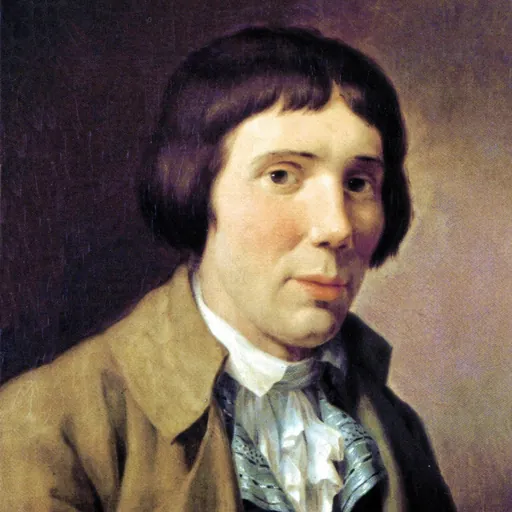
About Karl Philipp Moritz
Lived 1756 – 1793 (aged 36). Karl Philipp Moritz was a German writer, essayist and publisher.
Karl Philipp Moritz (Hameln, 15 September 1756 – Berlin, 26 June 1793) was a German author, editor and essayist of the Sturm und Drang, late Enlightenment, and classicist periods, influencing early German Romanticism as well. He led a life as a hatter's apprentice, teacher, journalist, literary critic, professor of art and linguistics, and member of both of Berlin's academies.
Biography Moritz was born into impoverished circumstances in Hameln in 1756. After receiving a scanty schooling, he was apprenticed to a hat maker. After distressful attempts to gain a living, he caught the attention of a patron in Hanover and entered a gymnasium; however, he soon accepted an engagement as actor under Ekhof at Gotha, failing in which he returned to study (1776) at Erfurt; but tiring again he joined the Herrnhuter (Moravian Church) at Barby, and studied theology at Wittenberg (1777); then taught philanthropy at the Potsdam military orphanage, soon again to take to wandering.
Teaching in Berlin, he made a reputation as writer, preacher and poet, and went to England. Then he became professor at the gymnasium (high school) at Berlin . Next he tried editing the Vossische Zeitung to make it proletarian, but failed. Later he traveled to Italy (1786) where he met Goethe, and on his return to Germany he took up residence as Goethe's guest at Weimar. Duke Karl August helped him join the Berlin Academy of Sciences, and in 1789 Moritz became a professor of antiquities at the Royal Academy of Fine Arts in Berlin. Among his students were Ludwig Tieck, Wilhelm Heinrich Wackenroder and Alexander von Humboldt. He was an avid admirer of Jean Paul, and befriended Moses Mendelssohn, and Asmus Jakob Carstens.
Works Apart from a four-part autobiographical novel, Anton Reiser, and two fictional Andreas Hartknopf novels, he also wrote a number of theoretical writings on aesthetics, especially "Über die bildende Nachahmung des Schönen" (On the Formative Imitation of Beauty), which Goethe excerpted in his Italian Journey. Moritz's Magazin zur Erfahrungsseelenkunde als ein Lesebuch für Gelehrte und Ungelehrte (Journal of Experiential Psychology, as reading for scholars and laymen) was one of the first Germanophone journals of psychology. His works include:
Blunt oder der Gast, 1781 Beiträge zur Philosophie des Lebens aus dem Tagebuch eines Freimäurers , 1780 Magazin zur Erfahrungsseelenkunde als ein Lesebuch für Gelehrte und Ungelehrte. 1783–1793 Reisen eines Deutschen in England im Jahre 1782, 1783. English: Journeys of a German in England in 1782 Ideal einer vollkommnen Zeitung, 1784 Anton Reiser (Part 1), 1785 Andreas Hartknopf, Eine Allegorie, 1785 Anton Reiser (Parts 2 and 3), 1786 Denkwürdigkeiten, aufgezeichnet zur Beförderung des Edlen und Schönen, 1786 Versuch einer deutschen Prosodie, 1786 Versuch einer kleinen praktischen Kinderlogik, 1786 Fragmente aus dem Tagebuche eines Geistersehers, 1787 Über die bildende Nachahmung des Schönen, 1788 Italien und Deutschland, 1789 Monats-Schrift der Akademie der Künste und Mechanischen Wissenschaften zu Berlin, 1789 Über eine Schrift des Herrn Schulrath Campe, und über die Rechte des Schriftstellers und Buchhändlers, 1789 Andreas Hartknopfs Predigerjahre, 1790 Anton Reiser (Part 4), 1790 Neues ABC-Buch, 1790 Annalen der Akademie der Künste und Mechanischen Wissenschaften, 1791 Anthusa oder Roms Alterthümer, 1791 Götterlehre oder Mythologische Dichtungen der Alten, 1791 Grundlinien zu meinen Vorlesungen über den Styl, 1791 Italienische Sprachlehre für die Deutschen, 1791 Über die Vereinfachung der menschlichen Kenntnisse, 1791 Lesebuch für Kinder, 1792 Mythologischer Almanach für Damen, 1792 Reisen eines Deutschen in Italien in den Jahren 1786 bis 1788, 1792 Vom richtigen deutschen Ausdruck, 1792 Allgemeiner deutscher Briefsteller, 1793 Die große Loge oder der Freimaurer mit Waage und Senkblei, 1793 Grammatisches Wörterbuch (4 vols. 1793–1800) Mythologisches Wörterbuch zum Gebrauch für Schulen, 1793 Reisen eines Deutschen in Italien in den Jahren 1786 bis 1788, 1793 Vorbegriffe zu einer Theorie der Ornamente, 1793 Vorlesungen über den Styl (Part 1), 1793 Die neue Cecilia, (1793, fragment)
Don’t just read it —
keep it.
Full-length biographies made to live with: read them, listen on the way to work, watch them tonight.
- E-book
- Audio
- Video
Instant download · yours to keep · every purchase keeps this site free
Important facts
People in Karl Philipp Moritz's life
Named in this biography and alive at the same time


Related people
Same field, nearest in time

Contemporaries
People whose lives overlapped Karl Philipp Moritz's




Frequently asked questions
Who was Karl Philipp Moritz?
German author, editor and essayist
When was Karl Philipp Moritz born?
Karl Philipp Moritz was born on 15 September 1756 in Hamelin.
When did Karl Philipp Moritz die?
Karl Philipp Moritz died on 26 June 1793 in Berlin.
What was Karl Philipp Moritz's occupation?
Karl Philipp Moritz was a writer, essayist and publisher.
What nationality was Karl Philipp Moritz?
Karl Philipp Moritz was German.
Sources & further reading
· Wikipedia: Karl Philipp Moritz
· DBpedia: Karl Philipp Moritz
Cite this page
APA: Biography.guide. (2026). Karl Philipp Moritz. https://biography.guide/karl-philipp-moritz/
MLA: "Karl Philipp Moritz." Biography.guide, https://biography.guide/karl-philipp-moritz/.
Chicago: "Karl Philipp Moritz." Biography.guide. https://biography.guide/karl-philipp-moritz/.
Data last updated: 2026-09-21 · Spot an error? Report a correction.
Portrait: Wikimedia Commons · author & licence
Page generated 2026-09-27 04:59 UTC