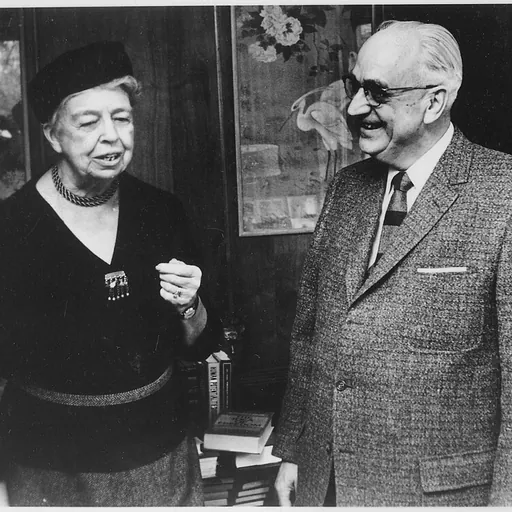
About Karl Menninger
Lived 1893 – 1990 (aged 96). Karl Menninger was an American psychiatrist, academic, non-fiction writer and businessperson.
Karl Augustus Menninger (July 22, 1893 – July 18, 1990) was an American psychiatrist, author, and activist. He was a member of the Menninger family of psychiatrists who founded the Menninger Foundation and the Menninger Clinic in Topeka, Kansas.
He wrote many books including The Human Mind (1930), Man Against Himself (1938), Love Against Hate (1942), The Vital Balance (1963) and The Crime of Punishment (1968). During his life he advocated for a number of causes including children suffering from abuse or neglect, Native Americans, women's rights, prisoners, the elderly, the environment, wildlife, and against nuclear weapons.
Despite being one of the most famous psychiatrists during his time, he was an outsider to mainstream psychiatry, calling the DSM-II a modern "Witches Hammer Manual."
Early life Menninger was born on July 22, 1893, in Topeka, Kansas, the son of Florence Vesta (Kinsley) and Charles Frederick Menninger. In addition to studying at Washburn University, Indiana University and the University of Wisconsin–Madison, he also studied medicine at Harvard Medical School. He graduated from the school cum laude in 1917. While at Washburn, he was a member of the Alpha Delta Fraternity, a local group. In 1960 he was inducted into the school's Sagamore Honor Society.
After his internship and his service as part of the Naval Reserve during World War I, Menninger worked at the Boston Psychopathic Hospital under Elmer Ernest Southard while also teaching neuropathology at Harvard Medical School. He would remain until the death of Southard in 1919
Menninger Clinic, Foundation and School In 1919, he returned to Topeka where, together with his father, he founded the Menninger Clinic. By 1925, they had attracted enough investors, including brother William C. Menninger, to build the Menninger Sanitarium.
The Menninger Foundation was established in 1941. After World War II, Karl Menninger was instrumental in founding the Winter Veterans Administration Hospital, in Topeka. It became the largest psychiatric training center in the world.
While the clinic housed Freudian analysts, there was no commitment to any one form of therapy and a belief in the therapeutic value of a warm and caring environment. It was renamed in his honor in 1985 as the Karl Menninger School of Psychiatry and Mental Health Science. In 1952, Karl Targownik, who would become one of his closest friends, joined the Clinic.
Other psychiatric work In 1930, he wrote his first book The Human Mind, where he argued that psychiatry was a science and that the mentally ill were only slightly different from healthy individuals.
From 1941-1942 he would serve a term as the president of the American Psychoanalytic Association (APsA).
In his 1963 book, The Vital Balance, he and his co-authors disagreed with diagnoses as they existed in psychiatry. While not going as far as saying mental illness is a myth, the book talked about mental disorganization as more generalized and more recoverable than was seen in mainstream psychiatry.
He was considered an outsider to mainstream psychiatry, for example calling the 1968 DSM-II a modern “Witches Hammer Manual”.
Prison reform Karl Menninger and with his brother Will had been activists for prison reform for a while before publishing The Crime of Punishment. In the book and elsewhere, Menninger argued that current prison system was based on a "vindictive attitude" toward crime and on retributive justice and that correctional facilities did little "correcting" of behavior. He argued that crime was preventable and real rehabilitation possible through educational programs.
He also called homosexuality an evil and a sin in a 1963 introduction to the American edition of the Wolfenden Report
Memberships in organizations He was among the first members of the Society for General Systems Research. Menninger remarried on September 9, 1941, taking Jeanette Lyle as his wife. Together they adopted a daughter named Rosemary in 1948. as well as a Freemason
Death He died of abdominal cancer July 18, 1990, four days before his 97th birthday.
Honors Beginning in 1962, the American Psychiatric Association gave Menninger the Isaac Ray Award, then The First Distinguished Service Award in 1965, and the First Founders Award in 1977. In 1978 The American Medical Association gave Menninger the Sheen Award. In 1981, Menninger was awarded the Presidential Medal of Freedom by Jimmy Carter. In 1985, the Menninger School of Psychiatry was named for him.
Publications Menninger wrote several books and articles. A selection: 1930. The Human Mind. Garden City, NY: Garden City Pub. Co. 1931. From Sin to Psychiatry, an Interview on the Way to Mental Health with Dr. Karl A. Menninger [by] L. M. Birkhead. Little Blue Books Series #1585. Girard, Kansas: Haldeman-Julius Press. 1938. Man Against Himself. New York: Harcourt, Brace. 1942. Love Against Hate 1950. Guide to Psychiatric Books; with a Suggested Basic Reading List. New York: Grune & Stratton. 1952. Manual for Psychiatric Case Study. New York: Grune & Stratton. 1958. Theory of Psychoanalytic Technique. New York: Basic Books. 1959. A Psychiatrist's World: Selected Papers. New York: Viking Press. 1963. The Vital Balance: The Life Process in Mental Health and Illness. New York: Viking Penguin. 1968. Das Leben als Balance; seelische Gesundheit und Krankheit im Lebensprozess. München: R. Piper. 1968. The Crime of Punishment. New York: Penguin Books. 1972. A Guide to Psychiatric Books in English [by] Karl Menninger. New York: Grune & Stratton. 1973 Sparks 1973. Whatever Became of Sin?. New York: Hawthorn Books. 1978. The Human Mind Revisited: Essays in Honor of Karl A. Menninger. Edited by Sydney Smith. New York: International Universities Press. 1981. Sexuality, Law, and the Developmentally Disabled Person: Legal and Clinical Aspects of Marriage, Parenthood and Sterilization (with Sarah R. Haavik) 1985. Conversations with Dr. Karl Menninger (sound recording) 1989. The Selected Correspondence of Karl A. Menninger 1919-1945 1995. The Selected Correspondence of Karl A. Menninger 1946-1965
Don’t just read it —
keep it.
Full-length biographies made to live with: read them, listen on the way to work, watch them tonight.
- E-book
- Audio
- Video
Instant download · yours to keep · every purchase keeps this site free
Important facts
People in Karl Menninger's life
Named in this biography and alive at the same time



Related people
Same field, nearest in time


Contemporaries
People whose lives overlapped Karl Menninger's

Frequently asked questions
Who was Karl Menninger?
American psychiatrist
When was Karl Menninger born?
Karl Menninger was born on 22 July 1893 in Topeka.
When did Karl Menninger die?
Karl Menninger died on 18 July 1990 in Topeka.
What was Karl Menninger's occupation?
Karl Menninger was a psychiatrist, academic, non-fiction writer and businessperson.
What nationality was Karl Menninger?
Karl Menninger was American.
Sources & further reading
Cite this page
APA: Biography.guide. (2026). Karl Menninger. https://biography.guide/karl-menninger-psychiatrist/
MLA: "Karl Menninger." Biography.guide, https://biography.guide/karl-menninger-psychiatrist/.
Chicago: "Karl Menninger." Biography.guide. https://biography.guide/karl-menninger-psychiatrist/.
Data last updated: 2026-09-23 · Spot an error? Report a correction.
Portrait: Wikimedia Commons · author & licence
Page generated 2026-09-27 05:06 UTC