
About Karl Hess
Born 1945. Karl Hess is an Austrian and American physicist and university teacher, known for Computational electronics, Quantum mechanics and Simulation.
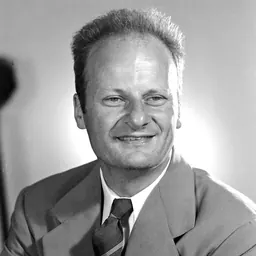
Karl Hess (born 20 June 1945 in Trumau, Austria) is the Swanlund Professor Emeritus in the Department of Electrical and Computer Engineering at the University of Illinois at Urbana–Champaign (UIUC). He helped to establish the Beckman Institute for Advanced Science and Technology at UIUC.
Hess is concerned with solid-state physics and the fundamentals of quantum mechanics. He is recognized as an expert in electron transport, semiconductor physics, supercomputing, and nanostructures. A leader in simulating the nature and movement of electrons with computer models, Hess is considered a founder of computational electronics.
In 1973 Hess went to the University of Illinois at Urbana-Champaign (UIUC) on a Fulbright scholarship to work with John Bardeen. With Chih-Tang Sah (the co-inventor of CMOS technology), Hess worked theoretically on electron transport in transistors, to find a solution of the Boltzmann transport equation for transistors.
Hess became "a leading theoretician in the realm of semiconductor transistors". Around 1995, a conversation with nanolithographer Joseph W. Lyding suggested to Hess that using deuterium to passivate the surfaces of integrated circuits had the potential to increase the speed or the lifetime of the circuit. Hess and Isik Kizilyalli compared the degradation of CMOS transistor wafers prepared with either deuterium or hydrogen, and found that use of deuterium substantially increased transistor lifetimes. In the 1960s, John Stewart Bell predicted that the question of hidden variables could be experimentally tested: the outcome of specific experiments based on the hypothetical Einstein–Podolsky–Rosen (EPR) paradox should differ depending on whether or not hidden variables did or did not exist. Hess and mathematician Walter Philipp controversially claim that Bell's theorem is flawed. They argue that Bell's test can be made to fail by modeling temporal information. With this addition, existing experimental findings can be explained without resorting to hidden variables or "action at a distance". Others have argued that Hess and Philipp's formulation does not depend on new time parameters, but rather on a violation of the assumption of locality required by Bell.
Hess officially retired from the University of Illinois at Urbana-Champaign in May 2004, but remains the Swanlund Professor Emeritus. 2006-2008, National Science Board (NSB) 1997, Fellow, American Academy of Arts and Sciences 1995, Sarnoff Award, Institute of Electrical and Electronics Engineers (IEEE) "For contributions to high field transport and real space transfer effects in semiconductor heterolayer structures." 1994, Fellow, American Physical Society, "For contributions to nonlinear electronic transport in semiconductors and in quantum well heterostructures." 1994, Fellow, American Association for the Advancement of Science 1993, J. J. Ebers Award, IEEE, for "Contributions to Electronic Transport in Semiconductors and in Quantum Well Heterostructures at High Energies"
Books published
Don’t just read it —
keep it.
Full-length biographies made to live with: read them, listen on the way to work, watch them tonight.
- E-book
- Audio
- Video
Instant download · yours to keep · every purchase keeps this site free
Important facts
People in Karl Hess's life
Named in this biography and alive at the same time



Related people
Same field, nearest in time

Contemporaries
People whose lives overlapped Karl Hess's


Frequently asked questions
Who is Karl Hess?
Austrian physicist
When was Karl Hess born?
Karl Hess was born on 20 June 1945 in Trumau.
What is Karl Hess's occupation?
Karl Hess is a physicist and university teacher.
What is Karl Hess known for?
Karl Hess is known for Computational electronics, Quantum mechanics, Simulation and Solid-state physics.
What nationality is Karl Hess?
Karl Hess is Austrian and American.
Sources & further reading
· DBpedia: Karl Hess (scientist)
Cite this page
APA: Biography.guide. (2026). Karl Hess. https://biography.guide/karl-hess/
MLA: "Karl Hess." Biography.guide, https://biography.guide/karl-hess/.
Chicago: "Karl Hess." Biography.guide. https://biography.guide/karl-hess/.
Data last updated: 2026-09-20 · Spot an error? Report a correction.
Page generated 2026-09-27 05:07 UTC