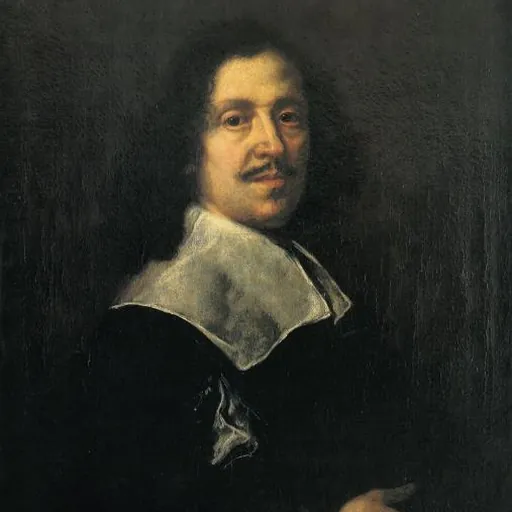
About Justus Sustermans
Lived 1597 – 1681 (aged 83). Justus Sustermans was a painter.
Justus Sustermans, Joost Sustermans or Suttermans, his given name Italianised to Giusto (28September 159723April 1681), was a Flemish painter and draughtsman who is mainly known for his portraits. He also painted history and genre paintings, still lifes and animals.
Sustermans is chiefly noted for his portraits of members of the Medici family as he was its court painter. The Holy Roman Emperor Ferdinand II invited him to Vienna to paint portraits of the Imperial family and granted Sustermans and his brothers patents of nobility. During his lifetime he was fêted as the finest portrait painter in Italy.
Life Justus Sustermans was born in Antwerp as the son of the tailor Frans Suttermans or Sustermans, originally from Bruges, and Esther Scheepmans. Justus was baptised in the Antwerp Cathedral on 28 September 1597. He was in 1609 registered as a pupil of Willem (or Gilliam) de Vos (a nephew of the painter Maerten de Vos) at the Antwerp Guild of Saint Luke. He left Antwerp for Paris in 1616, where he spent about two years in the workshop of Frans Pourbus the Younger, a prominent portrait painter from Antwerp.
When Cosimo II de' Medici, Grand Duke of Tuscany invited in 1620 a team of Flemish and French tapestry weavers from Paris to Tuscany, Suttermans joined them. The party likely reached Florence in October 1620. On 20 April 1621 he is first documented in Florence when the Compagnia dei SS Barbara e Quirino paid him for a painting of Saint Barbara. He is first recorded in the service of the Medici in October 1621. Suttermans gained this court appointment on the strength of a portrait of one of the tapestry weavers, a painting identified as a portrait of Pietro Févère or Ebert d'Egidio van Asselt.
As the Medici had many family connections with other courts in northern Italy and Austria, Sustermans often travelled to other cities in Italy as well as to Vienna. His brother Jan may have assisted with some of the portraits of the imperial family that Justus painted in Vienna. He returned to Florence by 17 February 1625, when he enrolled in the Accademia del Disegno. He commissioned from Rubens in 1638 the painting Horrors of War (Florence, Pitti Palace) for his own collection.
He died in Florence on 23 April 1681 and was buried in San Felice church. Sustermans did not share the Flemish preference for concentrating on the details of the sitters' clothes and rather favored a monumental simplicity in form. In Italy his style started to reflect the contact with Florentine painters such as Cristofano Allori and Domenico Passignano. The presence of Pietro da Cortona in Florence from 1637 may have been another element in his stylistic evolution. From the mid-1640s he returned to his earlier handling of surfaces, with sharp contrasts between light and shadow. An example is the full-length Portraits of Vittoria della Rovere with the young Cosimo III de Medici (Museo Nazionale di Palazzo Mansi, 1646). In the mid-50s there was a dip in the quality of his output. The reason behind this may have been an increased dependence on his workshop, either because Sustermans was regularly travelling or because of the Grand Duke's imposition of standard prices for anything other than full-length portraits. Portrait of the Grand Duke Ferdinando II of Tuscany and his Wife Vittoria della Rovere, oil on canvas (National Gallery, London) Vincenzo II Gonzaga, Ruler of Mantua from 1587–1612, Wearing the Order of the Redemeer, oil on canvas Portrait of Cardinale Carlo de' Medici, oil on canvas (Museo Poldi Pezzoli, Milan) Maria Maddalena of Austria, Wife of the Grand Duke Cosimo II de' Medici and Sister of the Emperor Ferdinand, with her son, the Future Ferdinand II, oil on canvas (Summerfield Gallery, Flint Institute of Art, Flint, Michigan) The family of Darius in front of Alexander, (Biblioteca Museu Víctor Balaguer, Vilanova i la Geltrú)
Don’t just read it —
keep it.
Full-length biographies made to live with: read them, listen on the way to work, watch them tonight.
- E-book
- Audio
- Video
Instant download · yours to keep · every purchase keeps this site free
Important facts
more
Giust' Suttermans, Josse Sustermans, Josse Suttermans, Giusto Susterman, Giusto Subtermans, Justus Suttermans, Giusto Soutermans, Giusto Fiammengo, Monsu Giusto, Soutermans, Joost Suttermanns, sustermann, Justi di Fiorenza, joost sustermann, monsù Giusti, jacob sustermans, Sustermans, Monsu' Giusto, Suterman, justus susterman, Monsigr Giusto, Sutterman, Souttermans, Giusto Sotterman, Mr.People in Justus Sustermans's life
Named in this biography and alive at the same time





Related people
Same field, nearest in time

Contemporaries
People whose lives overlapped Justus Sustermans's





Frequently asked questions
Who was Justus Sustermans?
Flemish painter (1597-1681)
When was Justus Sustermans born?
Justus Sustermans was born on 28 September 1597 in Antwerp.
When did Justus Sustermans die?
Justus Sustermans died on 23 April 1681 in Florence.
What was Justus Sustermans's occupation?
Justus Sustermans was a painter.
What nationality was Justus Sustermans?
Justus Sustermans's recorded nationality: Habsburg Netherlands.
Sources & further reading
· Wikipedia: Justus Sustermans
Cite this page
APA: Biography.guide. (2026). Justus Sustermans. https://biography.guide/justus-sustermans/
MLA: "Justus Sustermans." Biography.guide, https://biography.guide/justus-sustermans/.
Chicago: "Justus Sustermans." Biography.guide. https://biography.guide/justus-sustermans/.
Data last updated: 2026-09-22 · Spot an error? Report a correction.
Portrait: Wikimedia Commons · author & licence
Page generated 2026-09-27 05:01 UTC