
About Maerten de Vos
Lived 1532 – 1603 (aged 70–71). Maerten de Vos was a Belgian painter, draftsperson and visual artist.
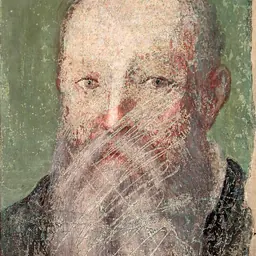
Maerten de Vos, Maerten de Vos the Elder or Marten de Vos (1532 – 4 December 1603) was a Flemish painter, known mainly for his history and allegorical paintings and portraits. He was, together with the brothers Ambrosius Francken I and Frans Francken I, one of the leading history painters in the Spanish Netherlands after Frans Floris's career slumped in the second half of the sixteenth century as a result of the Iconoclastic fury of the Beeldenstorm.
De Vos was a prolific draughtsman and produced numerous designs for the Antwerp printers. These were circulated widely in Europe and the Spanish colonies and contributed to his international reputation and influence. His designs were also used as models for tapestries and stained glass windows. His father was recorded in the registers of the Antwerp Guild of Saint Luke in 1507 as a pupil studying painting under Jeroom Scuelens and in 1519 as a free master. Maerten's mother was a daughter of the Antwerp painter Marten (Maerten) de Heere who was registered in 1498 as a free master of the Antwerp Guild of Saint Luke.
Maerten de Vos first trained, along his brother Pieter, under the guidance of their father. The 17th-century Italian artist biographer Carlo Ridolfi wrote that de Vos worked in the studio of Tintoretto in Venice, which would explain this influence.
In the 1560s an iconoclastic fury referred to in Dutch as the Beeldenstorm (Dutch for 'attack on the images or statues') raged in Flanders and reached its peak in 1566. Catholic art and many forms of church fittings and decoration were destroyed by nominally Calvinist Protestant crowds in the name of the Protestant Reformation. Floris never recovered from the shock of seeing his artworks destroyed, and soon found himself in a downward spiral in both his personal and professional affairs. He virtually stopped painting after 1566, and a younger generation of artists seized the opportunity to take over his important position in history painting in the Habsburg Netherlands. Among these artists Maerten de Vos became the most prominent.
De Vos received in 1570 the commission to decorate the palatine chapel of William, Duke of Brunswick-Lüneburg in Celle, Germany. His reputation grew and in 1572 he was appointed dean of the Antwerp guild.
In 1589 De Vos and Ambrosius Francken I were appointed by the Ghent magistrate to value the painting of the Last Judgment by Raphael Coxie. Their ruling would settle a dispute between the magistrate, who had commissioned the painting, and Coxie, who felt that the sum offered to him was too low for his masterpiece. De Vos and Francken were also chosen as the chief designers of the decorations for the 1594 Joyous Entry into Antwerp of the newly appointed governor of the Southern Netherlands, Archduke Ernest of Austria. De Vos was further one of the founders of the Guild of Romanists, which was established in 1572 in Antwerp's Cathedral of Our Lady. The Guild brought together artists, connoisseurs and humanists who had travelled to Rome and appreciated humanist culture. The diversity of the membership offered artists a good opportunity to network with potential patrons. To meet the strong demand for his work, including from foreign patrons, de Vos developed a streamlined workshop practice.
Maerten de Vos was not an innovative artist but rather an eclectic figure who borrowed liberally from Italian masters. His work was variously indebted to one or more of the Italian painters Veronese, Tintoretto and Michelangelo, as well as to Flemish painters such as the Master of the Prodigal Son, Pieter Aertsen, and the Flemish painters influenced by Italian art referred to as Romanists such as Lambert Lombard, Frans Floris and Michiel Coxie. Other publications on which he worked included series on the five senses, the seven deadly sins, the Christian virtues, the 12 months, the four seasons and the seven wonders of the world. De Vos provided 78 drawings for the illustrated Bible Thesaurus veteris et novi testamenti published in 1585 by Gerard de Jode. The export of this illustrated Bible by de Jode, as well as its publication in Amsterdam in a revised edition, contributed to the popularity of de Vos' illustrations throughout Europe.
De Vos' drawings are known for their lively and generally positive character. Romantic Italianate landscapes appear often in the background. His obvious proficiency led to a certain degree of routine formularization.
Don’t just read it —
keep it.
Full-length biographies made to live with: read them, listen on the way to work, watch them tonight.
- E-book
- Audio
- Video
Instant download · yours to keep · every purchase keeps this site free
Important facts
more
the elder Vos, Martino de Vos, Mar. de Vos, Marten de, Martín de Vos, Maarten Vos, Marten De Vos, Maerten Vos, Martìn de Vos, martin voz, Martin Voss, Martin de Voes, m. de vos, maerten de voss, Martinus de Vos, Martin fiamengo, M. von Bos, De Vos, martino di avossa, Marten de Voss, Martin de Voës, Martin Devos, Mart. de Vos, M. De. Vos, MarPeople in Maerten de Vos's life
Named in this biography and alive at the same time





Related people
Same field, nearest in time
Contemporaries
People whose lives overlapped Maerten de Vos's






Frequently asked questions
Who was Maerten de Vos?
Flemish painter, draughtsman (1532-1603)
When was Maerten de Vos born?
Maerten de Vos was born in 1532 in Antwerp.
When did Maerten de Vos die?
Maerten de Vos died in 1603 in Antwerp.
What was Maerten de Vos's occupation?
Maerten de Vos was a painter, draftsperson and visual artist.
What nationality was Maerten de Vos?
Maerten de Vos was Belgian.
Sources & further reading
Cite this page
APA: Biography.guide. (2026). Maerten de Vos. https://biography.guide/maerten-de-vos/
MLA: "Maerten de Vos." Biography.guide, https://biography.guide/maerten-de-vos/.
Chicago: "Maerten de Vos." Biography.guide. https://biography.guide/maerten-de-vos/.
Data last updated: 2026-09-20 · Spot an error? Report a correction.
Page generated 2026-09-27 05:19 UTC