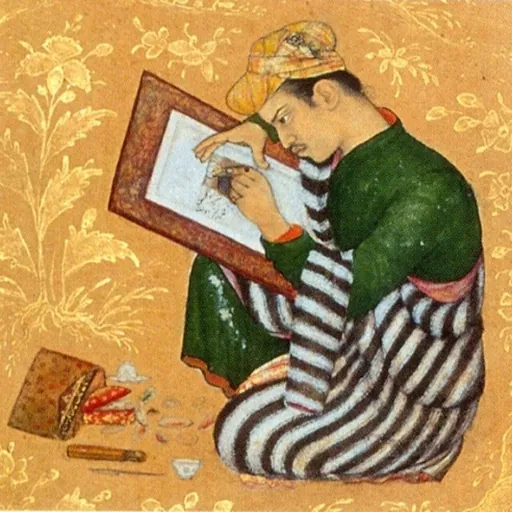
About Abu al-Hasan
Lived 1589 – 1700. Abu al-Hasan was an Indian painter and artist.
Abu'l-Hasan (or Abu al-Hasan; 1589 – c. 1630), from Delhi, India, was a Mughal painter of miniatures during the reign of Jahangir.
Biography
Abu al-Hasan was the son of Aqa Reza Heravi of Herat in Safavid Iran, a city with an artistic tradition. Aqa Reza was established as an artist and took up employment with Jahangir (r. 1605 –1627) before the latter's accession to the throne of the Mughal Empire. When Abu al-Hasan began producing art, the emperor, Jahangir, appreciated the skills of the boy. In 1599, Abu al-Hasan moved with Jahangir to his newly founded court in Allahabad.
The emperor considered Abu al-Hasan to be particularly special to him and under his care.
Abu al-Hasan's main task was the documentation of events at the imperial court, which resulted in many portraits being completed. Portraits were the hallmark of Jahangir's rule. and political paintings that showed the emperor and Mughal empire in a positive and powerful light. In addition to original works of art, Abu al-Hasan also retouched other artists' paintings (one such example is below: Dancing Dervishes) in Jangespur (which is not a known location today) that the emperor demanded be drawn. The gilding along the border decorated with floral motifs, however, was not completed by Abu al-Hasan, but another artist named as Harif by an inscription. This painting became a part of the St. Petersburg album when it, and many other Mughal artworks, were seized by Nader Shah in 1739. Opaque watercolor, gold and ink on paper Jahangir as the Queller of Rebellion c. 1623 Jahangir with a halo around his head, holds a globe with a royal seal on it while dressed in a Mughal outfit. The painting portrays the emperor after he successfully put an end to a rebellion led by one of his sons, Prince Shah Jahan. Was in an exhibition held at the Metropolitan Museum, October 21, 1987 – February 14, 1988. Dancing Dervishes c. 1610 This painting is attributed to Aqa-Miraq (mid-sixteenth century) but was painted over, most likely, by Abu al-Hasan (c. 1610). It portrays a Mevlevi Sema' Ceremony, an event filled with music, dance, and ritual. Was in an exhibition held at the Metropolitan Museum, October 21, 1987 – February 14, 1988 Ink, opaque watercolor, and gold on paper
Gallery
Don’t just read it —
keep it.
Full-length biographies made to live with: read them, listen on the way to work, watch them tonight.
- E-book
- Audio
- Video
Instant download · yours to keep · every purchase keeps this site free
Important facts
People in Abu al-Hasan's life
Named in this biography and alive at the same time


Related people
Same field, nearest in time



Contemporaries
People whose lives overlapped Abu al-Hasan's



Frequently asked questions
Who was Abu al-Hasan?
Mughal painter
When was Abu al-Hasan born?
Abu al-Hasan was born in 1589.
When did Abu al-Hasan die?
Abu al-Hasan died in 1700.
What was Abu al-Hasan's occupation?
Abu al-Hasan was a painter and artist.
What nationality was Abu al-Hasan?
Abu al-Hasan was Indian.
Sources & further reading
· DBpedia: Abu'l-Hasan (artist)
Cite this page
APA: Biography.guide. (2026). Abu al-Hasan. https://biography.guide/abu-al-hasan/
MLA: "Abu al-Hasan." Biography.guide, https://biography.guide/abu-al-hasan/.
Chicago: "Abu al-Hasan." Biography.guide. https://biography.guide/abu-al-hasan/.
Data last updated: 2026-09-20 · Spot an error? Report a correction.
Portrait: Wikimedia Commons · author & licence
Page generated 2026-09-27 04:57 UTC