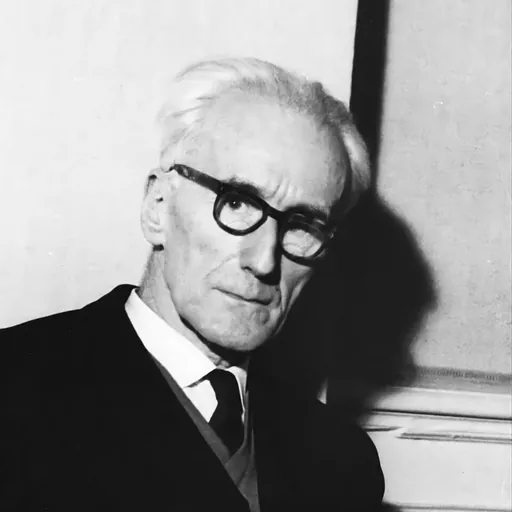
Józef Czapski
Polish artist, author, critic and Polish Army officer during WWII
About Józef Czapski
Lived 1896 – 1993 (aged 96). Józef Czapski was a Polish and French painter, writer, literary critic, essayist and draftsperson.
Józef Czapski (3 April 1896 – 12 January 1993) was a Polish artist, author, and critic, as well as an Major of the Polish Army reserves. As a painter, he is notable for his membership in the Kapist movement, which was heavily influenced by Cézanne. Following the Polish Defensive War, he was made a prisoner of war by the Soviets and was among the very few officers to survive the Katyn massacre of 1940. Following the Sikorski-Mayski Agreement, he was an official envoy of the Polish government searching for the missing Polish officers in Russia. After World War II, he remained in exile in the Paris suburb of Maisons-Laffitte, where he was among the founders of Kultura monthly, one of the most influential Polish cultural journals of the 20th century.
Life Early life
Józef Marian Franciszek hrabia Hutten-Czapski of Leliwa, as was his full name, was born on 3 April 1896 in Prague, to an aristocratic family. His father was landowner and conservative politician , mother was Józefa Thun-Hohenstein, daughter of Friedrich von Thun und Hohenstein, Austrian diplomat. Among his relatives were hr. Emeryk Hutten-Czapski, hr. Karol Hutten-Czapski, hr. Emeryk August Hutten-Czapski, his sister Maria Czapska, as well as Georgy Chicherin. Czapski spent most of his childhood in his family's manor of Przyłuki near Minsk. In 1915 he graduated from a gymnasium in St. Petersburg and joined the cadet corps. Czapski graduated from the law faculty of the University of Saint Petersburg, and in 1917 both joined and later resigned from the 1st Krechowce Uhlan Regiment, a Polish cavalry unit formed in Russia as part of the Polish I Corps. Following the Russian Revolution of 1917 he moved to newly-renascent Poland and in 1918 entered the Academy of Fine Arts in Warsaw. There he started his studies in the class of Stanisław Lentz. and The Inhuman Land (1949). During that period Czapski also met Aleksey Nikolayevich Tolstoy and Anna Akhmatova who is said to have dedicated one of her poems to him.
Anders subsequently removed his army through the Persian Corridor, and in Baghdad Czapski began writing for the Polish army newspapers Orzeł Biały ('White Eagle') and Kurier Polski ('Polish Courier').
Emigration
Czapski ended the war in Rome, and moved to France in 1946. Together with Maria Czapska, Gustaw Herling-Grudziński and Jerzy Giedroyc, he established the Instytut Literacki (Literary Institute) at Maisons-Laffitte, where he lived until his death, and contributed to the Polish émigré literary journal 'Kultura'. He published also in the French press, including „Le Figaro Littéraire”, „Preuves”, „Gavroche”, „Nova et Vettera”, „Carrefour”. He co-organized Congress for Cultural Freedom in Berlin (1950).
At first his major work was not deemed worthy of publication by many French publishers, despite the support of André Malraux and Raymond Aron. It was finally published in 1949 under the title The Inhuman Land, thanks to Daniel Halévy, at the very anti-communist Éditions Self.
His paintings were exhibited in France, Switzerland, Great Britain, Brazil and Belgium. His works were virtually inaccessible in Poland – after Polish October he had 1957 exhibitions in National Museum in Poznań and Kraków Society of Friends of Fine Arts, but the next one was held only in 1986 in Warsaw.
He signed a letter of Polish émigré writers who supported the Letter of 59. Polish People's Republic censored information about Czapski and had his name on a list of the people completely banned from publication. His literary and artistic works were popularized in Poland only after 1989. In 1990 he received Jan Cybis Award.
Czapski died 12 January 1993, and three days later was buried on a cemetery in Le Mesnil-le-Roi, by the side of his sister Maria, who died in 1981.
Czapski was awarded the Silver Cross of the Order of Virtuti Militari (1918–1920) and the Commander's Cross of the Order of Polonia Restituta (1990).
Private life Czapski was deeply Catholic, and his faith influenced his works and personal philosophy, but also his struggles with sexuality. Returning to Poland, Czapski met the writer Ludwik Hering. The pair lived together for a few years in Józefów, and despite the fact that they were separated by World War 2 and subsequent emigration of Czapski, they maintained the love for years by exchanging letters.
His Lost Time: Lectures on Proust in a Soviet Prison Camp was translated into English in 2018. Memories of Starobielsk was translated in 2022.
Notes and references
Don’t just read it —
keep it.
Full-length biographies made to live with: read them, listen on the way to work, watch them tonight.
- E-book
- Audio
- Video
Instant download · yours to keep · every purchase keeps this site free
Important facts
People in Józef Czapski's life
Named in this biography and alive at the same time





Related people
Same field, nearest in time


Contemporaries
People whose lives overlapped Józef Czapski's


Frequently asked questions
Who was Józef Czapski?
Polish artist, author, critic and Polish Army officer during WWII (1896-1993)
When was Józef Czapski born?
Józef Czapski was born on 3 April 1896 in Prague.
When did Józef Czapski die?
Józef Czapski died on 12 January 1993 in Maisons-Laffitte, Le Mesnil-le-Roi.
What was Józef Czapski's occupation?
Józef Czapski was a painter, writer, literary critic, essayist and draftsperson.
What nationality was Józef Czapski?
Józef Czapski was Polish and French.
Sources & further reading
Cite this page
APA: Biography.guide. (2026). Józef Czapski. https://biography.guide/jozef-czapski/
MLA: "Józef Czapski." Biography.guide, https://biography.guide/jozef-czapski/.
Chicago: "Józef Czapski." Biography.guide. https://biography.guide/jozef-czapski/.
Data last updated: 2026-09-22 · Spot an error? Report a correction.
Page generated 2026-09-27 05:10 UTC