
Raymond Aron
French philosopher, sociologist, journalist, and political scientist
About Raymond Aron
Lived 1905 – 1983 (aged 78). Raymond Aron was a French journalist, philosopher, writer, political scientist, sociologist and professor.
Raymond Claude Ferdinand Aron (; ; 14 March 1905 – 17 October 1983) was a French philosopher, sociologist, political scientist, historian and journalist, one of France's most prominent thinkers of the 20th century.
Aron is best known for his 1955 book The Opium of the Intellectuals, the title of which inverts Karl Marx's claim that religion was the opium of the people; he argues that Marxism was the opium of the intellectuals in post-war France. In the book, Aron chastised French intellectuals for what he described as their harsh criticism of capitalism and democracy and their simultaneous defense of the actions of the communist governments of the East. Critic Roger Kimball suggests that Opium is "a seminal book of the twentieth century". Aron is also known for his lifelong friendship, sometimes fractious, with philosopher Jean-Paul Sartre. The saying "Better be wrong with Sartre than right with Aron" became popular among French intellectuals.
Considered by many as a voice of moderation in politics, Aron had many disciples on both the political left and right; he remarked that he personally was "more of a left-wing Aronian than a right-wing one". Aron wrote extensively on a wide range of other topics. Citing the breadth and quality of Aron's writings, historian James R. Garland suggests, "Though he may be little known in America, Raymond Aron arguably stood as the preeminent example of French intellectualism for much of the twentieth century."
Life and career Raymond Claude Ferdinand Aron was born on 14 March 1905 in Paris, the son of Gustave Aron, a secular Jewish lawyer. Aron studied at the École Normale Supérieure, where he met Jean-Paul Sartre, who became his friend and later his lifelong intellectual opponent. and a leader among those who did not embrace existentialism. Aron took first place in the agrégation of philosophy in 1928, the year Sartre failed the same exam. In 1930, he received a doctorate in the philosophy of history from the University of Paris.
He had been teaching social philosophy at the University of Toulouse for only a few weeks when World War II began; he joined the Armée de l'Air. When France was defeated, he left for London to join the Free French forces, editing the newspaper, France Libre (Free France).
When the war ended, Aron returned to Paris to teach sociology at the École Nationale d'Administration and Sciences Po. From 1955 to 1968, he taught at the University of Paris, and after 1970 at the Collège de France and the École des hautes études en sciences sociales (EHESS). In 1953, he befriended the young American philosopher Allan Bloom, who was teaching at the Sorbonne.
A lifelong journalist, Aron in 1947 became an influential columnist for Le Figaro, a position he held for thirty years until he joined L'Express, where he wrote a political column up to his death.
He was elected a Foreign Honorary Member of the American Academy of Arts and Sciences in 1960 and an International member of the American Philosophical Society in 1966.
In 1978 he founded Commentaire, a quarterly journal of ideas and debate, together with Jean-Claude Casanova who was the venture's founding director.
Aron died of a heart attack in Paris on 17 October 1983.
Political commitment
In Berlin, Aron witnessed the rise to power of the Nazi Party and developed an aversion to all totalitarian systems. In 1938, he participated in the Colloque Walter Lippmann in Paris. By the 1950s, he had grown very critical of the Austrian School and described their obsession with private property as an "inverted Marxism". Aron always promoted an "immoderately moderate" form of liberalism which accepted a mixed economy as the normal economic model of the age.
Political thought Aron is the author of books on Karl Marx and on Carl von Clausewitz. In Peace and War, he set out a theory of international relations. He argues that Max Weber's claim that the state has a monopoly on the legitimate use of physical force does not apply to the relationship between states.
In the field of international relations in the 1950s, Aron hypothesized that despite the advent of nuclear weapons, nations would still require conventional military forces. The usefulness of such forces would be made necessary by what he called a "nuclear taboo."
Honours Officier of the Legion of Honour (France) Croix de Guerre 1939–1945 (France) Commander of the Ordre des Palmes académiques (France) Medal Pour le Mérite (Germany)
Works A prolific author, he "wrote several thousand editorials and several hundred academic articles, essays, and comments, as well as about forty books", which include: Translated to English as ; (under the pseudonym François Houtisse, with Boris Souvarine) The Opium of the Intellectuals, London: Secker & Warburg, 1957
(partially translated in ) ; The Great Debate, New York, Doubleday & Company, Inc., 1965 Dix-huit leçons sur la société industrielle, Paris: Gallimard, 1963; Eighteen Lectures on Industrial Society, London: Weidenfeld & Nicolson, 1967 La Lutte des classes, Paris: Gallimard, 1964 Essai sur les libertés, Paris: Calmann-Lévy, 1965 Démocratie et totalitarisme, Paris: Gallimard, 1965; Democracy and totalitarianism, Weidenfeld and Nicolson, 1968 Trois essais sur l'âge industriel, Paris: Plon, 1966; The Industrial Society. Three Essays on Ideology and Development, London: Weidenfeld & Nicolson, 1967 Les Étapes de la pensée sociologique, Paris: Gallimard, 1967; Main Currents in Sociological Thought, London: Weidenfeld & Nicolson, 1965 De Gaulle, Israël et les Juifs, Paris: Plon, 1968; De Gaulle, Israel and the Jews, Praeger, 1969 La Révolution introuvable. Réflexions sur les événements de mai, Paris: Fayard, 1968 Les Désillusions du progrès, Paris: Calmann-Lévy, 1969; Progress and Disillusion: The Dialectics of Modern Society, Pall Mall Press, 1968 D'une sainte famille à l'autre. Essai sur le marxisme imaginaire, Paris: Gallimard, 1969 De la condition historique du sociologue, Paris: Gallimard, 1971 Études politiques, Paris: Gallimard, 1972 République impériale. Les États-unis dans le monde (1945–1972), Paris: Calmann-Lévy, 1973; The Imperial Republic: The United States and the World 1945–1973, Little Brown & Company 1974 Histoire et dialectique de la violence, Paris: Gallimard, 1973; History and the Dialectic of Violence: Analysis of Sartre's Critique de la raison dialectique, Oxford: Blackwell, 1979 Penser la guerre, Clausewitz, Paris: Gallimard, 1976; Clausewitz: Philosopher of War, London: Routledge, 1983 Plaidoyer pour l'Europe décadente, Paris: Laffont, 1977; In Defense of Decadent Europe, South Bend IN: Regnery, 1977 with Andre Glucksman and Benny Levy. "Sartre's Errors: A Discussion". Telos 44 (Summer 1980). New York: Telos Press Le Spectateur engagé, Paris: Julliard, 1981 (interviews) Mémoires, Paris: Julliard, 1983 Les dernières années du siècle, Paris: Julliard, 1984 Ueber Deutschland und den Nationalsozialismus. Fruehe politische Schriften 1930–1939, Joachim Stark, ed. and pref., Opladen: Leske & Budrich, 1993 Le Marxisme de Marx, Paris: Éditions de Fallois, 2002 De Giscard à Mitterrand: 1977–1983 (editorials from L'Express), with preface by Jean-Claude Casanova, Paris: Éditions de Fallois, 2005
Other media Raymond Aron, spectateur engagé. Entretiens avec Raymond Aron. (Duration: 160 mins.), DVD, Éditions Montparnasse, 2005
Don’t just read it —
keep it.
Full-length biographies made to live with: read them, listen on the way to work, watch them tonight.
- E-book
- Audio
- Video
Instant download · yours to keep · every purchase keeps this site free
Important facts
People in Raymond Aron's life
Named in this biography and alive at the same time
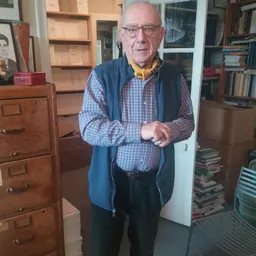

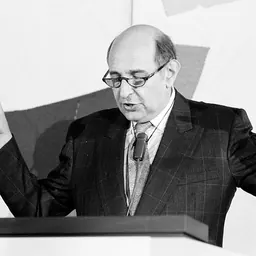

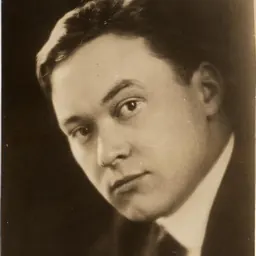


Related people
Same field, nearest in time




Contemporaries
People whose lives overlapped Raymond Aron's





Frequently asked questions
Who was Raymond Aron?
French philosopher, sociologist, journalist, and political scientist (1905–1983)
When was Raymond Aron born?
Raymond Aron was born on 14 March 1905 in Paris, 6th arrondissement of Paris.
When did Raymond Aron die?
Raymond Aron died on 17 October 1983 in Paris, 4th arrondissement of Paris.
What was Raymond Aron's occupation?
Raymond Aron was a journalist, philosopher, writer, political scientist, sociologist and professor.
What nationality was Raymond Aron?
Raymond Aron was French.
Sources & further reading
Cite this page
APA: Biography.guide. (2026). Raymond Aron. https://biography.guide/raymond-aron/
MLA: "Raymond Aron." Biography.guide, https://biography.guide/raymond-aron/.
Chicago: "Raymond Aron." Biography.guide. https://biography.guide/raymond-aron/.
Data last updated: 2026-09-20 · Spot an error? Report a correction.
Page generated 2026-09-27 05:31 UTC