
Joseph Ki-Zerbo
Burkinabé historian, politician and writer
About Joseph Ki-Zerbo
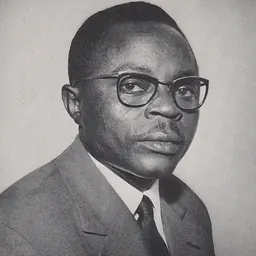
Lived 1922 – 2006 (aged 84). Joseph Ki-Zerbo was a Burkinabé politician, historian and university teacher.
Joseph Ki-Zerbo (June 21, 1922 – December 4, 2006, Burkina Faso) was a Burkinabé historian, politician and writer. He is recognized as one of Africa's foremost thinkers.
From 1972 to 1978 he was a professor of African History at the University of Ouagadougou. In 1983, he was forced into exile, only being able to return in 1992.
Ki-Zerbo founded the Party for Democracy and Progress / Socialist Party. He was its chairman until 2005, and represented it in the Burkina Faso parliament until his death in 2006. A socialist and an advocate of African independence and unity, Ki-Zerbo was also a vocal opponent of Thomas Sankara's revolutionary government.
Early life Ki-Zerbo was born in Toma in the province of Nayala, in what was, at that time, the French colony of Upper Volta. He was the son of Alfred Diban Ki-Zerbo and Thérèse Folo Ki. His father is considered to be the first Burkinabé Christian. In 1915 he intervened during the Volta-Bani War to stop Toma from being razed to the ground.
Between 1933 and 1940, Ki-Zerbo was educated at the Catholic primary school in Toma, then completed his secondary school at the preparatory seminaries in Pabré in the Province of Kadiogo and Faladié, a district of Bamako, Mali. He then attended the Grand Séminaire Saint-Pierre Claver at Koumi near Bobo Dioulasso, which trains young men for the Catholic priesthood.
However, Ki-Zerbo dropped out of the seminary and went to live in Dakar, Senegal for several years. In addition to teaching there, he worked for several months at the weekly newspaper Afrique nouvelle, and also as a railway construction labourer.
The aims of the MLN were immediate independence for Africans, the creation of a United States of Africa, and socialism. The MLN contacted nationalist leaders in many of the other French colonies, to persuade them to reject the referendum on the creation of a Franco-African community presented by the French president Charles de Gaulle. However, in the whole of West Africa at that time, only Guinea voted no to the referendum and, as a result, achieved its independence relatively early in 1958. As a result, Sekou Touré, the first president of independent Guinea, invited Ki-Zerbo and his wife along with other volunteers to come to Conakry to replace the French teachers who had left. From 1976 to 2001, Ki-Zerbo was the president of the African Historian Association and a professor at the University of Ouagadougou.
His conviction on education led him to found in 1980 the Centre for African Development Studies (CEDA) that has this goal “on ne developpe pas, on se developpe” ("we don’t develop, we develop ourselves"). Holenstein (2006) insisted that on the basis of a critique of North–South imperialism, Ki-Zerbo forecast an endogenous development that will take ecological and social skills, and the African cultural identity, seriously. His endogenous development is a practice that lets native farmers use their own ideas and traditions alongside new technology. It incorporates the ideas and knowledge of indigenous cultures rather than disregarding them.
Political fights After scientific research and teaching, Ki-Zerbo continued with his political activities. Under the Burkinabe President Maurice Yaméogo’s regime (1960-1966), the creation of any political party was forbidden. Holenstein (2006) explained this in an article on the interview about Ki-Zerbo’s book A quand l’Afrique. Ki-Zerbo got his members in the syndical teachers’ class and villagers. The syndicate and MLN played a big role in the popular movement organization on 3 January 1966 that brought down the President Maurice Yaméogo. General Secretary of the MLN, Ki-Zerbo went to the 1970s legislative elections; he got sixth rank.
In February the Burkina Faso parliament was ruined during a military coup. In October, banning was cancelled. Many new parties arose like Union Progressiste Voltaique (UPV) under the control of Ki-Zerbo that replaced MLN. UPV was in opposition to the government party (Union Democratique Voltaique-Rassemblement Democratique Africain (UDV-RDA).)
Exile
In 1983, a group of young officers took power by a military coup under the control of the Captain Thomas Sankara. A new stage started for Upper Volta which became Burkina Faso (“Land of the upright”). Under the power of the new government, Ki-Zerbo was obliged to go into exile.
In 1985 he was finally arrested with his family for two years of detention and became free only after another military coup organized by Blaise Compaore. Even in exile, he created research centers like the Research Centre for Endogenous Development (CRDE) and taught at Cheikh Anta Diop University in Dakar. He returned to Burkina Faso in 1987 to find that his library of 11,000 books in his hometown Faso had been burned in his absence. He came back and tried to rebuild by getting a place in parliament.
Awards Ki-Zerbo has received recognition through various international awards. In 1997 he was honoured with the Right Livelihood Award for his research on development. This prize is given to those who try to find credible solutions to the protection of the environment and nature; it is for people who helped the development of human rights and peace. In 2000, he received the Al-Gaddafi International Prize for Human Rights. In 2001, Ki-Zerbo was awarded the title of Doctor Honoris Causa of the University of Padua in Italy.
Don’t just read it —
keep it.
Full-length biographies made to live with: read them, listen on the way to work, watch them tonight.
- E-book
- Audio
- Video
Instant download · yours to keep · every purchase keeps this site free
Important facts
Family & relationships
People in Joseph Ki-Zerbo's life
Named in this biography and alive at the same time



Related people
Same field, nearest in time




Contemporaries
People whose lives overlapped Joseph Ki-Zerbo's
Frequently asked questions
Who was Joseph Ki-Zerbo?
Burkinabé historian, politician and writer (1922-2006)
When was Joseph Ki-Zerbo born?
Joseph Ki-Zerbo was born on 21 June 1922 in Toma.
When did Joseph Ki-Zerbo die?
Joseph Ki-Zerbo died on 4 December 2006 in Ouagadougou.
What was Joseph Ki-Zerbo's occupation?
Joseph Ki-Zerbo was a politician, historian and university teacher.
What nationality was Joseph Ki-Zerbo?
Joseph Ki-Zerbo was Burkinabé.
Sources & further reading
Cite this page
APA: Biography.guide. (2026). Joseph Ki-Zerbo. https://biography.guide/joseph-ki-zerbo/
MLA: "Joseph Ki-Zerbo." Biography.guide, https://biography.guide/joseph-ki-zerbo/.
Chicago: "Joseph Ki-Zerbo." Biography.guide. https://biography.guide/joseph-ki-zerbo/.
Data last updated: 2026-09-20 · Spot an error? Report a correction.
Page generated 2026-09-27 05:17 UTC