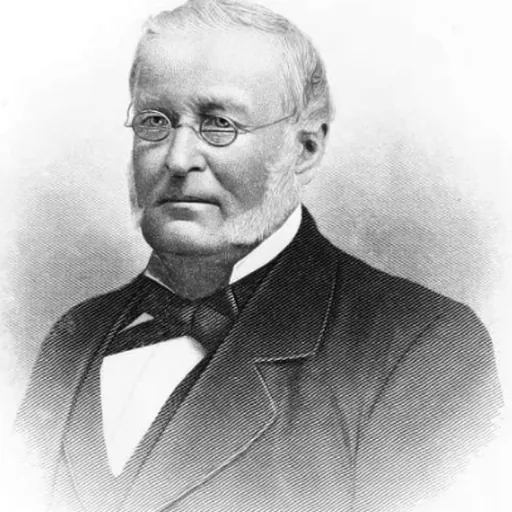
About Joseph Glidden
Lived 1813 – 1906 (aged 93). Joseph Glidden was an American inventor, farmer and businessperson.
Joseph Farwell Glidden (January 18, 1813 – October 9, 1906) was an American businessman and farmer. He was the inventor of the modern barbed wire. In 1898, he donated land for the Northern Illinois State Normal School in DeKalb, Illinois, which was renamed as Northern Illinois University in 1957.
Early life Glidden was born in Charlestown, New Hampshire, of English descent. His family later moved to Clarendon, New York. Glidden was a teacher there for about 8 years, during which years he married Clarissa Foster in 1837. In 1843, he moved to Illinois with his wife and children, first to Ogle County and then to DeKalb where they had purchased a farm. His wife died in 1846, in childbirth of their daughter in Ogle County, Illinois. Their three children, including the infant daughter Clara (Clarissa) died in an epidemic in 1847. Their two sons died after the move. Ellwood stayed in DeKalb and renamed the company I. L. Ellwood & Company of DeKalb. That company evolved into American Steel and Wire, and eventually was bought by U. S. Steel Manufacturing Company.
Glidden was embroiled in a legal battle initiated by fellow DeKalb resident Jacob Haish over whether the design for holding the barbs in place with an extra strand of wire was novel, an improved design. An earlier patent for barbed wire had been issued to a man in Ohio, among other patents related to barbed wire. Glidden eventually won at the US Supreme Court in an 1892 case, his patent protection expired the same year. The legal fees were estimated to have cost Glidden $100,000.
Henry B. Sanborn, a sales representative for Glidden's company, owned a ranch in Grayson County north of Dallas and wished to advertise barbed wire there. In 1881, Sanborn purchased ninety-five sections of land in southwestern Potter County from near the Canadian River extending into Randall County south of Amarillo. Included in the purchase was Tecovas Spring, once a watering site and a trading post for Indians and Comancheros. John Summerfield, a surveyor from Sherman, Texas, reported a constant flow of freshwater from the spring. Sanborn chose this site for his ranch headquarters and enclosed 120 miles of land in barbed wire for $39,000 ($ in dollars). Warren W. Wetzel, also of Sherman, used cedar posts brought from both the Palo Duro Canyon and the breaks of the Sierrita de la Cruz in the northwestern portion of the ranch to hold up the wire.
Besides ranchers, railroads were large purchasers of barbed wire, so that cattle did not stray onto their tracks.
The Frying Pan Ranch soon had 15,000 head of cattle, and 125,000 more acres were added. Later the ranch was divided. In 1898, Glidden deeded Frying Pan Ranch to his son-in-law William Henry Bush. Between 1908 and 1920, William Henry Bush and his second wife Ruth Bush built a larger ranch house near Tecovas Spring, which later became the residence of Stanley Marsh 3 and his wife, Wendy. Gwendolyn "Wendy" Bush O'Brien was the daughter of Emeline Bush and her husband Frank O'Brien; Emeline was a daughter of William Henry and Ruth Bush. Stanley Marsh called the estate "Toad Hall".
Land for the Northern Illinois State Normal School Glidden, a former teacher, gave 63 acres (255,000 m2) of his homestead as a site for the Northern Illinois State Normal School. The school opened on September 12, 1898, with 139 students and 16 members of the faculty. The school's name was changed to Northern Illinois University in 1957.
The town of Glidden, Iowa, is named in his honor.
Personal life He and his wife Lucinda had one daughter, Elva Frances, in 1851. She married William Henry Bush in DeKalb on February 1, 1877. His wife Lucinda died on October 28, 1895. Elva died in 1906 not long before her father died, and is buried in the Glidden family plot in a cemetery in DeKalb.
In 1898, Glidden deeded his Frying Pan ranch in Texas to his son-in-law, W. H. Bush. Bush married again in 1908, after being widowed, to Ruth Russell Gentry. He is buried in Graceland Cemetery in Chicago.
In popular culture The "barbed wire salesman" in Back to the Future Part III is either based on Joseph F. Glidden or John Warne Gates who was a pioneer promoter of barbed wire. He is played by Richard Dysart.
Don’t just read it —
keep it.
Full-length biographies made to live with: read them, listen on the way to work, watch them tonight.
- E-book
- Audio
- Video
Instant download · yours to keep · every purchase keeps this site free
Important facts
People in Joseph Glidden's life
Named in this biography and alive at the same time




Related people
Same field, nearest in time

Contemporaries
People whose lives overlapped Joseph Glidden's





Frequently asked questions
Who was Joseph Glidden?
American farmer who patented barbed wire (1813-1906)
When was Joseph Glidden born?
Joseph Glidden was born on 18 January 1813 in Charlestown.
When did Joseph Glidden die?
Joseph Glidden died on 9 October 1906 in DeKalb.
What was Joseph Glidden's occupation?
Joseph Glidden was an inventor, farmer and businessperson.
What nationality was Joseph Glidden?
Joseph Glidden was American.
Sources & further reading
Cite this page
APA: Biography.guide. (2026). Joseph Glidden. https://biography.guide/joseph-glidden/
MLA: "Joseph Glidden." Biography.guide, https://biography.guide/joseph-glidden/.
Chicago: "Joseph Glidden." Biography.guide. https://biography.guide/joseph-glidden/.
Data last updated: 2026-09-22 · Spot an error? Report a correction.
Portrait: Wikimedia Commons · author & licence
Page generated 2026-09-27 04:59 UTC