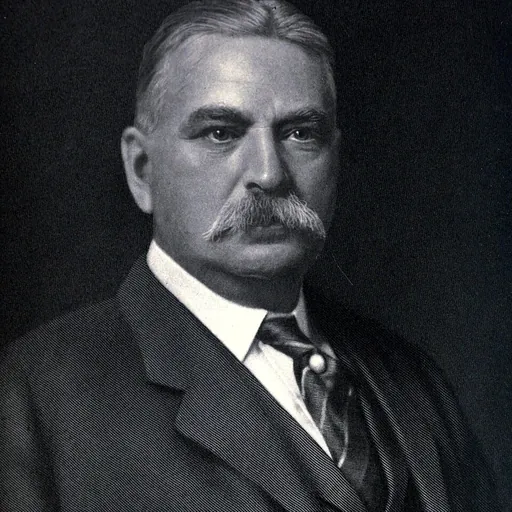
About John Warne Gates
Lived 1855 – 1911 (aged 56). John Warne Gates was an American businessperson.
John Warne Gates (May 18, 1855 – August 9, 1911), also known as "Bet-a-Million" Gates, was an American Gilded Age industrialist and gambler. He was a pioneer promoter of barbed wire. He was born and raised in what is now West Chicago, Illinois. He did not enjoy farm life and began offering neighbors various business propositions at an early age, including the sale of firewood to homes and to the local railroad. When he started a local grain brokerage that failed, Gates began spending time at the local railroad station and became reacquainted with the men he previously sold firewood to. He was invited to join their poker games and through this, Gates' aptitude for cards and other games of chance was developed.
After studying penmanship, bookkeeping and business law in North Central College (by then Northwestern College), he failed as an owner of a local hardware store. Gates became interested in barbed wire and became a salesman for the Washburn-Moen Company. When he was assigned to the Texas sales territory, he learned that ranchers were adamant about not buying his product. Gates staged a demonstration of the wire in San Antonio's Military Plaza with charging cattle failing to break the barbed wire fences he had set up. He then proved very successful in selling the company's product, and went on to start his own barbed wire manufacturing business, which eventually led to the production of steel. In the process, his company was purchased by J. P. Morgan's U. S. Steel. Gates was not invited to become part of the company, and he fought back at Morgan for many years through a series of business acquisitions and sales; both men were key figures in the Panic of 1907.
Gates was the president of Republic Steel and of the Texas Company, later known as Texaco. He was instrumental in changing the steel industry's production methods from the Bessemer process to the open hearth process and in building the city of Port Arthur, Texas.
Biography
Early years
Gates was born in West Chicago, Illinois (then known as Turner Junction) on May 18, 1855. He was the son of Asel A. and Mary Warne Gates. Gates had two older brothers, George and Gilbert, but both had died by the time he was 15 years old. While Gates was raised in a religious household, his mother, Mary, became more religious after the deaths of her two older sons. Because he had been involved in some harmless childhood mischief in both grammar and Sunday School, he was accused of stealing a collection at the Sunday School. He was barred from attending church as a result.
Gates was raised on the family's farm, but did not care for farm life. At an early age, he entered into his first business proposition: to husk a neighbor's corn. When his father discovered Gates in a poker game with some railroad men in the family's barn, Asel told his son he was no good and would never be any good. Only Mary's mediation stopped her son from leaving home. With the realization that he needed more education than grammar school had provided, he announced to his parents that he would be enrolling in some local college classes. Gates attended some courses at nearby Wheaton College and graduated from North Central College in 1876. He had little opportunity to put his new business education to work, as the financial Panic of 1873 began just as he was completing his college work. In order to be able to marry Dellora, Gates accepted every type of job he could get for the next year; most of them were for farm work. Gates and Dellora were married on February 25, 1874.
Marriage and early business ventures Gates tried to revive his grain brokerage business but lost all his savings through it. When the couple's first child was stillborn, Gates returned to his old pattern of playing poker and thought seriously about leaving town with Dellora. With this knowledge, Mary Gates told her husband he needed to help his son financially so he could start a new business. Gates' father-in-law, Ed Baker, had already offered to help his daughter and son in law in this way. Asel purchased a two-story brick building and Ed Baker provided the capital for stock to open a hardware store in Turner Junction.
The barbed wire and steel business Upon Ellwood's refusal to grant him a partnership in the company. Gates traveled to St. Louis, Missouri, where in partnership with Alfred Clifford, he started the Southern Wire Company to compete with Washburn-Moen.
Railroads, oil and Port Arthur, Texas Gates never forgot J. P. Morgan's snub at the U. S. Steel merger. One month after the deal was completed, he became involved in a struggle between E. H. Harriman of the Union Pacific Railroad and James J. Hill of the Northern Pacific Railway. Both men sought control of the Chicago, Burlington and Quincy Railroad. Hill, who was financed by J. P. Morgan, needed access to Chicago; Harriman was interested in stopping Hill from obtaining it. Gates saw this as an opportunity to get back at Morgan for his refusal to seat him on the board of U. S. Steel. Along with Harriman, he began buying shares of Northern Pacific stock. When James Hill noted a sudden rise in Northern Pacific stock prices, he traveled to New York to consult with Morgan. Morgan and Hill stopped the sales of the Northern Pacific stock, which remained high while other stocks took steep drops. Those who had been selling short could not obtain enough stock to cover themselves and were faced with large financial losses. It was rumored that Gates was short 60,000 shares of Northern Pacific stock. Gates did not confirm or deny any of the rumors about the railroad stock and would only say that he was doing well.
As Gates continued to search for a way to get back at Morgan for cutting him out of U. S. Steel, he found a vulnerability in Morgan's railroad holdings in 1902 and began buying large numbers of shares in Morgan's Louisville and Nashville Railroad. When it was decided to add another short line to the L&N system, its board of directors voted to issue 50,000 new shares of stock to finance the new line. A clerical error offered the stock for sale before it could be listed on the New York Stock Exchange. Gates saw the offering and purchased the shares prior to their listing; he also continued buying all the Louisville and Nashville stock he was able to. Gates had enough shares of the railroad to duplicate the panic that ensued the year before with the Great Northern Railway shares. J. P. Morgan learned of the events in April 1902 and found that Gates now owned more than 51 percent of the Louisville and Nashville's stock. Morgan decided to act to stop another Wall Street panic, and asked what Gates' terms of sale would be. Gates wanted US$150 per share of stock, an offer which Morgan initially rejected. He then dispatched his aide, George Walbridge Perkins, to talk to Gates and make the best possible arrangements. Perkins called on Gates in his Waldorf-Astoria suite at 1:30 am. The deal for the Louisville and Nashville cost Morgan US$43 million, with Gates making a more than US$15 million profit from the transaction.
After the Louisville and Nashville Railroad incident, Gates found that public opinion had turned against him as a result of it. Gates talked some associates into submitting his son's name for membership in the New York Yacht Club and New York's Union League Club. The application for Charlie Gates went from one desk to another for a number of weeks. When young Gates' name was brought up for a vote, the members of the admissions committee were unanimous in their "no" decision. Gates threatened to sue the club and the members denied his charges of Morgan being behind Charlie Gates' refusal. Gates withdrew Charlie's Yacht Club and Union League Club applications, apparently resigned that his son would not be a member of either society. When he and Dellora traveled to England, the couple wanted to stay at Claridge's, as they had done in 1900. Claridge's refused to accept their registration as Gates was now on the hotel's list of undesirables.
Pattillo Higgins had begun a well on Spindletop in 1900, but ran out of money to continue drilling for oil. Higgins went to Gates for funds to continue; Gates obliged. The Texas Fuel Company, founded by Joseph S. Cullinan, had little experience in drilling wells and producing crude oil. As such, they founded the Producers Oil Company on January 17, 1902, as an affiliate of The Texas Fuel Company. Investors like Gates invested "certificates of interest" to the sum of around $90,000 and Gates would invest another $590,000 in the company prior to it becoming known as Texaco. His investment entitled Gates to 46 percent of the company's stock.
Congress was beset with requests to deal with the U. S. Steel Trust as they had done with the Tobacco Trust and Standard Oil. The House of Representatives formed a committee to examine the dealings of Morgan's company. Congressman Augustus Owsley Stanley of Kentucky, was named chairman of the committee; in his long list of persons to subpoena for their testimony the first was John Gates. Gates appeared to give his testimony on May 28, 1911; he was seriously ill and this was evident by how thin and pale he had become. He planned a trip to Paris to consult with doctors there after his testimony. Gates spoke of all of his dealings with J. P. Morgan, from the American Steel and Wire Company to the Louisville and Nashville Railroad and to the time when control of Tennessee Coal and Iron Company was wrested from him forcibly. He left for Paris while the committee was still in session. The result of the hearings was an investigation of U. S. Steel and its practices which would last for almost ten years. J. P. Morgan, who held the belief that he had "saved" the country from the Panic of 1907, was disgusted at the "ingratitude" of both the government and the nation's citizens.
Bet A Million
Gates maintained a suite at the Waldorf-Astoria of New York City from 1894 onwards. Though he paid US $30,000 yearly for it, his visits pained the hotel's manager, George Boldt, at times. Gates and his guests were often loud and boisterous.
Gates continued his heavy betting on horse races when in the United States. In 1902, he attended the American Derby at Chicago's Washington Park Race Track, favoring Wyeth, the horse of an associate. When Wyeth won, Gates had profited close to US$100,000. At yet another race, Gates won US$650,000 from his large bets. The Jockey Club president, August Belmont, Jr., asked Gates to limit his bets to US$10,000, as such large wagers gave the impression that the races were not honest ones. Outside of his own hotel suite, Gates' favorite spot in New York City was the gambling establishment opened by Richard Canfield in 1898. The club was at 5 East 44th Street. Delmonico's was next door and provided catering to the club's guests. When there or at Canfield's Saratoga clubhouse, Gates' favored game was faro which he had learned while selling barbed wire in Texas.
Gates set up a brokerage office in the hotel's main lobby for his son, Charlie, and an experienced stockbroker. He speculated on Wall Street from there. In early 1907, when Gates realized that the market would be headed for a sharp downturn, he closed the offices of Charles G. Gates and Company, announcing he was done with Wall Street for good. Gates also changed his New York residence in May of the same year. He had purchased a substantial number of shares in the United States Realty Company, which had built New York's Plaza Hotel and was able to design his own 16 room apartment at the Plaza.
Death and legacy
Gates died in Paris, France, on August 9, 1911, following an unsuccessful operation to remove a throat tumor. His funeral was held on August 23, 1911, in the ballroom of the Plaza Hotel in New York; Gates had provided the funding for the construction of the hotel. Gates' mourners had come from all parts of the country; three floors of the Plaza Hotel were reserved for those attending his services. A large delegation arrived from Texas, where Gates had done much for the city of Port Arthur. While Gates left the bulk of his estate to his wife and son, he inserted a clause in his will that prohibited his family from selling any of his securities until ten years after his death. Gates is said to have included the clause in his will to protect friends who had invested with him from these securities being sold soon after his death. The mausoleum is featured in one of the opening scenes in the film Once Upon a Time in America.
The Gates Memorial Library in Port Arthur was funded by his widow and donated to the city in 1918. In 1971, Gates was honored with a state historical marker at the site of his Military Plaza barbed wire demonstration in San Antonio.
In 1909, as a gift to the city of Port Arthur, TX, and to improve the educational training and opportunities of the community, John Gates founded Port Arthur College, a private institution. In 1975 Port Arthur was converted to a public college and renamed Lamar University – Port Arthur, later changed to Lamar State College – Port Arthur.
John Gates is featured in the Museum of the Gulf Coast in Port Arthur, TX.
In 1972, he was inducted into the Hall of Great Westerners of the National Cowboy & Western Heritage Museum.
Don’t just read it —
keep it.
Full-length biographies made to live with: read them, listen on the way to work, watch them tonight.
- E-book
- Audio
- Video
Instant download · yours to keep · every purchase keeps this site free
Important facts
People in John Warne Gates's life
Named in this biography and alive at the same time




Related people
Same field, nearest in time


Contemporaries
People whose lives overlapped John Warne Gates's



Frequently asked questions
Who was John Warne Gates?
American industrialist (1855–1911)
When was John Warne Gates born?
John Warne Gates was born on 18 May 1855 in West Chicago.
When did John Warne Gates die?
John Warne Gates died on 9 August 1911 in Paris.
What was John Warne Gates's occupation?
John Warne Gates was a businessperson.
What nationality was John Warne Gates?
John Warne Gates was American.
Sources & further reading
Cite this page
APA: Biography.guide. (2026). John Warne Gates. https://biography.guide/john-warne-gates/
MLA: "John Warne Gates." Biography.guide, https://biography.guide/john-warne-gates/.
Chicago: "John Warne Gates." Biography.guide. https://biography.guide/john-warne-gates/.
Data last updated: 2026-09-22 · Spot an error? Report a correction.
Portrait: Wikimedia Commons · author & licence
Page generated 2026-09-27 05:01 UTC