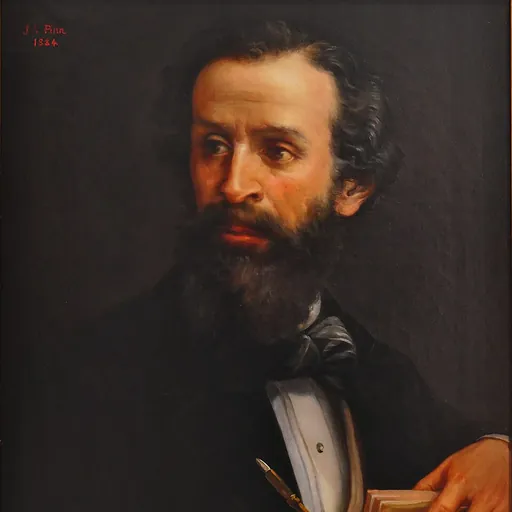
About José Salomé Pina
Lived 1830 – 1909 (aged 78–79). José Salomé Pina was a Mexican painter and university teacher.
José Salomé Pina (1830 – 1909) was a Mexican painter. Together with Santiago Rebull Gordillo and José María Velasco Gómez, he was one of the most famous 19th-century Mexican artists. He was schooled in the arts at the Academy of San Carlos in Mexico City by Pelegrí Clavé i Roqué, an accomplished Spanish painter from Barcelona who was associated with the Nazarene movement.
Biography
His activities as a painter became well known after 1852 when he painted the Agar e Ismael at the age of 22. A year later he gained more renown when he produced Sansón y Dalila (1853). In 1854, he competed for a pension in Rome, which he won with his painting San Carlos Borromeo (pictured above right). Later, in 1856, he was awarded a grant to study in Paris, joining the studio of Charles Gleyre where he painted two works: Abraham and Isaac and Dante and Virgil. Both of these paintings from 1856, were sent by Pina to be displayed at the Academy of San Carlos, though today they are on display at the MUNAL in Mexico City. In 1859, Salomé Pina exhibitioned his painting La Piedad (La Virgen de la Piedad) for which he received an honorable mention. After some time in Paris, Pina moved back to Rome in 1860 to complete his study of the classics under the tutelage of Consoni and Gariot. In 1865, he was commissioned to make a painting commemorating the visit to Rome of Archduke Maximilian on a trip to see Pope Pius IX. Salomé Pina was unable to finish this work, though there are sketches of the painting on display at the Museo Nacional de Historia. These sketches support the theory that Salomé Pina conducted his work from photographs. In 1869, Salomé Pina became a professor at the Academy of San Carlos.
Death and legacy Salomé Pina died in 1909. At the time of his death, his works had largely become unpopular with his students as the contemporary Mexican art had trended away from religious art. Both Germán Gedovius and Diego Rivera studied under Salomé Pina. In the modern day, he is remembered as an important art figure in Mexican history. His most famous works are Sansón y Dalila and San Carlos Borromeo en la peste de Roma.
Don’t just read it —
keep it.
Full-length biographies made to live with: read them, listen on the way to work, watch them tonight.
- E-book
- Audio
- Video
Instant download · yours to keep · every purchase keeps this site free
Important facts
People in José Salomé Pina's life
Named in this biography and alive at the same time



Related people
Same field, nearest in time

Contemporaries
People whose lives overlapped José Salomé Pina's





Frequently asked questions
Who was José Salomé Pina?
painter (1830-1909)
When was José Salomé Pina born?
José Salomé Pina was born in 1830 in Mexico City.
When did José Salomé Pina die?
José Salomé Pina died on 7 June 1909 in Tacubaya.
What was José Salomé Pina's occupation?
José Salomé Pina was a painter and university teacher.
What nationality was José Salomé Pina?
José Salomé Pina was Mexican.
Sources & further reading
Cite this page
APA: Biography.guide. (2026). José Salomé Pina. https://biography.guide/jose-salome-pina/
MLA: "José Salomé Pina." Biography.guide, https://biography.guide/jose-salome-pina/.
Chicago: "José Salomé Pina." Biography.guide. https://biography.guide/jose-salome-pina/.
Data last updated: 2026-09-23 · Spot an error? Report a correction.
Portrait: Wikimedia Commons · author & licence
Page generated 2026-09-27 05:07 UTC