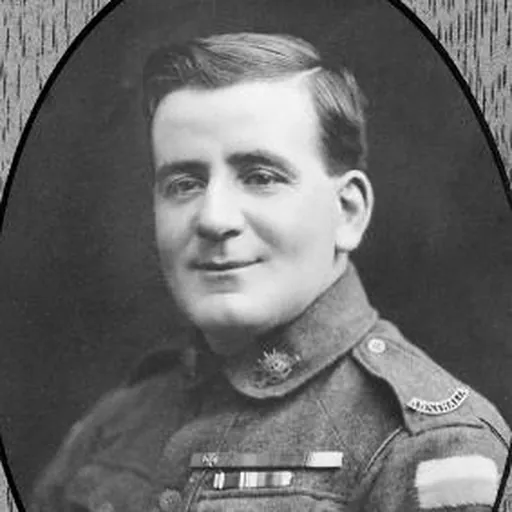
About John Whittle
Lived 1882 – 1946 (aged 63). John Whittle was an Australian military personnel.
John Woods Whittle, (3 August 1882 – 2 March 1946) was an Australian sailor, soldier and a recipient of the Victoria Cross, the highest decoration for gallantry "in the face of the enemy" that can be awarded to members of the British and British Commonwealth armed forces. Whittle was serving as a sergeant in the First World War when he was decorated with the Victoria Cross following two separate actions against German forces during their retreat to the Hindenburg Line in 1917. In the latter action, he attacked a machine gun crew, killing the group and seizing the gun.
Born in Tasmania, Whittle completed twelve months active service during the Second Boer War, before returning to Australia and enlisting in the Royal Navy, where he served for five years as a stoker. Re-enlisting in the army, he was posted to the Army Service Corps, artillery, and Tasmanian Rifle Regiment before the outbreak of the First World War. Transferring to the Australian Imperial Force in 1915, Whittle joined the 12th Battalion in Egypt and embarked for the Western Front the following year. During an attack on the village of La Barque, Whittle rushed a German trench and forced the men from the position; he was awarded the Distinguished Conduct Medal as a result.
Wounded three times during the war, Whittle was the subject of two courts-martial for unruly behaviour. In October 1918, he returned to Australia at the invitation of the Prime Minister of Australia to assist in recruitment. Discharged from the military in December 1918, he later moved to Sydney. In 1934, Whittle was presented with a Certificate of Merit after saving a drowning boy. He died in 1946, aged 63.
Early life Whittle was born on 2 August 1882 at Huon Island, Tasmania, to Henry Whittle, a labourer, and his wife Catherine (née Sullivan). He grew up in Hobart, and was living there when he enlisted as a private in the 4th Tasmanian (2nd Imperial Bushman) Contingent during 1899, for service in the Second Boer War. The unit embarked for South Africa on 27 March 1901, and arrived four weeks later. The contingent spent the following twelve months on active duty, which included action in the Cape Colony, Appointed acting corporal soon after arrival,
Embarking for the Western Front, the 12th Battalion joined the British Expeditionary Force upon arrival in France on 7 April 1916. Eight days later, Whittle was promoted to lance sergeant. the 12th Battalion was engaged in minor operations until July. During this time, Whittle was wounded on 18 June, the company encountered a German strongpoint and Newland was wounded. Rallying his men, Whittle rushed the post and started bombing the occupants with grenades. He then chased the Germans as they began to retreat down the trench line, before they were forced from the position.
Victoria Cross By early April 1917, three German-held outpost villages remained between the area to the south of the I Anzac Corps position and the Hindenburg Line. An attack to capture the villages of Boursies, Demicourt and Hermies by the 1st Australian Division was formulated to commence on 9 April, the day the British offensive opened at Arras. For his gallantry in two separate actions during this engagement, Whittle was awarded the Victoria Cross.
On 8 April, the 12th Battalion was tasked with the capture of the village of Boursies.
Following a four-day reprieve away from the frontline, the 12th Battalion relieved the 9th Battalion at Lagnicourt on 14 April. Around dawn the following day, the Germans launched a fierce counter-attack against the 1st Australian Division's line. Breaking through the Australian line, the Germans forced back the 12th Battalion's D Company, which was to the left of Newland's A Company. Newland withdrew the company to a sunken road which had been held by Captain Percy Cherry during the capture of the village three weeks earlier, and lined the depleted company out in a defensive position on both banks.
Later war service The group of ten Australian Victoria Cross recipients repatriated to Australia to assist in recruitment pictured on HMAT Medic with three naval officers. Whittle is in the centre of the back row.
In late April 1917, Whittle spent three days in a field hospital receiving treatment for psoriasis, before embarking for England on attachment to a training battalion. Joining the unit on 6 May, he once again underwent an eight-day furlough in a military hospital later in the month.
The 12th Battalion spent the next two months engaged in minor operations in Belgium, before once again transferring to the trenches in France during December. During this time, Whittle was re-promoted to the rank of sergeant. Just over two years later, and aged 63, John Whittle died of a cerebral haemorrhage at his home in Glebe on 2 March 1946. Survived by his wife, second son and three daughters, he was buried in Rookwood Cemetery.
Don’t just read it —
keep it.
Full-length biographies made to live with: read them, listen on the way to work, watch them tonight.
- E-book
- Audio
- Video
Instant download · yours to keep · every purchase keeps this site free
Important facts
People in John Whittle's life
Named in this biography and alive at the same time



Related people
Same field, nearest in time
Contemporaries
People whose lives overlapped John Whittle's


Frequently asked questions
Who was John Whittle?
Australian soldier, recipient of the VC (1882–1946)
When was John Whittle born?
John Whittle was born on 3 August 1882 in Huon Island.
When did John Whittle die?
John Whittle died on 2 March 1946 in glebe.
What was John Whittle's occupation?
John Whittle was a military personnel.
What nationality was John Whittle?
John Whittle was Australian.
Sources & further reading
Cite this page
APA: Biography.guide. (2026). John Whittle. https://biography.guide/john-whittle-military-personnel/
MLA: "John Whittle." Biography.guide, https://biography.guide/john-whittle-military-personnel/.
Chicago: "John Whittle." Biography.guide. https://biography.guide/john-whittle-military-personnel/.
Data last updated: 2026-09-25 · Spot an error? Report a correction.
Portrait: Wikimedia Commons · author & licence
Page generated 2026-10-04 09:29 UTC