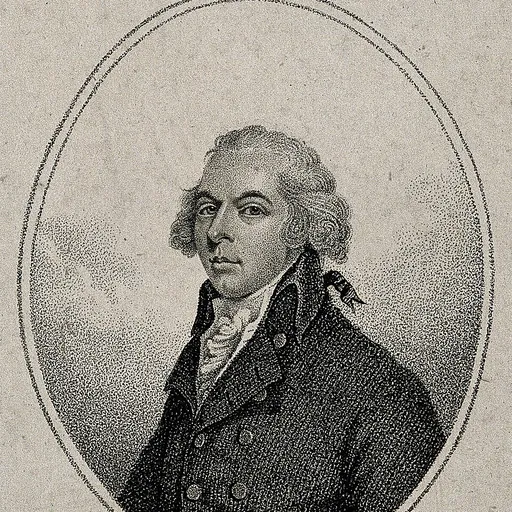
About John Stuart
Lived 1745 – 1814 (aged 69). John Stuart was a writer and soldier.
John Ferdinand Smyth Stuart (1745 – 20 December 1814), known until 1793 as John Ferdinand Smyth and mostly after that as Ferdinand Smyth Stuart, was a Scottish-born American loyalist and physician who claimed to be a great-grandson of King Charles II. As the author of A Tour in the United States of America, he used the name John Ferdinand Dalziel Smyth.
Leaving America during the Revolutionary War, Stuart spent the rest of his life in England and the West Indies.
Background and early life Stuart was born in Scotland in 1745 and began life there as John Smyth or John Ferdinand Smyth. He later wrote that he was the son of R. Wentworth Smyth, a gentleman who had fought in the Jacobite rising of 1715 and also the later one of 1745. According to Stuart's account, in 1744 his elderly father married Maria Julia Dalziel, a widow of fifteen, as his second wife. He reported that his mother was a granddaughter of General James Crofts, a natural son of the Duke of Monmouth, who was a son of Charles II, and that Wentworth Smyth was Monmouth's son by Henrietta Maria Wentworth, a daughter of Thomas, Lord Wentworth, and granddaughter of Thomas Wentworth, 1st Earl of Cleveland. Henrietta Maria had died in 1686, not long after Monmouth's execution, and Stuart said a Colonel Smyth, an aide-de-camp of Monmouth's, had adopted her son and made him his own heir. Consequently, Stuart's father had grown up in France, from where he returned to Scotland at the time of the 1715 Rising. Stuart stated in 1808 that he had been named for his godfather, Prince Ferdinand of Brunswick.
The historian Allan Fea states in his biography of Monmouth that Major-General James Crofts married a daughter of Sir Thomas Taylor (“after 1706, when he is described as single”) and had a daughter, Maria Julia; and that she married first a Mr Dalziel and secondly R. Wentworth Smyth-Stuart, who claimed to be Monmouth's son by Henrietta Maria Wentworth. Fea was convinced that Monmouth ”undoubtedly left a son by her (born in 1681), who was adopted and educated in Paris by Colonel Smyth”. A genealogist, Anthony J. Camp, has cast doubts on this account.
Stuart recalled being orphaned by the death of his mother when he was two and his father when he was five, his father being drowned in a river, after falling off a bridge during an attempt to arrest him. The Queen's Rangers were stationed at King's Bridge, New York, from July 1778,
In 1795, Stuart accepted a post as assistant barrack-master-general in San Domingo and to get there joined Admiral Sir Hugh Cloberry Christian on an expedition to the West Indies. He was shipwrecked three times in 1795 and 1796 and was present at the British capture of Saint Lucia and Martinique. In San Domingo, although not employed as a medical officer, he prescribed five grains of tartarised antimony and a tablespoonful of soft sugar for the treatment of yellow fever, later claiming that this had proved a good treatment. In 1814, he retired from his work as a barrack-master and settled in Vernon Place, Bloomsbury Square.
Before his return to New York in 1797, Stuart had begun a second family in England with Eunice Gray, a girl of about sixteen. Their son Henry was born in 1793, their first daughter, Henrietta Maria, in 1797, and another daughter, Mary Clementina, about 1799, then another son, Charles Henry, in 1802. Their third son, Constantine Wentworth, was born in August 1805, a fourth, Spencer Percival, in 1807, and a fifth and last son, Ferdinand, in 1812. As a result of Stuart's visit to New York in 1797, his daughter Elizabeth at Hempstead was in contact with her new relations in England. Four of the children in England died young: Henry in 1794, Charles Henry in 1802, Spencer Percival about 1807, and Henrietta Maria in 1813, He was buried on 1 January 1815 at Marylebone, where the parish register notes that he was of St George's parish, Bloomsbury. The Monthly Magazine printed a six-page obituary which celebrated Stuart's life, believing his version of all events, and appealed on behalf of his dependants: Quote|It may be hoped that some friend of the royal house of Guelph will do Humanity the justice to point out to them the necessities of this withered branch of the once-royal house of Stuart.
Two of Stuart's remaining children died in their twenties, Mary Clementina in 1826, and Ferdinand in 1835. Constantine Wentworth lived until 1849, and married. In July 1828, he was an officer in the 6th Regiment of Foot and was promoted from Ensign to Lieutenant without purchase. He resigned his commission at Poona, in 1832, and later visited his half-sister, Elizabeth, in Hempstead, New York. Stuart's view of the country has been called Quote|“...vigorous but not flattering. The republican opinions of the colonists were obnoxious to a loyalist, while their barbarous manners were repellent to a gentleman.” It was motivated by the death of one of his own children. Ferdinand Smyth Stuart, The Case of Ferdinand Smyth Stuart (London, 1807) returned to Stuart's complaints about his treatment by the British government. Ferdinand Smyth Stuart, Destiny and Fortitude: An Historical Poem: In Sixteen Elegies: Being a Detail of the Misfortunes of the Illustrious House of Stuart, by Ferdinand Smyth Stuart, the nearest descendant (London: Printed for the Author, by Cox, Son, and Baylis, 1808): this followed shortly after the death of Henry Benedict Stuart, the last legitimate Stuart descendant of King James II, and explained his own connection to the royal house.
Don’t just read it —
keep it.
Full-length biographies made to live with: read them, listen on the way to work, watch them tonight.
- E-book
- Audio
- Video
Instant download · yours to keep · every purchase keeps this site free
Important facts
People in John Stuart's life
Named in this biography and alive at the same time



Related people
Same field, nearest in time


Contemporaries
People whose lives overlapped John Stuart's




Frequently asked questions
Who was John Stuart?
British army officer and author
When was John Stuart born?
John Stuart was born on 17 January 1745.
When did John Stuart die?
John Stuart died on 17 January 1814.
What was John Stuart's occupation?
John Stuart was a writer and soldier.
Sources & further reading
· DBpedia: John Ferdinand Smyth Stuart
Cite this page
APA: Biography.guide. (2026). John Stuart. https://biography.guide/john-stuart-writer/
MLA: "John Stuart." Biography.guide, https://biography.guide/john-stuart-writer/.
Chicago: "John Stuart." Biography.guide. https://biography.guide/john-stuart-writer/.
Data last updated: 2026-09-22 · Spot an error? Report a correction.
Portrait: Wikimedia Commons · author & licence
Page generated 2026-09-27 05:01 UTC