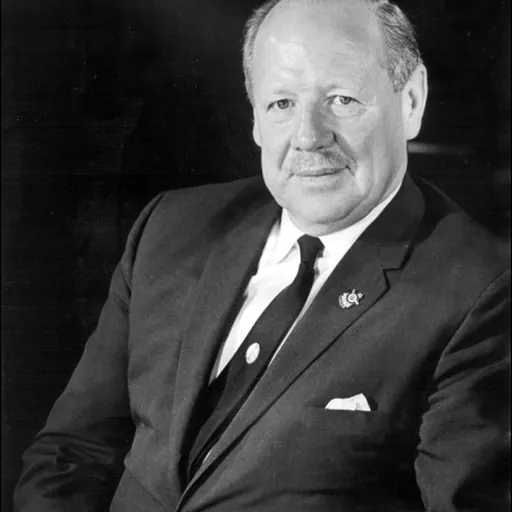
John Lloyd Waddy
Senior Royal Australian Air Force officer, Member of the New South Wales Legislative Assembly
About John Lloyd Waddy
Lived 1916 – 1987 (aged 70). John Lloyd Waddy was an Australian politician and aircraft pilot.
John Lloyd Waddy, (10 December 1916 – 11 September 1987) was a senior officer and aviator in the Royal Australian Air Force (RAAF), and later served as a member of the New South Wales Legislative Assembly and as a minister in the New South Wales government. As a fighter pilot during World War II, he shot down 15 enemy aircraft during the North African campaign, becoming one of Australia's top-scoring aces and earning the Distinguished Flying Cross. Waddy went on to command No. 80 Squadron in the South West Pacific, where he was awarded the US Air Medal. He was one of eight senior pilots who took part in the "Morotai Mutiny" of April 1945.
Discharged from the Permanent Air Force at the end of the war, Waddy took a commission in the RAAF Reserve and led the organisation as a group captain in the early 1950s. He was active in business and in veterans' groups, and was appointed an Officer of the Order of the British Empire in 1955. From 1962 to 1976, he was the Member for Kirribilli in the New South Wales Parliament, representing the Liberal Party. He held cabinet posts including Minister for Child Welfare and Social Welfare (later Youth and Community Services), Minister for Health, and Minister for Police and Services. Waddy retired from politics in 1976, and died in 1987 at the age of 70.
Family and early life Born in Sydney on 10 December 1916, Waddy was the son of first-class cricketer Edgar Lloyd Waddy and his wife Lottchen, and great-grandson of General Sir Richard Waddy, KCB. His four siblings included a sister and three brothers. He married Vera Nellie May (Ve) Dengate on 21 July 1938. The couple had a son, Lloyd, and two daughters, Denise and Rosalind.
Waddy enlisted in the Royal Australian Air Force (RAAF) in late 1940, learning to fly under the Empire Air Training Scheme (EATS) in Southern Rhodesia. His two older brothers, Edgar and Richard, were also pilots. Edgar had taken a short-service commission with the Royal Air Force (RAF) in the 1930s, and Richard trained in Canada with EATS during the war before active duty in Britain, where he was killed flying a single-engined fighter in 1941. Waddy's first operational sortie was as Caldwell's wingman; he found the ensuing dogfight so fast and confusing that he had no idea what was happening and afterwards had to ask the more experienced pilot how things had gone. On 9 December, he registered his first victory—in a Tomahawk that had previously been Caldwell's personal mount—when he shared in the destruction of a Messerschmitt Bf 110 twin-engined fighter near El Adem.
By the end of April 1942, Waddy had scored four-and-a-half victories over enemy aircraft. Promoted flying officer, he achieved four "kills" in a single sortie on 12 May 1942, destroying two Junkers Ju 52 cargo planes and two escorting Bf 110s from a German air transport convoy operating between Crete and North Africa. He was awarded the Distinguished Flying Cross (DFC) for this action, gazetted on 2 October. The citation praised his "masterly airmanship as a fighter pilot" and his "great courage and devotion to duty". Shortly after claiming a victory over a Messerschmitt Bf 109 on 22 May, Waddy was posted to another RAF unit, No. 260 Squadron, flying Kittyhawks. He accounted for two enemy aircraft in June, before being assigned to No. 4 Squadron, South African Air Force, with which he destroyed a Bf 109 in September. In October, Waddy began flying Spitfire Vs in No. 92 Squadron RAF. He claimed a further three victories with his latest unit before being posted back to Australia on 19 November 1942. His final tally of fifteen and a half victories made him one of the most successful Allied fighter pilots in the Desert War, and second only to Caldwell among the RAAF contingent.
South West Pacific
In April 1945, Waddy joined Caldwell, Arthur, Gibbes and four other senior pilots of No. 1 TAF in an action that became known as the "Morotai Mutiny". The eight attempted to resign their commissions in protest at the relegation of the RAAF's fighter squadrons to apparently worthless ground attack missions. Earlier that month, Waddy had asked his intelligence officer to produce a "profit and loss statement" for No. 80 Squadron, covering the period 1 October 1944 to 31 March 1945, to "bring out the fact that the expenditure by the squadron was not compensated for by the achievements of the Squadron". At the subsequent inquiry into events on Morotai, Justice John Vincent Barry cleared the pilots of fault over the incident, finding their motives in tendering their resignations to be sincere. the former promulgated on 25 June 1946 and the latter on 1 July 1948.
Post-war career
RAAF reservist and businessman
With the end of the Pacific War, Waddy was discharged from the Permanent Air Force (PAF) as an acting wing commander in September 1945. He also worked as a sales executive in the import-export firm of Falkiner, Caldwell Pty Ltd, run by Clive Caldwell and businessman George Falkiner. Promoted group captain, Waddy led the CAF from 1950 through 1954, becoming its first member to take a seat on the Air Board, the RAAF's controlling body that consisted of its most senior officers and which was chaired by the Chief of the Air Staff. During his tenure, CAF squadrons continued to operate aircraft and were expected to act as home defence in the absence of PAF units serving overseas, roles they would lose by the end of the 1950s.
Retiring from the CAF in 1954, Waddy established his own real estate and travel agency, John L. Waddy Pty Ltd, and served as Honorary Aide-de-camp to the Queen until 1957. The Australian delegate to the World Veterans Federation from 1956 to 1963, he was President of the New South Wales Division of the Australian Flying Corps and Royal Australian Air Force Association throughout the 1950s, becoming an honorary life member in 1958.
State parliamentarian
After an unsuccessful bid to become Lord Mayor of Sydney that saw him defeated by the Labor Party's Pat Hills, Appointed Parliamentary Secretary to the Minister for Education in 1967, he was an Assistant Minister from February 1969 until March 1971, when he became a Minister of the Crown in charge of Child Welfare and Social Welfare in Premier Robert Askin's cabinet, succeeding Frederick Hewitt. His portfolio included responsibility for Aboriginal affairs; in 1972 he founded the Aboriginal Lands Trust, staffed by a council of nine elected Indigenous Australians, to assume freehold title of former government reserves in New South Wales as a precursor to granting land rights.
Waddy's position was changed to Minister for Youth and Community Services in January 1973. In September he piloted a bill to reorganise the Ministries of Child Welfare and Social Welfare as the Department of Youth and Community Services; the move was designed to "revitalise" and re-focus welfare services, and to remove "overtones of charity and paternalism" inherent in the earlier titles. Waddy was succeeded by Dick Healey on 3 December 1973, and took over as Minister for Health from Harry Jago. He also put through a bill to hold a referendum on whether to make daylight saving a permanent fixture in New South Wales, following trials that had commenced in 1971.
Described by one of his parliamentary colleagues as a "mixture of bon vivant and conservatism", Waddy was also known for an occasionally quick temper; his staff were said to "start making motions as though they were bombing and strafing the enemy" when their boss got "wound up". and John Booth found him to have an "old-fashioned sense of service to the community". Having held his state seat in Kirribilli for fourteen years and four re-election campaigns—in 1965, 1968, 1971 and 1973—he was denied preselection by the Liberal Party for the 1976 contest. He resigned from the party and stood as an Independent, but was defeated by future Liberal leader Bruce McDonald. His parliamentary career was over but, in the words of a later Deputy Premier, Ian Armstrong, Waddy had "refused to retreat to political obscurity", and "went out fighting". After eleven years in power in New South Wales, the sitting Liberal government itself lost office in the 1976 poll, to Neville Wran's Labor Party.
Later life
Waddy maintained his interest in aviation during and after his political career. He flew a Beechcraft King Air twin-engined turboprop in the 1969 England-to-Australia Air Race, taking second prize in the New South Wales Government division. As Minister for Child Welfare and Social Welfare with responsibility for Aboriginal affairs in 1971, he piloted his own light plane on three of the longest legs of his tour of government reserves in rural New South Wales. Chairman of the Executive Committee of the Australian and British Guild of Air Pilots and Air Navigators in 1977–78, he was an honorary member of the American Fighter Aces Association, His pallbearers included Clive Caldwell and Tom Lewis. Waddy's son Lloyd served in the RAAF Reserve from 1979 to 1995, and was appointed Queen's Counsel in 1988 and later a Justice of the Family Court of Australia. He was also a co-founder and National Convenor of Australians for Constitutional Monarchy. Waddy's widow Ve died in 2006, at the age of ninety-six.
Don’t just read it —
keep it.
Full-length biographies made to live with: read them, listen on the way to work, watch them tonight.
- E-book
- Audio
- Video
Instant download · yours to keep · every purchase keeps this site free
Important facts
People in John Lloyd Waddy's life
Named in this biography and alive at the same time





Related people
Same field, nearest in time





Contemporaries
People whose lives overlapped John Lloyd Waddy's


Frequently asked questions
Who was John Lloyd Waddy?
Senior Royal Australian Air Force officer, Member of the New South Wales Legislative Assembly (1916-1987)
When was John Lloyd Waddy born?
John Lloyd Waddy was born on 10 December 1916 in Sydney.
When did John Lloyd Waddy die?
John Lloyd Waddy died on 11 September 1987 in Goulburn.
What was John Lloyd Waddy's occupation?
John Lloyd Waddy was a politician and aircraft pilot.
What nationality was John Lloyd Waddy?
John Lloyd Waddy was Australian.
Sources & further reading
Cite this page
APA: Biography.guide. (2026). John Lloyd Waddy. https://biography.guide/john-lloyd-waddy/
MLA: "John Lloyd Waddy." Biography.guide, https://biography.guide/john-lloyd-waddy/.
Chicago: "John Lloyd Waddy." Biography.guide. https://biography.guide/john-lloyd-waddy/.
Data last updated: 2026-09-21 · Spot an error? Report a correction.
Portrait: Wikimedia Commons · author & licence
Page generated 2026-09-27 04:59 UTC